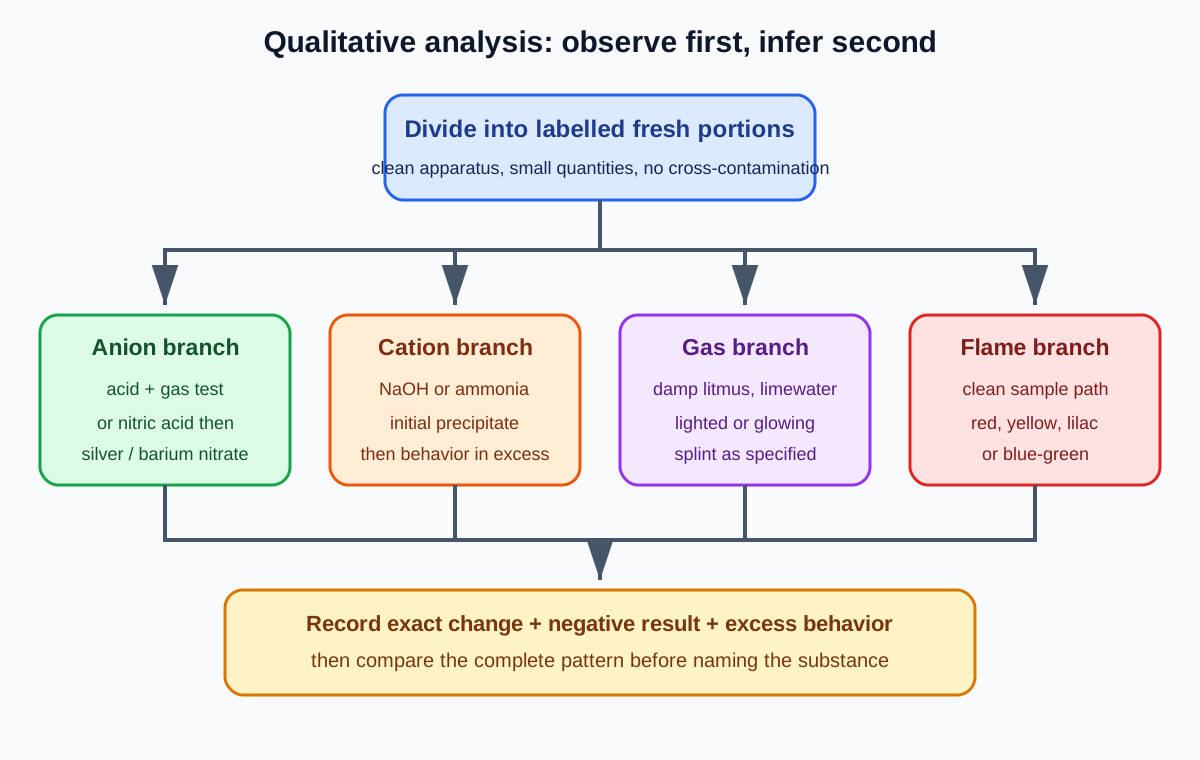
Qualitative analysis identifies ions and gases from a complete reagent-observation pattern. Cambridge provides the official qualitative-analysis notes in both Paper 5 and Paper 6, but candidates must still choose and sequence tests, handle fresh portions, observe accurately and justify an inference. Record what happens before naming the substance.
Separate observation from inference
An observation is directly detected: effervescence, a colour change, precipitate, solution colour, flame colour or splint result.
An inference names the ion or gas supported by that evidence. Write “a light blue precipitate forms and remains in excess sodium hydroxide, supporting copper(II) ions”, not merely “copper is present”.
This order makes the evidence auditable and prevents a remembered identity from replacing the actual result.
Use fresh portions for independent tests
Divide the unknown into separate labelled portions before adding reagents. A reagent added for one test can create ions, change pH or form precipitates that interfere with another branch.
Use clean droppers and apparatus. Do not return unused material to the stock container.
Fresh portions are especially important when comparing sodium hydroxide with ammonia or applying separate anion tests.
Observe before and after excess reagent
For aqueous-cation tests, add the reagent dropwise first and record whether a precipitate forms and its colour.
Then add excess reagent and record whether the precipitate remains or dissolves, and the colour of any resulting solution.
“White precipitate” alone cannot distinguish calcium from zinc. Behaviour in excess completes the pattern.
Clear and colourless are different words
Colourless describes absence of colour. Clear describes transparency.
A coloured solution can be clear, and a colourless suspension can be cloudy. Use “colourless solution” when a dissolved zinc precipitate produces the stated result.
Use “milky” for limewater after carbon dioxide and “precipitate” for a solid formed within solution.
Carbonate gives carbon dioxide with dilute acid
Add dilute acid to the test portion. Effervescence occurs and a gas is produced.
Pass or test the gas with limewater. Carbon dioxide turns limewater milky.
The bubbles alone are not enough because several reactions can release gases. The confirmatory gas test supports carbonate ions.
Halides require nitric acid then silver nitrate
For chloride, bromide or iodide in solution, acidify a fresh portion with dilute nitric acid, then add aqueous silver nitrate.
Check this topic from memory
Attempt the matching topic bank before reopening the notes. Use each missed idea to decide what to review next.
Chloride gives a white precipitate. Bromide gives a cream precipitate. Iodide gives a yellow precipitate.
Keep the colours ordered from white through cream to yellow and record the reagent sequence, not only “add silver nitrate”.
Sulfate requires nitric acid then barium nitrate
Acidify a fresh solution portion with dilute nitric acid, then add aqueous barium nitrate.
A white precipitate supports sulfate ions.
The result resembles chloride in colour, so reagent identity and test branch are essential. Do not infer sulfate from any white precipitate without the specified sequence.
Ammonium releases ammonia on warming
Add aqueous sodium hydroxide and warm the sample. Ammonia gas is produced if ammonium ions are present.
Confirm it because ammonia turns damp red litmus paper blue.
Do not place the litmus into the hot mixture or identify ammonia by smell. Use the safe prescribed paper test.
Calcium gives contrasting reagent results
With aqueous sodium hydroxide, calcium ions produce a white precipitate insoluble in excess.
With aqueous ammonia, calcium gives no precipitate or a very slight white precipitate.
Use fresh portions for the two reagents. The contrast distinguishes calcium from zinc, which dissolves in excess of both.
Copper(II) gives a dark-blue excess-ammonia result
With aqueous sodium hydroxide, copper(II) gives a light blue precipitate insoluble in excess.
With aqueous ammonia, it first gives a light blue precipitate, then dissolves in excess to form a dark blue solution.
State the sequence. The final dark blue solution is not the same observation as the initial light blue precipitate.
Iron(II) starts green and changes on standing
With either aqueous sodium hydroxide or aqueous ammonia, iron(II) gives a green precipitate insoluble in excess.
The precipitate turns brown near its surface on standing.
Record the immediate green result before the later surface change. Otherwise iron(II) may be confused with the immediate red-brown iron(III) result.
Iron(III) gives an immediate red-brown precipitate
With either aqueous sodium hydroxide or aqueous ammonia, iron(III) gives a red-brown precipitate insoluble in excess.
It does not need standing to produce the listed initial colour.
Record both colour and insolubility rather than writing only “brown”.
Zinc dissolves in excess of either reagent
With aqueous sodium hydroxide, zinc gives a white precipitate that dissolves in excess to form a colourless solution.
With aqueous ammonia, zinc gives the same overall pattern: white precipitate, then colourless solution in excess.
Formulas of complex ions are not required. The observation pattern is the examinable evidence.
Gas tests require the named test condition
Ammonia turns damp red litmus paper blue. Carbon dioxide turns limewater milky. Chlorine bleaches damp litmus paper.
Hydrogen pops with a lighted splint. Oxygen relights a glowing splint.
Lighted and glowing are not interchangeable. Damp paper is specified for ammonia and chlorine.
Flame tests need a clean sample path
Lithium ions give a red flame, sodium ions yellow, potassium ions lilac and copper(II) ions blue-green.
Use the apparatus and cleaning method supplied or instructed. Sodium contamination can produce a strong yellow colour and obscure another result.
Flame colour supports an ion inference, but it does not replace other evidence when the question requires a full analysis.
Negative results can be diagnostic
No precipitate, an unchanged colour or failure to dissolve can eliminate possibilities when the method and reagents worked correctly.
For calcium with aqueous ammonia, no precipitate or a very slight white precipitate is itself the official result.
Do not invent a dramatic change because every practical line seems expected to be positive.
Use small-scale addition and controlled excess
Add cation-test reagents dropwise initially so the first precipitate is visible. After recording it, add enough reagent to test solubility in excess.
Adding a large volume immediately can hide an intermediate precipitate that subsequently dissolves.
Use consistent sample volume and reagent addition when comparing unknowns or references.
Manage analysis hazards through the method
Wear supplied eye protection and avoid skin contact with corrosive or moderate-hazard reagents. Keep test tubes in a rack or use a holder when warming as instructed.
Point heated tubes away from people and use small quantities. Never stopper a heated gas-producing test tube.
Do not use smell as an identification method. Follow centre instructions for chemical disposal.
Diagnose an inconclusive result before inferring
If expected observations conflict, check labels, reagent identity, contamination, sequence, excess volume and whether the sample was fresh.
Repeat on a new portion rather than changing the recorded observation to match the table.
An inconclusive outcome should be reported as such until the method produces discriminating evidence.
Build a branch from the evidence
Start by deciding whether the task concerns an anion, aqueous cation, gas or flame test. Use the corresponding official table rather than mixing reagents from different branches.
Within a cation branch, compare initial precipitate colour, solubility in excess sodium hydroxide and solubility in excess ammonia. Within an anion branch, reagent identity and precipitate colour carry the distinction.
Use all supplied results together before naming a complete salt.
Worked application: resolve two white precipitates
An unknown gives a white precipitate with aqueous sodium hydroxide that dissolves in excess to a colourless solution. This could support zinc, but a fresh portion must be tested with aqueous ammonia. It also gives a white precipitate that dissolves in excess to a colourless solution, completing the zinc pattern. Calcium would instead give no precipitate or only a very slight white precipitate with ammonia. A separate anion portion is acidified with dilute nitric acid and treated with silver nitrate, producing a cream precipitate that supports bromide. Together, the independent results are consistent with zinc bromide.
Common misconceptions and corrections
Writing only the ion name. Give reagent, observation and inference.
Calling an inference an observation. “Copper present” is not directly seen.
Using the same portion for every test. Reagents interfere.
Returning tested material to the stock. It contaminates the source.
Adding excess reagent before recording the first change. An intermediate precipitate may be missed.
Writing clear when colourless is required. The terms describe different properties.
Calling limewater's result a white solution. It turns milky.
Identifying carbonate from bubbles alone. Confirm carbon dioxide.
Testing halides without acidifying first. Use dilute nitric acid, then silver nitrate.
Using hydrochloric acid before silver nitrate. It introduces chloride.
Calling every silver-halide precipitate white. Bromide is cream and iodide yellow.
Testing sulfate with silver nitrate. Use acidified barium nitrate.
Calling every white precipitate sulfate. Reagent sequence matters.
Forgetting to warm ammonium with sodium hydroxide. Warming releases ammonia.
Testing ammonia with dry blue litmus. Use damp red litmus.
Smelling ammonia directly. Use the prescribed paper test.
Saying calcium dissolves in excess sodium hydroxide. It remains insoluble.
Saying calcium gives a strong ammonia precipitate. None or very slight white is listed.
Calling copper(II)'s initial precipitate dark blue. It is light blue.
Calling copper(II)'s excess-ammonia result a precipitate. It is a dark blue solution.
Calling iron(II)'s initial precipitate brown. It starts green.
Calling iron(III)'s precipitate green. It is red-brown.
Saying iron precipitates dissolve in excess. They are listed as insoluble.
Saying zinc remains as a white solid in excess ammonia. It dissolves.
Writing complex-ion formulas as required evidence. They are not required.
Using dry paper for chlorine. Use damp litmus.
Saying chlorine turns litmus blue. It bleaches it.
Using a glowing splint for hydrogen. Use a lighted splint for the pop.
Using a lighted splint for oxygen. Use a glowing splint for relighting.
Swapping sodium and potassium flames. Sodium is yellow; potassium lilac.
Calling copper(II)'s flame blue. The listed colour is blue-green.
Ignoring a negative result. It can eliminate alternatives.
Inventing a positive change for every test. Record what occurs.
Changing an observation to fit the table. Repeat the method on a fresh portion.
Heating a stoppered gas-producing tube. Pressure can build.
Pointing a heated tube toward someone. Point it away.
Using large quantities to make results clearer. Small-scale work is safer and sufficient.
Naming a whole salt from one cation test. Anion evidence is also needed.
Treating the provided table as automatic marks. Selection and interpretation remain assessed.
Calling an inconclusive result proof. Diagnose and repeat before inferring.
Co-ordinated Sciences context extension
For 0654, analysis includes qualitative identification and quantitative evidence from titration, temperature, mass, volume, solubility, melting-point and boiling-point data. Record the raw observation or reading first, process it transparently and then state the supported identity, purity judgement or relationship.
Assessment guidance
Write every analysis answer as test, immediate observation, excess-reagent result where relevant, and inference. Use a fresh portion for each branch and preserve negative findings. Halide and sulfate tests require dilute nitric acid before the named precipitating reagent. Cation identification depends on colour plus solubility patterns, not colour alone. Gas tests must include damp paper or the correct lighted or glowing splint. If results conflict, evaluate contamination, sequence and reagent addition before repeating. Never use smell or replace an actual observation with the expected one.
Retrieval practice
Rebuild the complete anion, cation, gas and flame tables from reagent-observation pairs. Practise branching among all white precipitates using excess sodium hydroxide and ammonia. Write twenty observation-first inferences, including negative results, then diagnose forty errors involving fresh portions, acidification, colour language, excess addition, gas-test conditions, contamination, heating and premature salt identification.
Topic ownership
This note owns the practical workflow and complete prescribed qualitative-analysis observation matrix for Co-ordinated Sciences 0654. Chemistry theory C12 owns conceptual test knowledge, while Practical 5 owns the wider Chemistry context list. This note does not add unlisted ions, complex-ion formulas or unsafe smell tests. Planning, data presentation and general safety remain owned by Practicals 2, 3 and 8.