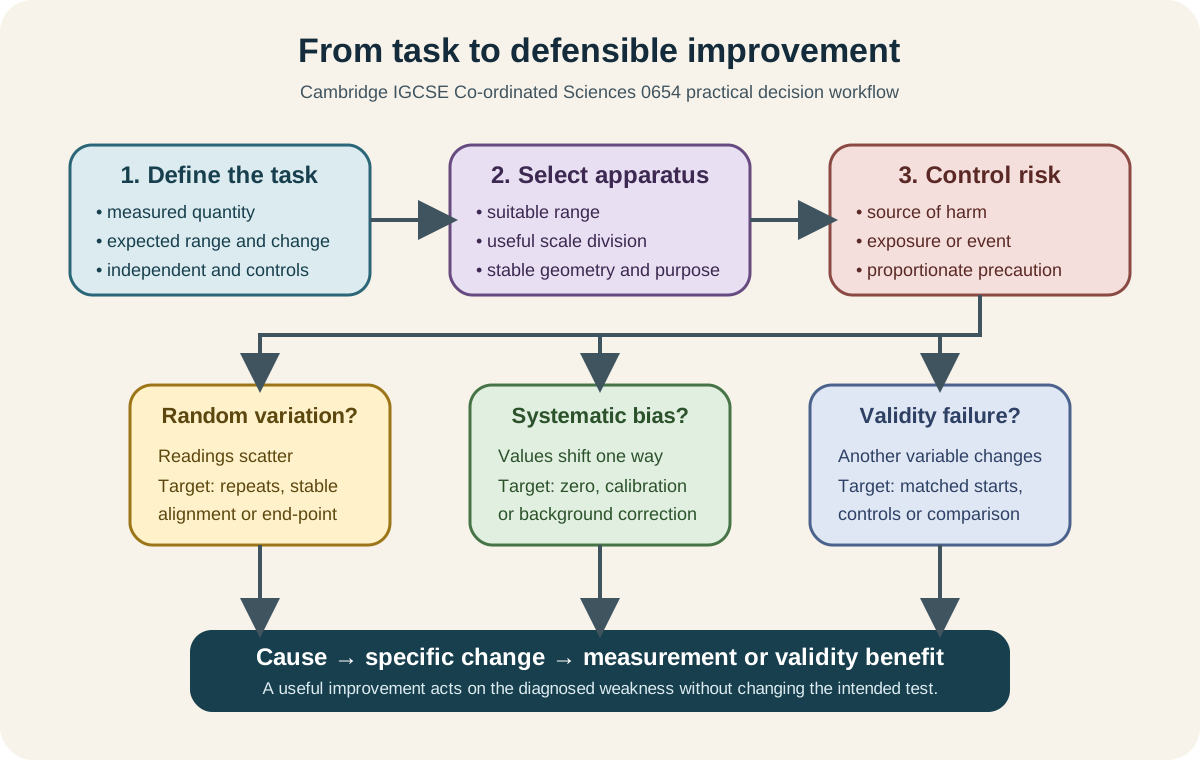
Cambridge IGCSE Co-ordinated Sciences 0654 practical questions do not reward an apparatus name, safety phrase or improvement in isolation. The decision must fit the quantity, range, hazard or weakness in the stated investigation. The official apparatus list describes equipment candidates should know, but it is not exhaustive. Prepare to interpret unfamiliar arrangements by asking what each item measures, changes, holds, transfers or protects.
Begin with the quantity and expected range
Name what must be measured before choosing the instrument. Length, mass, force, time, temperature, liquid volume, potential difference and current need different sensing or scale systems.
Estimate the largest and smallest expected values. An instrument must cover the full useful range without forcing readings beyond its scale. It should also have divisions fine enough to resolve the change being investigated.
A finer scale is not automatically the best choice. A small measuring cylinder may resolve a small liquid volume well but cannot contain a large sample. A highly sensitive meter can be overloaded if the expected current exceeds its range.
Match the instrument to the task
Use a ruler for ordinary lengths, a balance for mass, a force meter for force, a stop-clock for time and a thermometer for temperature. Use the circuit instrument in the correct arrangement: an ammeter in series and a voltmeter in parallel across the component.
For liquid volume, distinguish transfer from measurement. A dropping pipette adds small amounts but is not normally used to claim an exact delivered volume. A measuring cylinder supports an approximate measured volume. A volumetric pipette transfers one fixed volume accurately when that technique is required. A burette delivers and measures a variable volume.
State the purpose in the answer. "Use a burette" is weaker than "use a burette to deliver and measure the variable volume of solution added."
Read the scale before recording a value
Find the value represented by one scale division. Read to the precision supported by the apparatus and task, including the nearest half-division when required.
Keep the eye perpendicular to a ruler, meter pointer or scale. Read a liquid level at eye height using the appropriate part of the meniscus. Keep the thermometer bulb immersed as required without allowing it to touch the container unless the method says otherwise.
Digital apparatus still has finite resolution. Record the displayed digits, but do not invent extra decimal places. If the display changes continuously, define a stable reading rule or take repeated values.
Check this topic from memory
Attempt the matching topic bank before reopening the notes. Use each missed idea to decide what to review next.
Inspect an analogue pointer or scale before use. If a zero error is present and cannot be removed, record it and apply the correct correction. Starting a ruler at a clear non-zero mark and subtracting the two readings can avoid a damaged end.
Record raw initial and final readings before their difference. This preserves the evidence needed to check a delivered volume, extension, temperature change or displacement.
A zero check addresses one possible systematic offset. It does not prove that the whole instrument is calibrated or that the method is valid.
Stability apparatus protects the measurement
Retort stands, bosses and clamps hold rulers, thermometers, tubes, springs, lenses or other items in a fixed geometry. A set square or pointer can transfer a position to a ruler and reduce alignment ambiguity. A test-tube rack keeps tubes upright, while a test-tube holder allows safer heating.
The improvement must match the weakness. Clamping a ruler matters if its position changes. It does not improve a chemical end-point judged from an unclear colour change.
Use the least complicated arrangement that keeps the required variables stable and allows the reading to be made safely.
Safety answers connect hazard, route and control
A hazard is the source of possible harm. Risk describes the chance and consequence of harm under the stated conditions. A precaution is the action or equipment used to reduce that risk.
Write the chain explicitly: identify the material, apparatus or action; state the harm or exposure route; then give a control that acts on that route. For example, a corrosive solution may splash into the eyes, so wear suitable eye protection and use small controlled transfers.
Do not claim that a precaution makes an activity completely safe. It reduces risk. School, centre, education-authority and government rules still control actual laboratory practice.
Chemical risks need specific controls
Corrosive or irritant liquids can contact skin or eyes. Use eye protection, suitable gloves when directed, small quantities, controlled pouring and immediate spill procedures appropriate to the centre.
Flammable liquids must be kept away from flames and other ignition sources. If warming is required, use the specified safer heating arrangement. Do not place ethanol near a lit Bunsen burner.
Gases may be harmful or irritating. Use small quantities, avoid direct inhalation and follow the stated ventilation or handling instructions. Smelling a gas directly is not a valid identification method.
Reagent hazard codes and detailed handling requirements can change. In real work, follow current labels, safety data and centre instructions rather than relying only on a memorised code.
Heat, glass and sharp tools need different controls
Hot glass can look like cold glass. Use a holder or tongs when instructed, place hot apparatus on a heat-resistant surface and allow it to cool before touching. Point a heated test tube away from people and do not seal a system that generates gas unless the apparatus is designed for pressure.
Inspect cracked glassware before use. Keep glass apparatus away from the bench edge and support tall or loaded arrangements securely.
Scalpels, knives, needles and broken glass can cut or puncture. Cut away from fingers on a suitable surface, use forceps where appropriate and follow the centre's disposal procedure. Eye protection does not control the direction of a blade.
Mechanical and electrical risks depend on stored energy
A stretched spring, suspended mass, moving trolley or loaded clamp can release energy suddenly. Keep the load within the stated range, secure the stand and keep the fall or travel path clear. Add masses carefully and do not place the face close to a stretched spring.
Build or reconnect circuits with the supply off or the switch open. Use the specified low-voltage supply and meter range. Avoid direct short circuits, and switch off between wire-heating readings where temperature would rise.
Electrical safety and measurement quality can align: limiting current protects components and also reduces resistance change caused by heating.
Separate random variation from systematic bias
Random variation makes repeated values differ unpredictably. Reaction time, judgement of a colour end-point and small alignment changes can contribute. Repeats help reveal spread, support a representative value and expose an anomalous result.
A systematic error shifts results consistently in one direction. A zero offset, miscalibrated scale or unaccounted background reading may do this. Repeating the same biased procedure does not remove the bias.
Name the physical cause rather than writing "human error". The examiner needs to know what action varied or what feature produced the bias.
Precision, accuracy and validity answer different questions
Precision concerns how close repeated measured values are to one another. Accuracy concerns closeness to the true value. A group of closely clustered readings can be precise but inaccurate if the instrument has a systematic offset.
Validity concerns whether the investigation tests what it claims to test. If two variables change together, the data cannot isolate the stated independent variable. Better scale resolution may improve reading precision while leaving that confounding variable untouched.
Use these terms only when the evidence supports them. The syllabus encourages consistent language, but candidates are not required to recite the formal definitions word for word.
Repeats are useful only when the method is repeatable
Repeat a measurement or complete experimental condition when random variation is plausible. Keep the same method and controlled conditions, then compare results before calculating a representative value.
Investigate an anomalous result rather than deleting it automatically. Check the raw reading, calculation and method. Repeat that condition when appropriate. Exclude a result only with a defensible reason.
Repeats do not correct heat loss, a shifted zero, an incorrect circuit or a control variable that changed with every trial.
Range and intermediate values reveal the relationship
Use a suitable minimum and maximum value and enough intermediate settings to show the shape of a relationship. Closely spaced values over a tiny interval may conceal curvature or a threshold.
The selected range must remain safe and measurable. Extending a spring beyond its usable region or increasing a current until a wire heats strongly may change the system being tested.
Add values near an apparent change or anomaly when this helps distinguish a real pattern from one uncertain point.
Controls and comparisons strengthen validity
A controlled variable must be named, monitored or held by a credible method. "Keep temperature constant" is incomplete if the method provides no way to measure or stabilise it.
A control setup helps determine whether the observed change depends on the tested factor. It should differ from the experimental setup only in the relevant feature. A control is not the same as a controlled variable.
When comparing two treatments, match starting conditions, sample size, duration, geometry and measurement rule as appropriate. Otherwise the comparison may answer a different question.
Improvements follow a cause-change-benefit chain
First identify the specific limitation and its effect on evidence. Next give a feasible change. Finally explain the measurement or validity benefit.
For a reaction timed until a cross disappears, subjective end-point judgement creates random variation. Use the same observer and viewing geometry, repeat each condition and calculate a representative time. If a suitable light sensor is available, define an objective threshold instead.
For a cooling investigation, uncontrolled heat exchange and unequal starts weaken the comparison. Use identical containers, equal volumes and checked starting temperatures, keep thermometer depth fixed, and insulate or cover containers when compatible with the tested factor.
Replace generic improvements with targeted ones
"Use better apparatus" gives no testable change. Name the apparatus feature, such as a finer division, appropriate range, fixed support, automatic trigger or objective detector.
"Take more readings" should say where and why. Add intermediate independent-variable values to define a curve; repeat conditions to assess random variation; or extend the safe range to test whether a trend continues.
"Be more careful" should become a method instruction: view perpendicular to the scale, release without pushing, align from a fiducial marker, switch off between readings or use the same end-point rule.
Improvements can create new limitations
A lid reduces heat exchange but may alter gas exchange or pressure. Insulation changes the cooling system and cannot be added when insulation itself is the independent variable. A sensor can reduce reaction-time uncertainty but still needs correct placement and calibration.
Choose an improvement that preserves the intended investigation. State any relevant new control. An expensive device is not automatically better than a simple apparatus change that directly targets the dominant weakness.
Unfamiliar apparatus can be decoded by function
Trace the path through the setup. Identify the source, sample or component, the feature being changed, the sensor or scale, and the support or safety control.
Then ask four questions: What quantity enters the evidence table? What range and resolution are needed? Which geometry or condition must stay fixed? What could cause harm or bias?
This functional reading works for Paper 5 apparatus and Paper 6 diagrams. Both papers assess the same experimental skills and understanding of the same experimental contexts, although only Paper 5 requires candidates to carry out experiments during the test.
Worked application: improve a temperature-change comparison
Two reactions are compared using different beakers, unequal solution volumes and thermometers held at different depths. One reading is taken before mixing and one after an estimated minute. The largest displayed temperature change cannot be attributed confidently to reaction type because container, amount, probe position and timing also differ. Use identical insulating cups, equal measured volumes and the same thermometer depth. Record each initial temperature, mix in a defined way, start the timer at mixing and record temperature at short regular intervals until the maximum is identified. Repeat each reaction with fresh materials. A lid can reduce heat exchange if gas release and pressure are not concerns. These changes improve validity, timing consistency and the estimate of the true maximum change.
Common misconceptions and corrections
Choosing the instrument with the most decimal places. Range, resolution and suitability all matter.
Calling a dropping pipette an exact volume measure. It usually transfers drops rather than supporting an exact delivered volume.
Assuming a digital display has no uncertainty. Its finite resolution and response still limit the reading.
Recording only a calculated difference. Keep the initial and final raw readings.
Ignoring a zero error because all readings use the same instrument. A consistent offset can bias every result.
Saying parallax applies to every digital reading. It mainly concerns alignment with analogue scales or positions.
Listing apparatus without its purpose. Connect each item to a measured, changed, controlled or supported quantity.
Using eye protection as a complete safety answer. Name the hazard and exposure it helps control.
Calling a precaution a hazard. The hazard is the source of harm; the precaution reduces risk.
Claiming precautions remove all risk. They reduce risk under stated conditions.
Heating a flammable liquid over a flame. Keep it away from ignition and use the specified safer method.
Smelling a gas directly. Avoid direct inhalation and use the stated chemical test.
Touching glass to decide whether it is hot. Allow cooling or use the specified handling tool.
Pointing a heated test tube toward a person. Point it away and keep it unsealed unless designed otherwise.
Cutting toward the supporting hand. Cut away on a suitable surface and use forceps where appropriate.
Reconnecting a live circuit. Open the switch or turn off the supply first.
Leaving a resistance wire energised continuously. Heating can change resistance and add risk.
Calling all scatter human error. Identify the varying action or physical cause.
Repeating a biased measurement to improve accuracy. Repeats do not remove a systematic offset.
Treating close repeated values as proof of accuracy. They show precision, not closeness to the true value.
Using a finer scale to fix an uncontrolled variable. Resolution does not repair invalid design.
Deleting an anomaly automatically. Check it and repeat the condition before deciding.
Using only two values to establish a relationship. Several values across a useful range are needed.
Extending the range beyond safe operation. A wider range is useful only while the system remains valid and safe.
Confusing a control setup with a controlled variable. They serve related but different purposes.
Writing "keep it constant" without a method. State how it is measured, fixed or stabilised.
Suggesting more readings without saying which readings. Link repeats, intermediate values or wider range to the weakness.
Writing "use better apparatus" without a feature. Name the necessary range, division, support or sensor.
Adding insulation when insulation is the tested factor. An improvement must preserve the independent variable.
Assuming automated apparatus cannot be wrong. Placement, calibration, range and settings still matter.
Memorising the published apparatus list as exhaustive. Cambridge may use other simple items in a specific examination.
Treating Paper 6 as theory only. It tests the same AO3 skills and contexts without requiring candidate-run experiments in the paper.
Co-ordinated Sciences context extension
The 0654 evaluation language explicitly distinguishes accuracy, precision, repeatability, reproducibility, validity, range and anomalies. Candidates are not required to recall formal definitions, but they should apply each idea correctly when judging data or improving a method.
Assessment guidance
For an apparatus-selection question, name the measured quantity, expected range, useful scale division and instrument purpose. For a safety question, connect a specific hazard to the harm or exposure route and a proportionate control. For an evaluation question, identify the evidence weakness before proposing a change. Distinguish random variation, systematic bias and invalid design because repeats, zero correction and variable control solve different problems. Use the cause-change-benefit chain: state what goes wrong, what you would alter and how the alteration improves the resulting measurement, comparison or conclusion. Keep improvements feasible with the stated apparatus and do not change the independent variable accidentally.
Retrieval practice
Choose and justify apparatus for measuring a small volume, a large temperature range, current, force and a short time. Diagnose one random error, one systematic error and one validity failure in an unfamiliar setup. Write hazard-control chains for a corrosive splash, hot glass, a blade, a falling mass and a live circuit. Convert ten generic suggestions into cause-change-benefit improvements, then identify which changes improve precision, accuracy, safety or validity.
Topic ownership
This note consolidates the official AO3 requirements for apparatus identification and selection, safe technique, hazards and precautions, measurement quality, method evaluation and targeted improvements. It also orients learners to the non-exhaustive general, Biology, Chemistry and Physics apparatus lists without reproducing them as a fixed examination inventory. Practical 2 owns full planning logic, Practical 3 owns tables and graphs, and Practicals 4 to 7 own subject-context application. Theory notes own the scientific concepts used to predict and explain results.