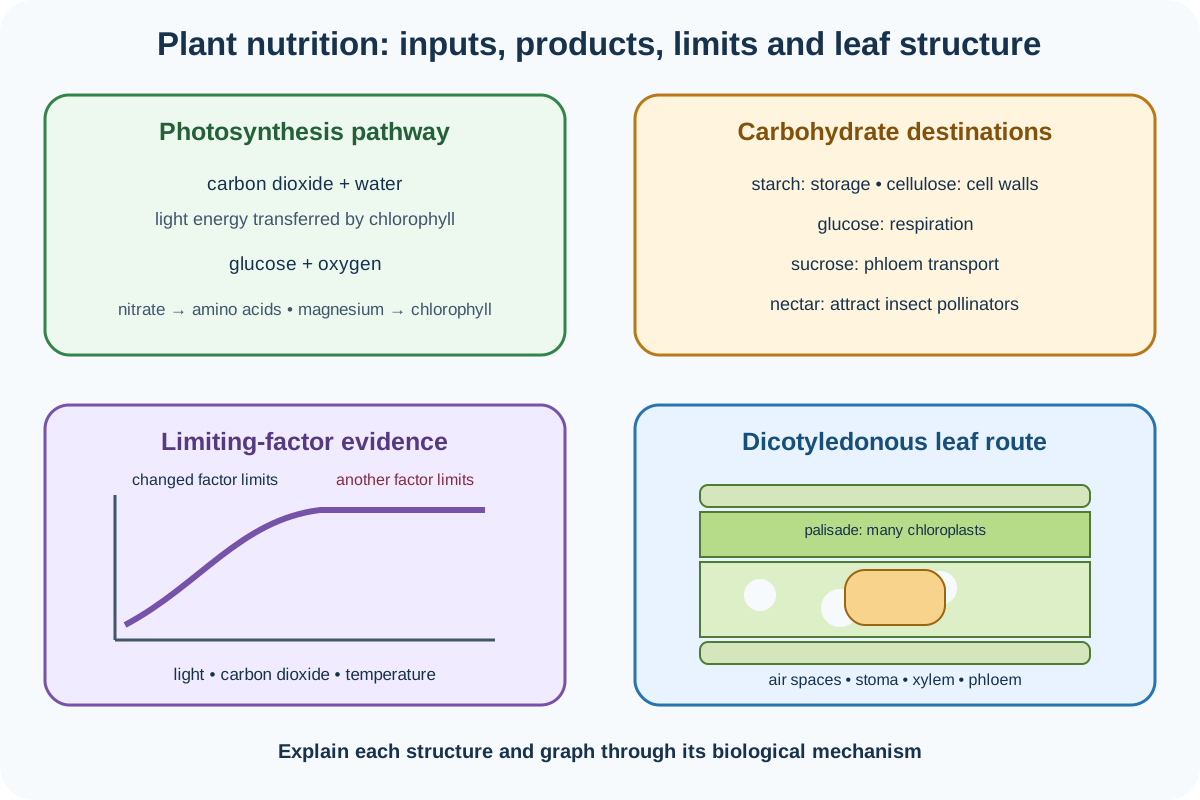
Topic 6 of Cambridge IGCSE Co-ordinated Sciences 0654 and 0973 connects photosynthesis, carbohydrate use, mineral requirements and limiting factors to the structure of a dicotyledonous leaf. Practical work tests the need for light, chlorophyll and carbon dioxide and investigates rate and gas exchange, but detailed execution remains in the separate practical hub.
Photosynthesis transfers energy
Photosynthesis is the process by which plants synthesise carbohydrates from raw materials using energy from light. Carbon dioxide and water are the raw materials. Light provides energy rather than matter.
The Core word equation is:
carbon dioxide+water→glucose+oxygen
in the presence of light and chlorophyll.
For Supplement candidates, the balanced chemical equation is:
6CO2+6H2O→C6H12O6+6O2.
Check this topic from memory
Attempt the matching topic bank before reopening the notes. Use each missed idea to decide what to review next.
The equation balances atoms but does not show every intermediate reaction. Chlorophyll is a green pigment found in chloroplasts. It transfers energy from light into energy in chemicals for carbohydrate synthesis. Chlorophyll is not used as a raw material in the equation and is not itself the carbohydrate product.
Photosynthesis stores transferred energy in chemical substances. Respiration later releases energy from glucose for metabolism. These processes are related but are not simply the same equation running at all times in opposite directions.
Uses and storage of photosynthetic carbohydrate
Cambridge specifies five subsequent routes for carbohydrates made in photosynthesis.
Glucose is used in respiration to provide energy for metabolism.
Glucose units are built into starch for energy storage.
Glucose units are built into cellulose for cell walls.
Carbohydrate is converted to sucrose for transport in the phloem.
Sugars are used in nectar to attract insects for pollination.
Starch is useful for storage because it is a large, insoluble molecule and therefore does not diffuse away readily or strongly affect cell water movement. Sucrose is the named transport form in the phloem. Do not exchange these two roles in an assessed answer.
Cellulose is structural rather than an energy store. Nectar has an ecological reproductive role because it can attract animal pollinators. A plant may direct carbohydrate to different sinks depending on growth, storage and reproduction.
Mineral-ion requirements
Plants absorb mineral ions from the soil solution through roots. The required Topic 6 links are specific:
Nitrate ions are needed to make amino acids. Amino acids are then used to make proteins.
Magnesium ions are needed to make chlorophyll.
A nitrate shortage can restrict protein production and growth because the plant cannot obtain the required nitrogen simply from carbon dioxide or water. A magnesium shortage can reduce chlorophyll production, which can contribute to yellow leaves and reduced light absorption.
The biological explanation matters more than a memorised colour. State the missing ion, the molecule it helps make and the resulting process or growth effect. Plants do not obtain ready-made food from soil; they obtain water and mineral ions and manufacture carbohydrate through photosynthesis.
Limiting factors: Supplement
A limiting factor is the factor in shortest effective supply that restricts the rate of a process. Cambridge names light intensity, carbon dioxide concentration and temperature as variables affecting photosynthesis rate.
At low light intensity, increasing light can increase the rate because more energy is transferred to the photosynthetic reactions. A rate graph may rise and then level off. The plateau does not mean that light has stopped existing. It means that another factor, such as carbon dioxide concentration or temperature, now limits the rate under those conditions.
Increasing carbon dioxide concentration can increase the rate while carbon dioxide is limiting because more raw material is available. Once another requirement limits the process, extra carbon dioxide produces little or no further increase.
Temperature affects enzyme-controlled reactions involved in photosynthesis. Low temperature can slow reaction rate. Rate may rise toward an optimum as kinetic energy and effective collision frequency increase. Above a suitable range, enzyme shape and active-site fit can be disrupted, so rate falls. Light and carbon dioxide do not show this same high-value denaturation explanation.
To identify a limiting factor from data, compare conditions rather than reciting a definition. If extra light increases rate at low carbon dioxide but has no effect at high light, light was limiting only in the first comparison. If raising carbon dioxide then increases the plateau, carbon dioxide had become limiting.
In real conditions, more than one factor can constrain rate. The assessed task is usually to identify the factor supported by the graph or table and explain how changing it affects photosynthesis.
Evidence from photosynthesis investigations
The theory boundary includes what evidence should mean.
To test the need for light, compare illuminated and covered regions while keeping the same leaf and other conditions. After removing stored starch before the test and using the appropriate starch test, starch evidence in the illuminated region supports the need for light.
To test the need for chlorophyll, use a variegated leaf and compare green and non-green areas that experienced the same light and carbon dioxide. Starch evidence in green regions supports the role of chlorophyll.
To test the need for carbon dioxide, compare a plant supplied with carbon dioxide against a matched condition in which carbon dioxide is removed, using suitable controls. A control separates the effect of carbon dioxide from enclosure or handling.
For rate work, oxygen volume, bubble production or another stated measure may act as a proxy. Bubble count is less reliable if bubble sizes vary. Practical execution, decolourising a leaf, reagent safety, apparatus control and evaluation belong to the practical note.
Hydrogencarbonate indicator provides gas-exchange evidence in aquatic-plant investigations. Interpret the supplied reference colours and controls rather than assuming that any colour change measures photosynthesis alone. In light, both photosynthesis and respiration occur; net carbon dioxide movement depends on their relative rates. In darkness, photosynthesis stops while respiration continues.
Dicotyledonous leaf structure
Most leaves have a large surface area and are thin. Large surface area increases light interception and provides an extensive surface for gas exchange. Thinness gives a short diffusion distance between air and photosynthesising cells and allows light to penetrate tissue.
The waxy cuticle is transparent and reduces uncontrolled water loss. The upper epidermis is usually transparent, allowing light to reach the palisade mesophyll. Palisade mesophyll cells lie near the upper surface and contain many chloroplasts, so they absorb light efficiently.
Spongy mesophyll has irregularly arranged cells and air spaces. The air spaces create internal surfaces and short diffusion paths for carbon dioxide and oxygen. Mesophyll cell surfaces are moist so gases can dissolve before diffusion.
Stomata are pores, commonly abundant in the lower epidermis, through which carbon dioxide enters and oxygen and water vapour can leave. Guard cells alter stomatal opening. Do not call the guard cells themselves the pore.
Vascular bundles contain xylem and phloem. Xylem supplies water and mineral ions to leaf tissue. Phloem transports sucrose and other assimilates away from photosynthetic sources to sinks. The bundle also helps support the leaf.
An identification question may use a diagram, photomicrograph or unfamiliar orientation. Use relationships rather than memorising top and bottom positions alone: palisade tissue is closely packed and chloroplast-rich; spongy tissue contains air spaces; a vascular bundle contains xylem and phloem; paired guard cells surround a stoma.
Worked application: identify a limiting factor and leaf route
At 20 °C and low carbon dioxide, increasing light from 200 to 600 arbitrary units raises oxygen production from 4 to 9 units per minute, but further light causes no increase. When carbon dioxide is raised at 600 light units, rate rises to 14 units per minute. Light was limiting between 200 and 600 units. At the first plateau, carbon dioxide became limiting because increasing it raised the rate. Water for the reaction reaches the leaf through xylem, carbon dioxide diffuses through stomata and air spaces to mesophyll cells, chloroplast-rich palisade cells transfer light energy, and sucrose made from photosynthetic carbohydrate can leave through phloem.
Common misconceptions and corrections
Saying plants obtain food from soil. They absorb water and mineral ions and synthesise carbohydrate.
Calling light a raw material. It supplies energy; carbon dioxide and water supply matter.
Putting chlorophyll on the reactant side. It transfers light energy and is not a raw material.
Saying chlorophyll is an enzyme. It is a green pigment in chloroplasts.
Leaving oxygen out of the word equation. It is a product.
Writing an unbalanced Supplement equation. Use six carbon dioxide and six water molecules to produce one glucose and six oxygen molecules.
Saying photosynthesis directly releases usable energy. It transfers light energy into chemical energy.
Saying respiration occurs only in animals. Plant cells respire too.
Calling starch the phloem transport sugar. The named transport form is sucrose.
Calling sucrose the main storage form here. The named energy store is starch.
Calling cellulose an energy store. Its named use is building cell walls.
Ignoring nectar's role. It attracts insects for pollination.
Saying nitrate ions make chlorophyll. They are needed for amino acids.
Saying magnesium ions make proteins. They are needed for chlorophyll.
Explaining deficiency only by leaf colour. Link ion to molecule and biological consequence.
Saying more light always increases rate. Another factor can become limiting.
Calling a plateau zero photosynthesis. It shows no further rate increase under those conditions.
Naming a limiting factor without comparing evidence. Use the changed variable and response.
Saying temperature provides a photosynthetic raw material. It affects enzyme-controlled reaction rate.
Using denaturation to explain a high carbon dioxide value. Denaturation applies to enzymes at unsuitable temperature or pH.
Assuming oxygen bubbles are identical. Variable bubble size weakens bubble count as a rate measure.
Saying a starch test directly detects photosynthesis. It detects stored starch as evidence after suitable control.
Omitting destarching from light or carbon dioxide reasoning. Pre-existing starch could invalidate the inference.
Using an unpaired variegated-leaf comparison. Green and non-green areas should share the other conditions.
Saying darkness stops respiration. It stops photosynthesis; respiration continues.
Assuming gas exchange equals photosynthesis alone. Net movement reflects photosynthesis and respiration.
Saying a thin leaf has a longer diffusion path. Thinness shortens it.
Calling the upper epidermis the main photosynthetic tissue. Palisade mesophyll contains many chloroplasts.
Calling a guard cell a stoma. A stoma is the pore between guard cells.
Swapping xylem and phloem. Xylem supplies water and ions; phloem transports sucrose.
Saying air spaces absorb light. They support rapid internal gas diffusion.
Identifying tissues only by page orientation. Use cell arrangement, chloroplasts, air spaces and vascular features.
Assessment guidance
Define photosynthesis as carbohydrate synthesis from raw materials using light energy, then give the requested word or balanced equation. Link each carbohydrate destination and mineral ion to its exact named role. On limiting-factor questions, read the axes, identify the interval, cite the response to a controlled change and explain why another factor takes over at a plateau. For leaf structure, pair every feature with a mechanism: large area with interception, thinness and air spaces with diffusion, palisade chloroplasts with light absorption, stomata with gas exchange, xylem with water supply and phloem with sucrose transport. Keep method detail in practical answers and molecular or structural explanations in theory answers.
Retrieval practice
Reconstruct both photosynthesis equations, then route the resulting carbohydrate to starch, cellulose, respiration, sucrose and nectar. Analyse two multi-factor graphs to identify the limiting factor in each interval. Finally, label an unfamiliar leaf section and explain every structure through light capture, diffusion, water supply, sugar transport or water-loss control.
Theory and practical ownership
This theory note owns photosynthesis, carbohydrate uses, mineral roles, limiting-factor explanations, gas-exchange interpretation and leaf structure-function relationships. The separate Biology practical hub owns destarching, leaf starch-test execution, carbon dioxide and variegated-leaf controls, aquatic-plant apparatus, indicator handling, temperature and light control, rate measurement, safety, tables, graphs and evaluation.