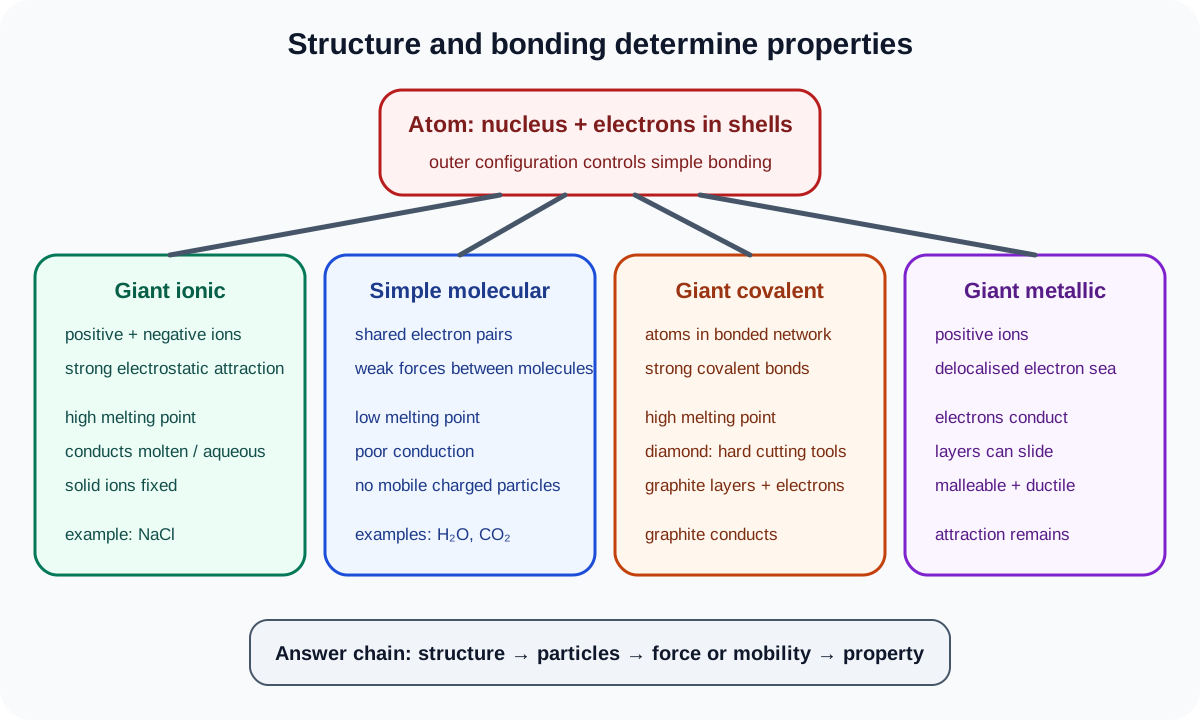
Chemistry C2 of Cambridge IGCSE Co-ordinated Sciences 0654 connects composition and atomic structure to four bonding models. Official sections 2.1 to 2.7 require electron configurations, isotopes, ions, simple molecules, giant covalent structures and metallic lattices, with properties explained by the particles and forces present.
Elements, compounds and mixtures
An element contains only one type of atom. It cannot be chemically broken down into simpler substances.
A compound contains two or more different elements chemically bonded in fixed proportions. Its properties differ from those of its constituent elements, and separating it requires chemical change.
A mixture contains two or more substances not chemically bonded. Composition can vary, each substance retains its chemical properties and physical methods can separate the components.
Air is a mixture because gas proportions can vary and the gases are not chemically joined. Water is a compound because hydrogen and oxygen atoms are bonded in a fixed ratio.
Atomic structure
An atom has a tiny central nucleus containing protons and neutrons, surrounded by electrons in shells.
Particle
Relative charge
Relative mass
Location
proton
+1
1
nucleus
neutron
0
1
nucleus
Check this topic from memory
Attempt the matching topic bank before reopening the notes. Use each missed idea to decide what to review next.
Most atomic mass lies in the nucleus. Most atomic volume is the region occupied by electron shells.
A neutral atom has equal numbers of protons and electrons. Gaining or losing electrons forms an ion; ordinary chemical ion formation does not change proton number.
Proton number and mass number
Proton number, also called atomic number, is the number of protons in the nucleus. It identifies the element.
Mass number, also called nucleon number, is the total number of protons and neutrons in the nucleus.
Use:
number of neutrons = mass number - proton number
In a nuclide symbol, mass number appears at upper left and proton number at lower left. Any ionic charge appears at upper right.
For chlorine-35, proton number 17 gives 17 protons. Mass number 35 gives 18 neutrons. A chloride ion has 18 electrons because the atom gained one electron.
Electronic configuration for proton numbers 1 to 20
Electrons fill shells. For the first 20 elements, use arrangements such as 2,8,3 for aluminium and 2,8,8,2 for calcium.
Group VIII noble gases have full outer shells. For Groups I to VII, the group number equals the number of outer-shell electrons. Period number equals the number of occupied electron shells.
An atom of sodium has configuration 2,8,1, placing it in Group I and Period 3. Chlorine has 2,8,7, placing it in Group VII and Period 3.
Ion configurations reflect electron loss or gain. Sodium forms Na⁺ with 2,8; chlorine forms Cl⁻ with 2,8,8. The nucleus remains unchanged.
Isotopes
Isotopes are different atoms of the same element with the same number of protons but different numbers of neutrons.
They have the same proton number and, as neutral atoms, the same number and arrangement of electrons. They therefore have the same chemical properties because chemical reactions involve electrons and electron configuration.
Their masses and some physical or nuclear properties differ because neutron numbers differ.
Form cations and anions
A positive ion is a cation, formed when an atom loses electrons. A negative ion is an anion, formed when an atom gains electrons.
Metals commonly lose outer electrons and non-metals commonly gain them to reach noble-gas electronic configurations in the simple model.
Group I atoms lose one electron to form 1+ ions. Group II atoms lose two to form 2+ ions. Group VII atoms gain one to form 1- ions. The ion charge records electron imbalance, not proton transfer.
Ionic bonding
An ionic bond is a strong electrostatic attraction between oppositely charged ions.
For sodium chloride, sodium transfers one electron to chlorine. Na⁺ and Cl⁻ ions form, each with a noble-gas electron configuration. A dot-and-cross diagram distinguishes the original sources of outer electrons and encloses each ion in brackets with its charge.
Group I and Group VII formation is Core. Supplement extends this reasoning to ions of metallic and non-metallic elements more generally.
An ionic compound is not made of separate sodium chloride molecules. It forms a giant ionic lattice: a regular alternating arrangement of positive and negative ions.
Explain ionic properties
Ionic compounds have high melting and boiling points because strong electrostatic attractions act in all directions throughout the giant lattice. Much energy is needed to separate oppositely charged ions.
They conduct electricity when molten or aqueous because ions are free to move and carry charge. They conduct poorly when solid because ions remain fixed in lattice positions.
Dissolving does not turn ions into electrons. Mobile ions carry current in the solution.
Covalent bonding
A covalent bond forms when a pair of electrons is shared between two atoms, leading to noble-gas electronic configurations.
Core molecules include H₂, Cl₂, H₂O, CH₄, NH₃ and HCl. Supplement adds CH₃OH, C₂H₄, O₂, CO₂ and N₂.
A single bond is one shared pair, a double bond two shared pairs and a triple bond three shared pairs. Dot-and-cross diagrams show outer-shell electrons and shared pairs, not the physical size or colour of atoms.
In H₂, each hydrogen contributes one electron to a shared pair. In O₂, two pairs are shared. In N₂, three pairs are shared.
Simple molecular properties
Simple molecular substances contain strong covalent bonds within molecules but weak intermolecular forces between molecules. Specific intermolecular-force types are not required.
They have low melting and boiling points because melting or boiling overcomes weak forces between molecules, not the strong covalent bonds inside them.
They conduct electricity poorly because they do not have mobile ions or delocalised electrons.
Molecular size can affect the strength of intermolecular forces, but the official boundary centres on the general structure-property explanation.
Diamond
Diamond is a giant covalent structure in which each carbon atom forms four covalent bonds in a rigid three-dimensional network.
Strong covalent bonds throughout give a high melting point and make diamond hard. It is used in cutting tools because the rigid structure resists deformation.
Diamond does not conduct electricity because all four outer electrons of each carbon atom are localised in bonds and no mobile charged particles exist.
Graphite
Graphite is a giant covalent structure in which each carbon atom forms three covalent bonds in flat layers.
Strong covalent bonds within layers give a high melting point. Weak forces between layers allow them to slide, so graphite works as a lubricant.
Each carbon contributes one delocalised electron. These electrons move along layers and carry charge, so graphite can be used as an electrode.
Do not explain graphite conductivity through mobile carbon atoms.
Metallic bonding
Metallic bonding is the electrostatic attraction between positive ions in a giant metallic lattice and a sea of delocalised electrons.
Metals conduct electricity because delocalised electrons move through the lattice and carry charge.
Metals are malleable and ductile because layers of positive ions can slide past one another while attraction to the mobile electron sea remains. The metallic bond is non-directional in this model, so rearrangement does not immediately shatter the structure.
Do not call a metal a lattice of neutral atoms surrounded by spare electrons. The assessed model uses positive ions and delocalised electrons.
Property questions require the full chain: structure, charged or bonded particles, force or mobility, then property.
Worked application: combine isotope and bonding evidence
An atom of element X has 12 protons, 12 neutrons and electron configuration 2,8,2. Its proton number is 12 and mass number is 24. An isotope with 13 neutrons still has 12 protons and the same neutral electron configuration, so it has the same chemical properties. X is in Group II and Period 3 and forms X²⁺ by losing two electrons. With a Group VII element Y that forms Y⁻, charge balance gives XY₂. The compound has a giant ionic lattice, high melting point and conducts when molten because its ions become mobile. Neutron number does not determine ion charge; outer electrons do.
Common misconceptions and corrections
Calling every pure substance an element. Compounds are also pure substances.
Saying mixtures have fixed ratios. Their composition can vary.
Separating compounds by filtration. Chemical bonds require chemical change.
Putting electrons in the nucleus. They occupy shells around it.
Giving an electron relative mass 1. It is about 1/1836.
Defining proton number as protons plus neutrons. That is mass number.
Changing proton number when forming an ion. Electrons change.
Using mass number as electron count. Neutral electron count equals proton number.
Saying Group VIII has eight shells. It has a full outer shell.
Equating period with outer electrons. Period equals occupied shells.
Defining isotopes as different elements. They have the same proton number.
Saying isotopes have different electron configurations. Neutral isotopes of one element have the same configuration.
Calling a cation negative. A cation is positive.
Forming a negative ion by losing electrons. It gains electrons.
Defining ionic bonding as electron transfer. Transfer forms ions; attraction bonds them.
Calling sodium chloride a molecule. It is a giant ionic lattice.
Using electrons as charge carriers in molten ionic material. Mobile ions carry charge.
Saying solid ionic compounds have no charged particles. Ions exist but are fixed.
Defining covalent bonding as transfer. A pair is shared.
Drawing all electrons rather than outer electrons in dot-and-cross diagrams. Show the assessed shells clearly.
Breaking covalent bonds when a simple molecule boils. Intermolecular forces are overcome.
Naming specific intermolecular forces as required. Their specific types are excluded.
Calling diamond a molecule. It is a giant network.
Saying diamond conducts because carbon is in Group IV. It lacks mobile charge carriers.
Attributing graphite conduction to moving atoms. Delocalised electrons move.
Describing metallic bonding as attraction between metals. It is ions to delocalised electrons.
Saying metal layers slide because bonds break completely. Attraction to the electron sea remains.
Explaining a high melting point as particles being strong. Name the strong attraction or bonds throughout a giant structure.
Assessment guidance
Start structure-property answers by identifying whether the substance is giant ionic, simple molecular, giant covalent or metallic. Name the particles and force, then explain energy or charge mobility. Electron configurations should be checked against proton number, group, period and ion charge. For isotopes, preserve proton number and change neutron number, and explain identical chemical properties through identical electron configuration. Dot-and-cross diagrams need outer electrons, shared pairs or transferred electrons, brackets and charges where ionic. Keep intermolecular forces between simple molecules separate from covalent bonds within molecules and electrostatic attractions in ionic or metallic lattices.
Retrieval practice
Build atoms and ions for proton numbers 1 to 20, including proton, neutron and electron counts. Interpret six isotope and ion symbols and explain why isotopes share chemical properties. Draw all Core and Supplement named covalent molecules and two ionic dot-and-cross diagrams. Compare ionic, simple molecular, diamond, graphite and metallic structures using particle, force, melting and conduction columns, then explain one unfamiliar material from supplied structural evidence.
Theory and practical ownership
This theory note owns atomic structure, electron configurations, isotopes, bonding models and structure-property explanations. The dedicated Co-ordinated Sciences practical series owns conductivity, melting, separation and material-observation procedures, apparatus, hazards, measurements and evaluation.