

Co-ordinated Sciences Chemistry C6: Chemical Reactions
Cambridge IGCSE Co-ordinated Sciences 0654 Chemistry C6 notes with worked examples, misconception checks and assessment guidance.
Chemistry C6 of Cambridge IGCSE Co-ordinated Sciences 0654 connects observable change to collision theory and redox. Official sections C6.1 to C6.3 cover physical and chemical changes, five rate factors, mass-loss and gas-formation methods, graph interpretation, collision theory, activation energy, oxygen transfer, electron transfer and increases or decreases in oxidation number. Reversible equilibrium, industrial equilibrium conditions, oxidising-agent tests and oxidation-number calculations are outside this boundary.
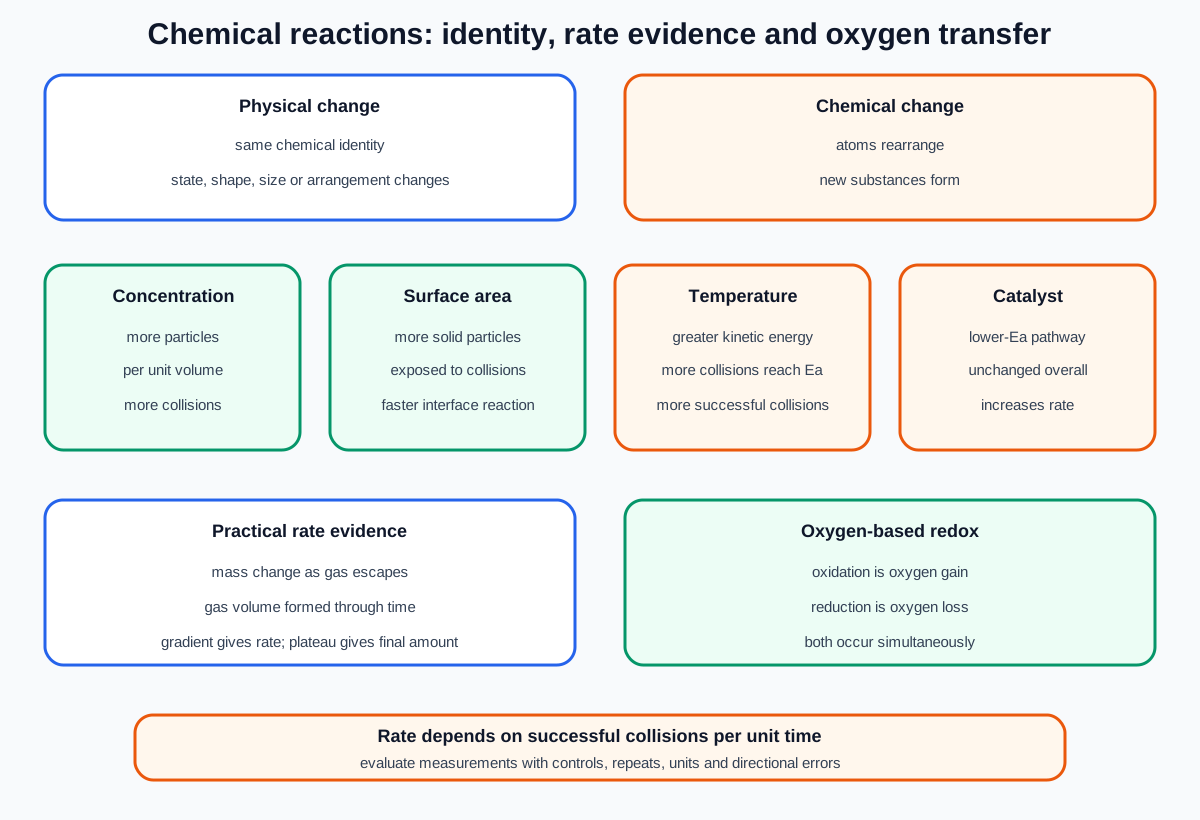
Physical and chemical changes
A physical change does not form a new substance. State, shape or arrangement may change, and the process is often reversible by a physical method. Melting ice is physical because the substance remains water.
A chemical change forms one or more new substances. Evidence may include a persistent colour change, gas formation, precipitate, light or temperature change, but evidence must be interpreted in context. Boiling also forms bubbles, yet it is physical.
Reversibility alone is not a perfect definition. Some physical changes are difficult to reverse and some chemical reactions are reversible. The decisive question is whether chemical composition changes.
Rate of reaction
Rate describes how quickly reactants are used or products are formed. It can be represented as change in a measured quantity divided by time.
Common measurements include loss of mass when gas escapes, increase in gas volume, decrease in reactant concentration, increase in product concentration, or time to a visible endpoint.
On a product-against-time graph, gradient gives rate. A steeper gradient means faster reaction. The curve becomes horizontal when no further measured product forms. For the same limiting reactant, different rates can reach the same final quantity.
An initial rate is found from a tangent at time zero. An average rate over an interval uses change in quantity divided by change in time.
Collision theory
Particles must collide to react, and a successful collision must have energy at least equal to the activation energy, Ea, with a suitable collision arrangement.
Collision theory explanations should identify which of these changes:
- number of particles per unit volume
- frequency of collisions
- kinetic energy distribution
- fraction of collisions reaching Ea
- activation energy itself
Avoid saying simply that particles collide more. Explain why the tested condition changes successful collisions per unit time.
Check this topic from memory
Attempt the matching topic bank before reopening the notes. Use each missed idea to decide what to review next.
Start the topic quiz