

Co-ordinated Sciences Chemistry C10: Chemistry of the Environment
Cambridge IGCSE Co-ordinated Sciences 0654 Chemistry C10 notes with worked examples, misconception checks and assessment guidance.
Chemistry C10 of Cambridge IGCSE Co-ordinated Sciences 0654 connects chemical evidence and human activity to water treatment, air pollution and climate. Official sections C10.1 and C10.2 require water tests and treatment stages, clean-air composition, source-effect-strategy chains, the greenhouse mechanism, acid-rain reduction, and nitrogen-oxide formation and removal in catalytic converters. Fertilisers, the Haber process and photosynthesis equations are outside this Chemistry boundary.
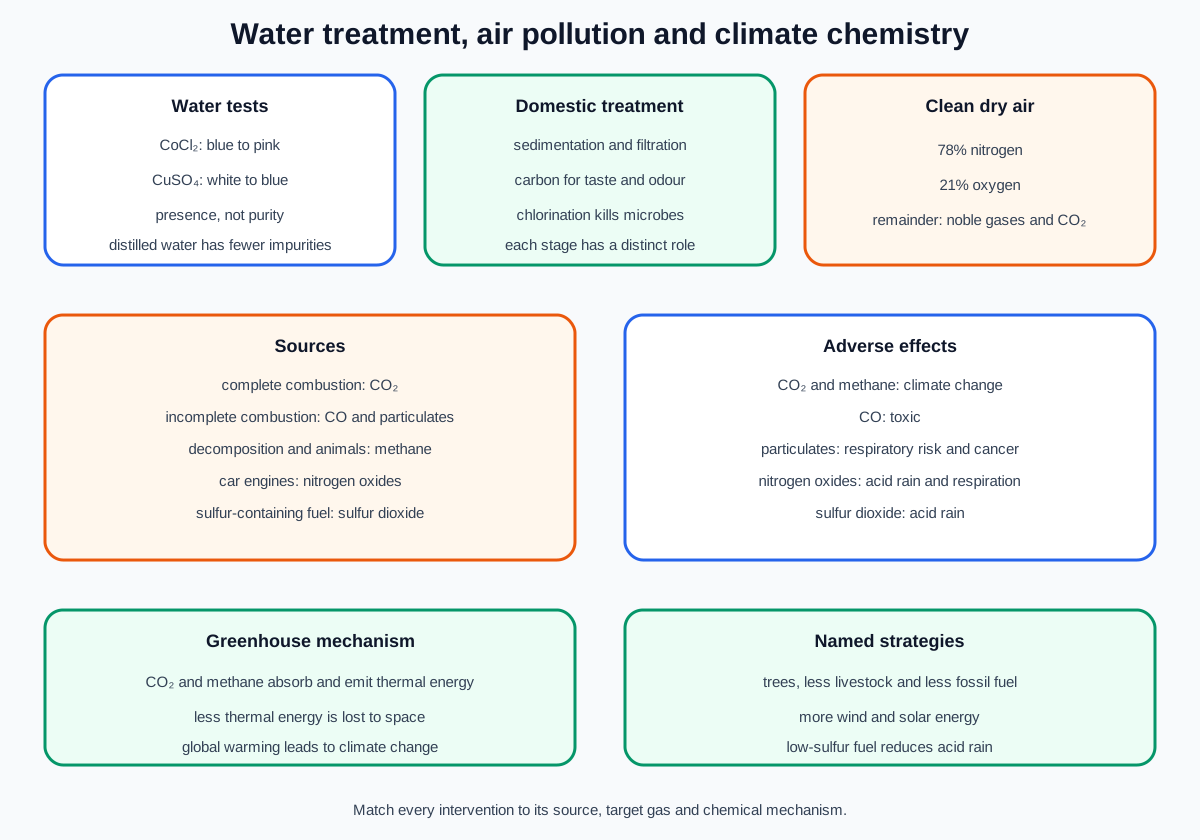
Test for the presence of water
Anhydrous cobalt(II) chloride changes from blue to pink when water is present.
Anhydrous copper(II) sulfate changes from white to blue when water is present.
These tests show that water is present. They do not by themselves show that a liquid is pure water, because an aqueous solution also produces the colour change.
Test water purity
Pure water has sharp melting and boiling points at a stated pressure. At standard atmospheric pressure, expected values are 0 °C and 100 °C.
Impurities can change the measured melting or boiling behaviour. A value close to the expected constant point supports purity, while a range or shifted result suggests impurities.
Pressure affects boiling point, so a careful conclusion uses the conditions provided rather than treating 100 °C as universal at every altitude and pressure.
Distilled water is used in practical chemistry because it contains fewer chemical impurities than tap water. Fewer dissolved ions reduce unwanted reactions and contamination.
Domestic water treatment
Domestic water treatment makes water safer and acceptable to use. It does not necessarily make it chemically pure.
- Sedimentation allows larger suspended solids to settle.
- Filtration removes remaining solid particles.
- Carbon removes tastes and odours by adsorption.
- Chlorination kills harmful microbes.
Each stage addresses a different problem. Filtration does not reliably kill microbes, while chlorination does not remove suspended stones or sand. Distillation and domestic treatment therefore have different purposes and products.
Composition of clean, dry air
Clean, dry air is approximately:
- 78% nitrogen, N₂
- 21% oxygen, O₂
- the remainder a mixture of noble gases and carbon dioxide, CO₂
Dry air excludes variable water vapour. Percentages are approximate, so do not force the remainder to one named gas.
Check this topic from memory
Attempt the matching topic bank before reopening the notes. Use each missed idea to decide what to review next.
Start the topic quiz