

Co-ordinated Sciences Chemistry C11: Organic Chemistry
Cambridge IGCSE Co-ordinated Sciences 0654 Chemistry C11 notes with worked examples, misconception checks and assessment guidance.
Chemistry C11 of Cambridge IGCSE Co-ordinated Sciences 0654 organises carbon compounds by structure, naming and reaction. Official sections C11.1 to C11.7 cover displayed formulae, saturation, homologous-series characteristics, unbranched alkanes and alkenes up to four carbons, ethanol, petroleum fractions, alkane combustion, cracking, alkene addition, ethanol combustion and uses, addition polymers, condensation polymers and nylon. Carboxylic acids, esters, fermentation, PET and proteins are outside this boundary.
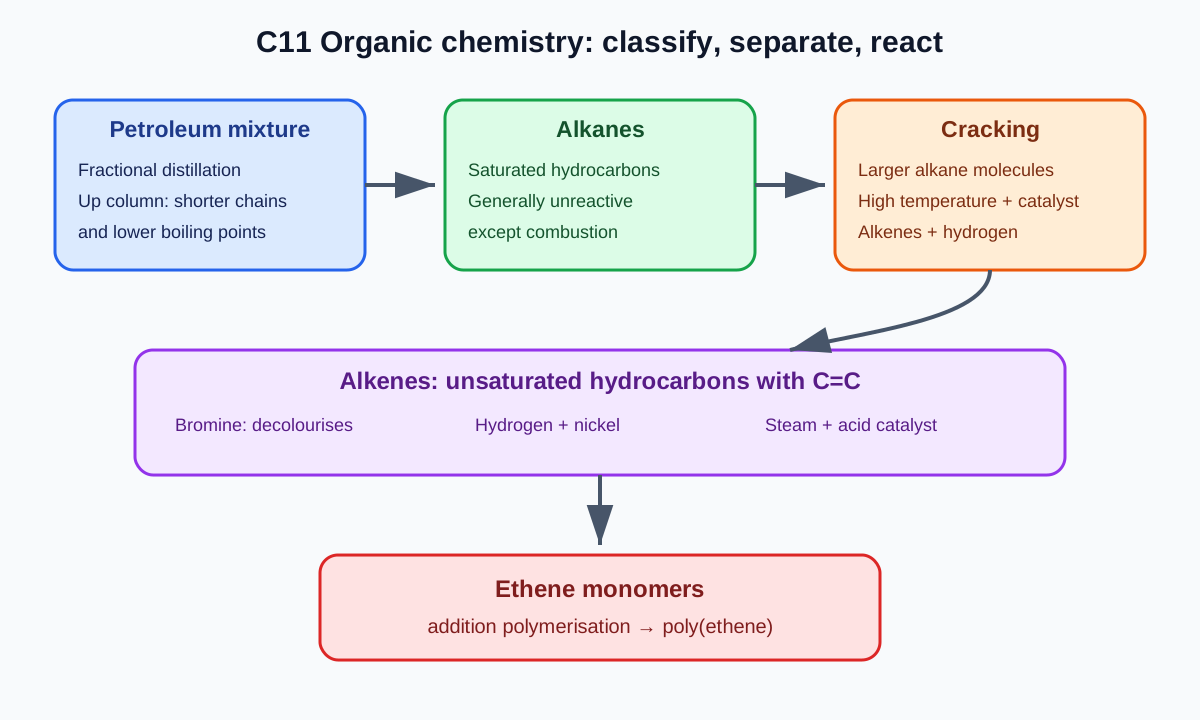
Formulae and functional groups
A displayed formula shows every atom and every bond. A structural formula gives an unambiguous compact description of atom arrangement, such as CH₂=CH₂, CH₃CH₂OH or CH₃COOCH₃.
A homologous series is a family of similar compounds with similar chemical properties. Its members have the same general formula and show a trend in physical properties. Recall of specific general formulae is not required in C11.
Name and draw organic compounds
The prefix gives carbon-chain length: meth-, eth-, prop- and but- for one to four carbon atoms. The suffix identifies the required type: -ane, -ene or -ol. Name and draw methane, ethane, ethene and ethanol, plus unbranched alkanes and alkenes up to four carbon atoms. For butenes, distinguish but-1-ene and but-2-ene; cis-trans naming is not required.
Fossil fuels and hydrocarbons
Coal, natural gas and petroleum are fossil fuels. Methane is the main constituent of natural gas.
A hydrocarbon contains hydrogen and carbon only. Petroleum is a mixture of hydrocarbons rather than one pure compound.
Ethanol contains oxygen and is therefore not a hydrocarbon.
Fractional distillation of petroleum
Petroleum is heated so much of it vaporises. Vapours enter a fractionating column that is hot at the bottom and cooler at the top. Compounds condense at levels where temperature falls below their boiling ranges. Fractions are mixtures with similar boiling points.
From bottom to top of the column, average chain length decreases, volatility increases, boiling point decreases and viscosity decreases.
| Fraction | Required use |
| refinery gas |
Check this topic from memory
Attempt the matching topic bank before reopening the notes. Use each missed idea to decide what to review next.
Start the topic quiz