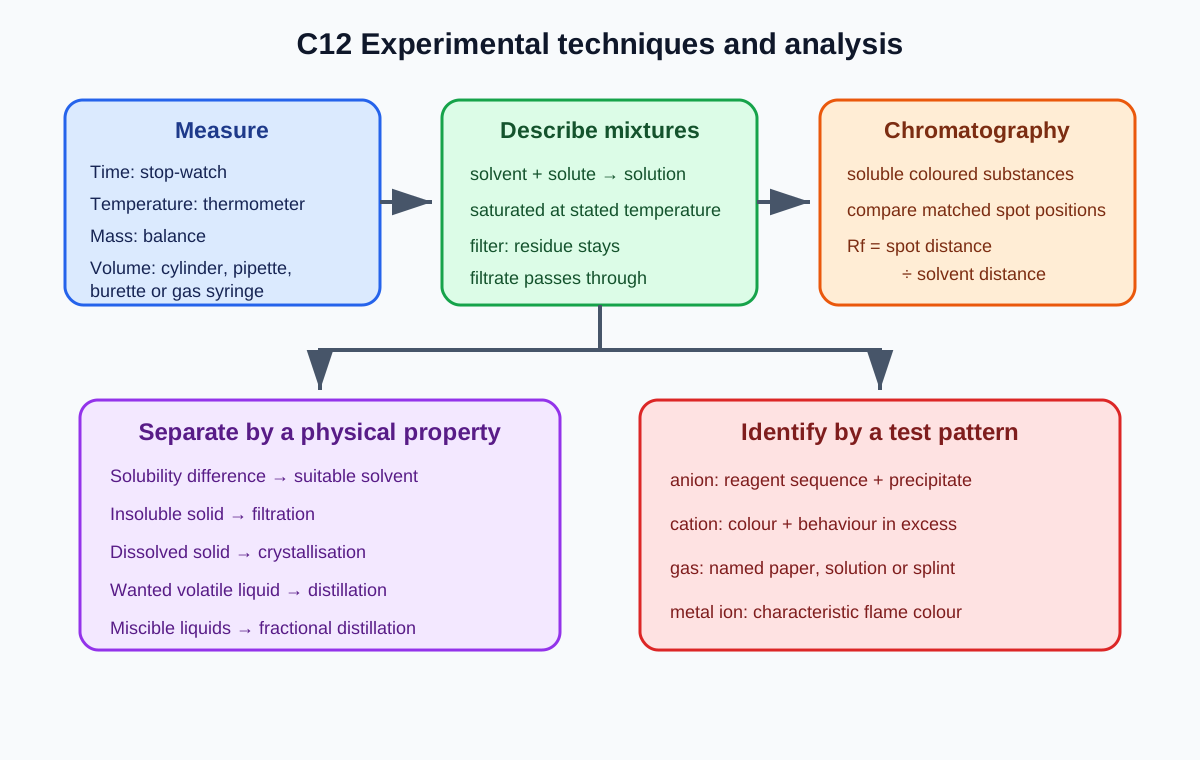
Cambridge IGCSE Co-ordinated Sciences Chemistry C12 develops the theory needed to choose measurement, titration and separation methods and interpret prescribed chemical tests. It covers official sections C12.1 to C12.5, including melting-point and boiling-point purity evidence and the nitrate test. The paired practical hub owns detailed execution, risk controls, planning, data collection and evaluation.
Select apparatus for the quantity being measured
Choose apparatus by first identifying the quantity: time, temperature, mass or volume. Then consider the expected range and the precision the task needs.
A correct answer names an instrument that measures the required quantity directly. A thermometer does not measure thermal energy, and a balance measures mass rather than weight.
Practical details such as reading scales at eye level remain important in experiments, but C12.1 first tests recognition and appropriate selection.
Stop-watches measure time
A stop-watch is appropriate for a time interval, such as the duration of a reaction or the time taken for a visible change.
Its resolution should be suitable for the event. Human reaction time can be significant when the interval is very short.
Do not use a stop-watch to infer reaction rate unless the chosen endpoint is clearly defined.
Thermometers measure temperature
A thermometer measures temperature. Its range must include the temperatures expected in the experiment, and its scale must allow a useful reading.
Temperature is not the same quantity as heat or thermal energy. A thermometer reading therefore cannot directly report energy transferred.
In a planned method, allow the sensing part to reach the sample temperature before recording a stable result.
Balances measure mass
A balance measures mass. The result is usually obtained directly for an object or by finding a difference between container-plus-sample and container alone.
Select a balance with suitable capacity and resolution. Recording more decimal places than the instrument displays creates false precision.
Mass is measured in units such as grams, while weight is a force.
Measuring cylinders measure general liquid volumes
A measuring cylinder is suitable when a measured liquid volume is needed but the highest available precision is not essential.
It can deliver a range of volumes and is normally more appropriate than a beaker for measurement.
Choose a cylinder whose capacity is reasonably close to the volume required so the scale divisions remain useful.
Check this topic from memory
Attempt the matching topic bank before reopening the notes. Use each missed idea to decide what to review next.
Volumetric pipettes transfer one accurate fixed volume
A volumetric pipette is designed to transfer a particular fixed volume accurately, such as a measured portion used in an analysis.
It is not the best choice when many unrelated volumes must be selected, because its calibration is for the stated volume.
Do not confuse a volumetric pipette with a dropping pipette, which is not used to deliver a precisely calibrated volume.
Burettes deliver accurate variable volumes
A burette allows accurate measurement of a variable volume delivered from the instrument. Initial and final readings are used to find the delivered volume.
It is especially useful when the required amount is not known in advance.
The burette is different from a pipette: the pipette transfers one fixed calibrated volume, while the burette measures a variable delivered volume.
Acid-base titration locates an indicator endpoint
Use a volumetric pipette to transfer a fixed volume of one solution into a conical flask and add a suitable indicator. Fill a burette with the other solution and record the initial reading. Add from the burette while swirling, then approach the colour change drop by drop. Record the final reading and subtract to find the delivered volume.
The endpoint is the indicator's specified colour change. It is evidence that the chosen indicator has reached its transition, so avoid calling any temporary local colour the endpoint. Rinse flask walls with distilled water during the procedure if needed; this does not change the amount of substance already pipetted into the flask.
Gas syringes measure gas volume
A gas syringe collects and measures the volume of a gas. It is appropriate when the gas must be contained rather than allowed to escape.
Connections must be gas-tight in an actual investigation or the measured volume will be too low.
A measuring cylinder may measure a liquid volume, but a gas syringe is the named apparatus designed for direct gas-volume collection.
Solvent, solute and solution describe dissolving
A solvent is a substance that dissolves a solute. A solute is the substance dissolved in the solvent.
A solution is a mixture of one or more solutes dissolved in a solvent. Dissolving produces a mixture, not a new pure compound.
The same substance can act as a solute in one context and a solvent in another, so use the relationship in the stated mixture.
A saturated solution is at its concentration limit
A saturated solution contains the maximum concentration of a solute dissolved in the solvent at a specified temperature.
Temperature is part of the definition because solubility can change with temperature. “Full of solute” is too vague and does not identify the condition.
Undissolved solid may be present after more solute is added, but the definition concerns the dissolved concentration at the specified temperature.
Residue and filtrate name different outcomes
A residue is a solid substance that remains after evaporation, distillation, filtration or a similar process.
A filtrate is the liquid or solution that has passed through a filter.
In filtration, the residue stays on the filter while the filtrate passes through. Do not call the collected liquid a residue merely because it remains in the flask.
Paper chromatography separates soluble coloured substances
Paper chromatography can separate a mixture of soluble coloured substances using a suitable solvent. Place small sample spots on a start line, position the solvent below that line and allow the solvent to move through the paper.
Substances travel different distances because their relative attractions to the moving solvent and paper differ. The separated spots form a chromatogram.
The sample substances must dissolve in the chosen solvent, and the solvent must not begin above the spots or the samples may wash directly away.
A chromatogram can compare unknowns with knowns
Run unknown and known substances under the same conditions. Spots at matching positions can support the identification of a component in the unknown.
The comparison is conditional: solvent, paper and experimental conditions must match. Position alone from unrelated chromatograms is not reliable evidence.
A match supports identity but should not be overstated as absolute proof when different substances could behave similarly.
Spots indicate pure and impure samples
A pure coloured substance produces one spot under the stated chromatographic conditions. A mixture that separates produces more than one spot.
One spot is evidence of purity under those conditions, not proof that no impurity exists. An impurity might be colourless, insoluble or move to the same position.
Interpret what is visible while respecting the method's limitations.
Rf compares substance and solvent movement
The retention factor is calculated using Rf=distance travelled by solventdistance travelled by substance.
Measure both distances from the same start line. For the substance, measure to the centre of its spot; for the solvent, measure to the solvent front.
The units cancel because one distance is divided by another distance. Under a valid run, the substance cannot travel farther than the solvent front, so the value normally lies between zero and one.
A suitable solvent can separate by solubility
A solvent can dissolve one component while leaving another undissolved. The dissolved component can then be separated from the insoluble residue by filtration.
Solvent choice depends on the substances involved. A method is not justified by saying only “use a solvent”; state which difference in solubility makes it suitable.
After separation, the dissolved solute can be recovered by crystallisation where appropriate.
Filtration separates an insoluble solid from a fluid
Filtration traps an insoluble solid as residue while liquid or solution passes through as filtrate.
It cannot separate a dissolved solute from its solution because dissolved particles pass through with the solvent.
The key selection property is insolubility and particle size relative to the filter structure.
Crystallisation recovers a dissolved solid
Crystallisation obtains a dissolved solid from solution. Some solvent is removed to make a sufficiently concentrated solution, then cooling or further solvent loss allows crystals to form.
It is chosen when the desired solute should be recovered as crystals rather than heated until completely dry.
The mother liquor remains a mixture and may retain some dissolved solute, so recovery need not be complete.
Simple distillation recovers a solvent
Simple distillation separates a volatile liquid from dissolved non-volatile material, or liquids whose boiling points are sufficiently different for the stated problem.
The more volatile liquid vaporises, passes into a condenser and becomes liquid distillate. The less volatile material remains as residue.
Distillation is selected when the liquid is wanted. Evaporation alone would allow it to escape rather than collect it.
Fractional distillation separates miscible liquids with different boiling points, especially when repeated vaporisation and condensation are needed for better separation.
The fractionating column provides many opportunities for higher-boiling vapour to condense while lower-boiling vapour continues toward the condenser.
This is the same physical principle used to separate petroleum into boiling-point fractions, although a school mixture may contain fewer components.
Melting and boiling behaviour provide purity evidence
A pure substance has a characteristic melting point or boiling point under stated conditions. Compare the measured value with reliable reference information. A sharp melting point close to the expected value supports purity, while an impurity commonly lowers and broadens a melting range. A boiling value away from the expected value can also indicate impurity.
This is evidence rather than absolute proof. Measurement error, pressure and heating technique can also shift a result, so record the range and conditions rather than reporting only a preferred number.
Choose a separation sequence from properties
When several substances are mixed, one method may not be enough. Identify whether each component is insoluble, dissolved or a miscible liquid, then order techniques so each step prepares the next.
For sand, salt and water, filtration removes insoluble sand. Simple distillation can then collect water from the salt solution, leaving salt-containing residue; crystallisation is appropriate if solid salt is the desired purified product.
A strong answer names the wanted product at each stage and explains the property used.
Anion tests require reagents and observations
For carbonate, add dilute acid. Effervescence occurs and carbon dioxide is produced; confirm the gas because carbon dioxide turns limewater milky.
For chloride, bromide and iodide solutions, first acidify with dilute nitric acid, then add aqueous silver nitrate. Chloride gives a white precipitate, bromide gives a cream precipitate and iodide gives a yellow precipitate.
For sulfate solution, acidify with dilute nitric acid and add aqueous barium nitrate. A white precipitate forms.
For nitrate, add aluminium foil and aqueous sodium hydroxide, then warm carefully. Ammonia is produced; confirm it because the gas turns damp red litmus paper blue. The aluminium and alkaline conditions are part of the required reagent sequence.
Do not identify an ion from “a precipitate” alone. Reagent sequence and colour distinguish the result.
Ammonium ions release ammonia on warming
Add aqueous sodium hydroxide to an ammonium-ion sample and warm it. Ammonia gas is produced.
Confirm ammonia because it turns damp red litmus paper blue.
This result differs from the metal-cation precipitates. The assessment table does not prescribe an aqueous-ammonia result for ammonium.
Calcium ions give a selective white result
With aqueous sodium hydroxide, calcium ions give a white precipitate insoluble in excess.
With aqueous ammonia, calcium ions give no precipitate or a very slight white precipitate.
The contrast between the two reagents helps distinguish calcium from zinc, which dissolves in excess with both reagents.
Copper(II) ions give blue results
With aqueous sodium hydroxide, copper(II) ions give a light blue precipitate insoluble in excess.
With aqueous ammonia, they first give a light blue precipitate that dissolves in excess to form a dark blue solution.
State light blue precipitate before excess and dark blue solution after excess; “blue” alone loses the diagnostic sequence.
Iron(II) ions give a green precipitate
With either aqueous sodium hydroxide or aqueous ammonia, iron(II) ions give a green precipitate insoluble in excess.
The precipitate turns brown near its surface on standing.
Do not record the initial precipitate as red-brown. That is the immediate iron(III) observation.
Iron(III) ions give a red-brown precipitate
With either aqueous sodium hydroxide or aqueous ammonia, iron(III) ions give a red-brown precipitate insoluble in excess.
The initial colour distinguishes it from the green iron(II) precipitate.
Neither iron precipitate is described as dissolving in excess reagent in the official table.
Zinc ions dissolve in both excess reagents
With aqueous sodium hydroxide, zinc ions give a white precipitate soluble in excess, producing a colourless solution.
With aqueous ammonia, the same overall observation occurs: white precipitate, then a colourless solution in excess.
This dual solubility distinguishes zinc from calcium and from the other listed metal ions. Formulas of the complex ions are not required.
Five prescribed gas tests give characteristic results
Ammonia turns damp red litmus paper blue. Carbon dioxide turns limewater milky. Chlorine bleaches damp litmus paper.
Hydrogen produces a pop with a lighted splint. Oxygen relights a glowing splint.
Keep lighted and glowing splints distinct. Litmus must be damp for the ammonia and chlorine tests because the colour response requires the gas to interact with moisture.
Flame tests identify four metal ions
Lithium ions produce a red flame. Sodium ions produce a yellow flame. Potassium ions produce a lilac flame. Copper(II) ions produce a blue-green flame.
Flame colour is an observation, while the metal ion is the inference. Write both in the correct order when explaining identification.
Contamination, especially by sodium, can obscure colours in practice, which is why clean technique belongs in the practical treatment.
Worked application: identify an unknown salt solution
An unknown solution gives a white precipitate when acidified with dilute nitric acid and treated with aqueous silver nitrate, supporting chloride ions. A fresh portion gives a light blue precipitate with aqueous sodium hydroxide that remains in excess. Another fresh portion gives a light blue precipitate with aqueous ammonia, but this dissolves in excess to form a dark blue solution. Those paired observations identify copper(II) ions. The salt is therefore consistent with copper(II) chloride. Separate fresh portions prevent one reagent contaminating the next test. The conclusion depends on the complete reagent-observation pattern, not merely on seeing “a precipitate”.
Common misconceptions and corrections
Using a thermometer to measure heat. It measures temperature.
Calling a balance a weight meter. It measures mass.
Using a beaker as the default precise volume instrument. Choose from the named calibrated apparatus.
Calling a burette fixed-volume apparatus. It delivers measured variable volumes.
Calling a volumetric pipette variable-volume apparatus. It transfers one calibrated fixed volume.
Reading a burette from one value only. Delivered volume is final minus initial reading.
Calling the first temporary colour an endpoint. Add dropwise near the persistent indicator change.
Using a measuring cylinder as the direct gas collector. A gas syringe is the named gas-volume instrument.
Calling the solvent the substance dissolved. That is the solute.
Calling a solution a pure compound. It is a mixture.
Omitting specified temperature from saturated-solution definition. The maximum concentration depends on it.
Calling filtrate the trapped solid. The filtrate passes through the filter.
Calling residue only a filtration product. It can remain after several processes.
Putting the chromatography solvent above the start spots. It should begin below them.
Using an unsuitable solvent that does not dissolve the sample. Separation requires soluble coloured substances.
Comparing spots from different conditions as certain identities. Comparisons require matched conditions.
Treating one spot as absolute proof of purity. It is evidence only under the conditions.
Measuring Rf distance from different origins. Both start at the baseline.
Giving Rf a unit. The distance units cancel.
Measuring the spot to its lower edge. Use its centre.
Using filtration to recover dissolved salt directly. Dissolved material passes into the filtrate.
Using crystallisation to collect a wanted volatile solvent. Use distillation.
Calling distillation a chemical reaction. It is a physical separation.
Choosing a method without naming the property difference. Justify solubility or boiling point.
Treating any melting value as proof of purity. Compare a sharp range with reference data and consider measurement conditions.
Testing halides without dilute nitric acid first. Acidify, then add aqueous silver nitrate.
Giving all silver-halide precipitates as white. Bromide is cream and iodide is yellow.
Using barium nitrate first for sulfate without acidifying. Acidify with dilute nitric acid first.
Testing nitrate without aluminium foil or alkali. Both are part of the required reduction conditions.
Identifying carbonate from bubbles alone. Confirm carbon dioxide with limewater.
Forgetting to warm ammonium with sodium hydroxide. Warming releases ammonia.
Calling copper(II)'s ammonia product colourless. Excess ammonia gives a dark blue solution.
Calling iron(II)'s initial precipitate brown. It starts green and browns near the surface on standing.
Calling iron(III)'s precipitate green. It is red-brown.
Saying zinc remains insoluble in excess ammonia. It dissolves to a colourless solution.
Saying calcium dissolves in excess sodium hydroxide. Its white precipitate is insoluble.
Using dry red litmus for ammonia. The paper must be damp.
Saying chlorine turns litmus blue. It bleaches damp litmus.
Using a glowing splint for hydrogen. Hydrogen pops with a lighted splint.
Using a lighted splint for oxygen. Oxygen relights a glowing splint.
Swapping sodium and potassium flame colours. Sodium is yellow; potassium is lilac.
Calling copper(II)'s flame simply blue. The listed colour is blue-green.
Writing only the inferred ion. Include the visible observation and reagent.
Assessment guidance
Apparatus answers should link quantity, range and required precision. Titration descriptions need a volumetric pipette, burette, suitable indicator, initial and final readings, swirling and a persistent endpoint colour. Definitions need every limiting phrase, especially specified temperature for a saturated solution. Chromatography answers require a suitable solvent, baseline, matched spot comparison and correct Rf distances. Separation choices must identify the physical property and wanted product, while purity answers compare melting or boiling evidence with a reference. Qualitative analysis scores through exact reagent order, observation, excess-reagent behaviour and inference.
Retrieval practice
Match all seven instruments to quantities and precision roles and write a complete acid-base titration method. Rebuild the six solution and separation definitions. Calculate three Rf values, select sequences for three unfamiliar mixtures and interpret four melting or boiling results. Reproduce every anion, including nitrate, every cation, gas and flame test as reagent, condition, initial observation, excess result and inference. Diagnose forty deliberately incomplete test statements.
Topic ownership
This theory note owns C12.1 apparatus and solution language, C12.2 titration description, C12.3 chromatography and Rf, C12.4 separation and purity evidence, and C12.5 prescribed qualitative-analysis observations. The Co-ordinated Sciences practical hub owns executable quantities, hazards, recording tables, planning, reliability and evaluation. Titration calculations and unlisted ions are not promoted into this theory boundary.