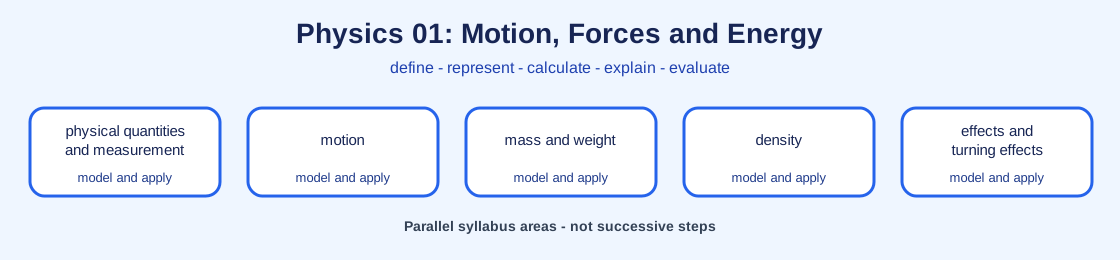
Physics P1 of Cambridge IGCSE Co-ordinated Sciences 0654 covers physical quantities and measurement, motion, mass and weight, density, effects and turning effects of forces, centre of gravity, energy, work, power, energy resources and pressure. Momentum is not a named P1 outcome in the 2025 to 2027 syllabus and is therefore not taught here.
Physical Quantities and Measurement
Q: What does Cambridge IGCSE Physics Notes 1.1: Physical Quantities and Measurement cover? A: It follows official Cambridge Physics section 1.1 for syllabuses 0625 and 0972, with Core ideas separated from Supplement depth.
Measurement turns a physical idea into a value with a unit, while scalar and vector classification determines how quantities can be combined.
The ideas that organise this section
Choose an instrument whose range and scale suit the quantity.
Measure repeated small intervals or distances together, then divide to reduce percentage uncertainty.
Scalars have magnitude; vectors have magnitude and direction.
Core route
Core candidates should be ready to describe, calculate, interpret, and apply the following:
Use rulers, measuring cylinders, clocks, and digital timers appropriately.
Find an average value by measuring multiples, such as several pendulum oscillations.
Supplement route
Extended candidates study all Core content and add the following depth:
Classify the syllabus quantities as scalars or vectors.
Determine the resultant of two perpendicular forces or velocities graphically or by calculation.
Formula route
Relationship: resultant squared = first component squared + second component squared.
Write the relationship before substituting. Convert units first, keep extra figures during working, and round only the final answer to sensible precision.
Worked reasoning example
Timing twenty oscillations and dividing by twenty gives a more reliable period than timing one oscillation because the same reaction-time error is a smaller fraction of the total interval.
For explanation questions, state the physical principle, apply it to the named system, then give the consequence. A formula or keyword by itself is not a complete explanation.
A reliable answer method
Identify the quantity, law, graph feature, or physical model being tested.
Check this topic from memory
Attempt the matching topic bank before reopening the notes. Use each missed idea to decide what to review next.
Mark a positive direction or label the diagram when direction matters.
Write the equation or principle before inserting data.
Keep units consistent and show the main substitution.
Check whether the magnitude, direction, trend, and unit are physically reasonable.
Common mistakes
Recording a number without a unit.
Calling speed a vector or velocity a scalar.
Adding perpendicular vector magnitudes directly.
Motion
Q: What does Cambridge IGCSE Physics Notes 1.2: Motion cover? A: It follows official Cambridge Physics section 1.2 for syllabuses 0625 and 0972, with Core ideas separated from Supplement depth.
Motion questions translate between words, equations, and graphs. Gradient describes a rate of change, while area under a speed-time graph gives distance travelled.
The ideas that organise this section
Speed is distance travelled per unit time; velocity also includes direction.
The gradient of a distance-time graph gives speed, and the gradient of a speed-time graph gives acceleration.
Terminal velocity occurs when drag balances weight so resultant force and acceleration are zero.
Core route
Core candidates should be ready to describe, calculate, interpret, and apply the following:
Calculate speed and average speed and interpret distance-time and speed-time graphs.
Use the area under a speed-time graph for constant-speed or constant-acceleration motion.
Recall that gravitational acceleration near Earth's surface is approximately constant.
Supplement route
Extended candidates study all Core content and add the following depth:
Calculate acceleration from velocity change and graph gradient.
Describe free fall with and without resistance, including terminal velocity.
Use negative acceleration consistently when velocity decreases in the chosen positive direction.
Formula route
Relationship: speed = distance / time.
Relationship: acceleration = change in velocity / time.
Write the relationship before substituting. Convert units first, keep extra figures during working, and round only the final answer to sensible precision.
Worked reasoning example
On a speed-time graph, a horizontal line above zero means constant speed, not rest. Rest is represented by zero speed.
For explanation questions, state the physical principle, apply it to the named system, then give the consequence. A formula or keyword by itself is not a complete explanation.
A reliable answer method
Identify the quantity, law, graph feature, or physical model being tested.
Mark a positive direction or label the diagram when direction matters.
Write the equation or principle before inserting data.
Keep units consistent and show the main substitution.
Check whether the magnitude, direction, trend, and unit are physically reasonable.
Common mistakes
Using graph height when the question asks for gradient.
Finding distance from a speed-time graph without calculating area.
Saying forces are absent at terminal velocity.
Mass and Weight
Q: What does Cambridge IGCSE Physics Notes 1.3: Mass and Weight cover? A: It follows official Cambridge Physics section 1.3 for syllabuses 0625 and 0972, with Core ideas separated from Supplement depth.
Mass describes the quantity of matter, while weight is the gravitational force acting on that mass in a gravitational field.
The ideas that organise this section
Mass is measured in kilograms and does not depend on local gravitational field strength.
Weight is a force measured in newtons and changes when gravitational field strength changes.
A balance compares masses, while a force meter measures force.
Core route
Core candidates should be ready to describe, calculate, interpret, and apply the following:
Distinguish mass and weight by meaning, unit, and measuring instrument.
Use gravitational field strength as force per unit mass.
Compare weights and masses using appropriate apparatus.
Supplement route
Extended candidates study all Core content and add the following depth:
Describe weight as the effect of a gravitational field on mass.
Apply the relationship consistently when either mass, weight, or field strength changes.
Formula route
Relationship: weight = mass x gravitational field strength.
Write the relationship before substituting. Convert units first, keep extra figures during working, and round only the final answer to sensible precision.
Worked reasoning example
An astronaut's mass remains the same on the Moon, but the astronaut's weight is lower because the Moon's gravitational field strength is lower.
For explanation questions, state the physical principle, apply it to the named system, then give the consequence. A formula or keyword by itself is not a complete explanation.
A reliable answer method
Identify the quantity, law, graph feature, or physical model being tested.
Mark a positive direction or label the diagram when direction matters.
Write the equation or principle before inserting data.
Keep units consistent and show the main substitution.
Check whether the magnitude, direction, trend, and unit are physically reasonable.
Common mistakes
Giving weight in kilograms.
Saying mass becomes zero in space.
Using gravitational field strength without checking its unit.
Density
Q: What does Cambridge IGCSE Physics Notes 1.4: Density cover? A: It follows official Cambridge Physics section 1.4 for syllabuses 0625 and 0972, with Core ideas separated from Supplement depth.
Density compares mass with occupied volume and can be measured by pairing a mass measurement with the correct volume method.
The ideas that organise this section
Use dimensions for regular solids and liquid displacement for irregular solids that sink.
Keep mass and volume units compatible before division.
For non-mixing substances, the lower-density material floats above the higher-density material.
Core route
Core candidates should be ready to describe, calculate, interpret, and apply the following:
Calculate density from mass and volume.
Describe density measurements for a liquid, regular solid, and irregular solid.
Use density data to predict whether an object floats.
Supplement route
Extended candidates study all Core content and add the following depth:
Use density data to predict the ordering of non-mixing liquid layers.
Select and justify a method when the object shape or behaviour makes direct measurement difficult.
Formula route
Relationship: density = mass / volume.
Write the relationship before substituting. Convert units first, keep extra figures during working, and round only the final answer to sensible precision.
Worked reasoning example
An irregular stone's volume is the rise in measuring-cylinder reading after full submersion, provided trapped air and splashing are avoided.
For explanation questions, state the physical principle, apply it to the named system, then give the consequence. A formula or keyword by itself is not a complete explanation.
A reliable answer method
Identify the quantity, law, graph feature, or physical model being tested.
Mark a positive direction or label the diagram when direction matters.
Write the equation or principle before inserting data.
Keep units consistent and show the main substitution.
Check whether the magnitude, direction, trend, and unit are physically reasonable.
Common mistakes
Using the final water reading as the object's volume instead of the change.
Mixing grams with cubic metres.
Assuming every object denser than air sinks in water without comparing with water's density.
Forces, Moments and Centre of Gravity
Q: What does Cambridge IGCSE Physics Notes 1.5: Forces, Moments and Centre of Gravity cover? A: It follows official Cambridge Physics section 1.5 for syllabuses 0625 and 0972, with Core ideas separated from Supplement depth.
Forces change motion or shape. Their combined translational effect is described by resultant force, while their turning effect is described by moment.
The ideas that organise this section
Zero resultant force means no acceleration, not necessarily no motion.
Moment depends on force and perpendicular distance from the pivot.
Stability improves when the centre of gravity is lower and the base is wider.
Core route
Core candidates should be ready to describe, calculate, interpret, and apply the following:
Describe force effects, friction, drag, load-extension behaviour, and resultants along one line.
Calculate moments and apply the principle of moments to equilibrium.
Determine centre of gravity experimentally and relate it to stability.
Supplement route
Extended candidates study all Core content and add the following depth:
Use spring constant and limit of proportionality.
Apply resultant force to acceleration and describe circular motion qualitatively.
Resolve or combine forces where the syllabus permits vector treatment.
Formula route
Relationship: force = mass x acceleration.
Relationship: spring constant = force / extension.
Relationship: moment = force x perpendicular distance.
Write the relationship before substituting. Convert units first, keep extra figures during working, and round only the final answer to sensible precision.
Worked reasoning example
A smaller force can balance a larger force if it acts farther from the pivot, because equilibrium depends on equal clockwise and anticlockwise moments.
For explanation questions, state the physical principle, apply it to the named system, then give the consequence. A formula or keyword by itself is not a complete explanation.
A reliable answer method
Identify the quantity, law, graph feature, or physical model being tested.
Mark a positive direction or label the diagram when direction matters.
Write the equation or principle before inserting data.
Keep units consistent and show the main substitution.
Check whether the magnitude, direction, trend, and unit are physically reasonable.
Common mistakes
Using the full lever length instead of perpendicular distance.
Saying an object at constant speed has no forces acting on it.
Extending a straight load-extension line beyond the limit of proportionality.
Energy, Work and Power
Q: What does Cambridge IGCSE Physics Notes 1.7: Energy, Work and Power cover? A: It follows official Cambridge Physics section 1.7 for syllabuses 0625 and 0972, with Core ideas separated from Supplement depth.
Energy is conserved through transfers between stores, while work measures energy transferred by a force and power measures how quickly transfer occurs.
The ideas that organise this section
Describe an energy transfer by naming the initial store, transfer pathway, and final stores.
Useful output plus dissipated output equals the total input.
Resource comparisons require both physical performance and environmental or practical consequences.
Core route
Core candidates should be ready to describe, calculate, interpret, and apply the following:
Identify energy stores and transfer pathways and apply conservation.
Calculate work, kinetic energy, gravitational potential energy, power, and efficiency in direct situations.
Compare renewable and non-renewable energy resources using advantages and disadvantages.
Supplement route
Extended candidates study all Core content and add the following depth:
Use energy relationships in multi-step problems and explain dissipation.
Evaluate resource choices using reliability, response time, environmental effects, and location.
Connect power to both work done and energy transferred per unit time.
Formula route
Relationship: work done = force x distance moved in force direction.
Relationship: kinetic energy = 0.5 x mass x speed squared.
Relationship: gravitational energy change = mass x gravitational field strength x height.
Relationship: power = work done / time.
Relationship: efficiency = useful output / total input.
Write the relationship before substituting. Convert units first, keep extra figures during working, and round only the final answer to sensible precision.
Worked reasoning example
Two motors may lift the same load through the same height and transfer the same useful energy, but the motor that does it in less time has greater power.
For explanation questions, state the physical principle, apply it to the named system, then give the consequence. A formula or keyword by itself is not a complete explanation.
A reliable answer method
Identify the quantity, law, graph feature, or physical model being tested.
Mark a positive direction or label the diagram when direction matters.
Write the equation or principle before inserting data.
Keep units consistent and show the main substitution.
Check whether the magnitude, direction, trend, and unit are physically reasonable.
Common mistakes
Saying energy is used up instead of transferred or dissipated.
Using total output rather than useful output in efficiency.
Treating power as the same quantity as energy.
Pressure
Q: What does Cambridge IGCSE Physics Notes 1.8: Pressure cover? A: It follows official Cambridge Physics section 1.8 for syllabuses 0625 and 0972, with Core ideas separated from Supplement depth.
Pressure describes how concentrated a force is over area, while liquid pressure increases with depth and liquid density.
The ideas that organise this section
For the same force, a smaller contact area produces greater pressure.
At the same depth, a denser liquid produces greater pressure.
A pressure difference can produce a resultant force and fluid movement.
Core route
Core candidates should be ready to describe, calculate, interpret, and apply the following:
Calculate pressure from normal force and area.
Describe qualitatively how liquid pressure varies with depth and density.
Explain familiar effects of atmospheric pressure.
Supplement route
Extended candidates study all Core content and add the following depth:
Calculate the pressure due to a liquid column.
Apply pressure differences to manometers, barometers, or related contexts when data are supplied.
Formula route
Relationship: pressure = force / area.
Relationship: liquid pressure = density x gravitational field strength x depth.
Write the relationship before substituting. Convert units first, keep extra figures during working, and round only the final answer to sensible precision.
Worked reasoning example
A sharp knife cuts more easily because the same force acts over a smaller area, producing greater pressure at the edge.
For explanation questions, state the physical principle, apply it to the named system, then give the consequence. A formula or keyword by itself is not a complete explanation.
A reliable answer method
Identify the quantity, law, graph feature, or physical model being tested.
Mark a positive direction or label the diagram when direction matters.
Write the equation or principle before inserting data.
Keep units consistent and show the main substitution.
Check whether the magnitude, direction, trend, and unit are physically reasonable.
Common mistakes
Using total surface area when only the contact area matters.
Confusing depth below the surface with total container height.
Claiming liquid pressure depends on container shape.
Worked application
A 1200 kg car accelerates from rest to 15 m/s in 6.0 s. Its acceleration is 2.5 m/s squared, so the resultant force is 3000 N. At 15 m/s its kinetic energy is 135000 J. If braking removes this energy over 45 m, the average braking force is 3000 N because work done equals force times distance. These answers describe different links in one model: the resultant force changes velocity, the moving car stores kinetic energy, and braking transfers that energy. A complete answer keeps the vector direction of force separate from the scalar energy calculation and states every unit.
Common misconceptions and corrections
Using a remembered keyword without its physical link. State the principle, apply it to the named system and give the resulting change.
Substituting before checking units. Convert to a consistent set of units, write the relationship and then insert values.
Treating a diagram or graph as decoration. Label quantities, directions and scales so the representation carries evidence used in the answer.
Adding ideas from another syllabus topic. Answer within the named P1 outcomes unless the question explicitly supplies a cross-topic context.
Assessment guidance
For calculations, identify the required relationship, convert units, substitute with a clear line of working and give the final unit. Graph questions require the correct gradient or area interpretation rather than a description of shape alone. Force diagrams need labelled arrows whose directions and relative sizes match the situation. Moment questions use perpendicular distance from pivot to line of action. Energy-resource comparisons should pair an advantage with a relevant limitation, not simply label one resource good or bad. Pressure explanations must connect force, area and the physical consequence. Do not introduce momentum into a P1 syllabus-recall answer.
Retrieval practice
Reconstruct the distance-time and speed-time graph rules, then solve one acceleration and one distance-from-area problem. Compare mass with weight, calculate density for a regular and an irregular object, and draw a force diagram. Practise one moment equilibrium, one kinetic or gravitational energy transfer, one power calculation, one energy-resource comparison and one solid-pressure question.
Theory and practical ownership
This theory note owns the physical models, relationships, calculations and explanations in P1. The dedicated Co-ordinated Sciences practical series owns apparatus choice, measurement procedure, tables, graph construction, uncertainty, safety and evaluation.