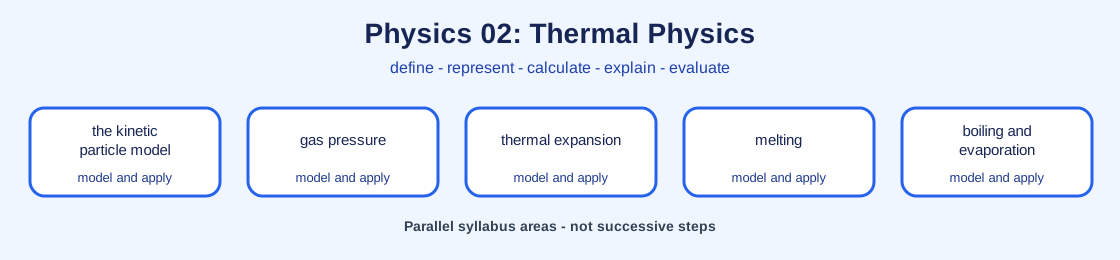
Physics P2 of Cambridge IGCSE Co-ordinated Sciences 0654 covers the kinetic particle model, gas pressure, thermal expansion, melting, boiling and evaporation, conduction, convection, radiation and consequences of thermal energy transfer.
Kinetic Particle Model
Q: What does Cambridge IGCSE Physics Notes 2.1: Kinetic Particle Model cover? A: It follows official Cambridge Physics section 2.1 for syllabuses 0625 and 0972, with Core ideas separated from Supplement depth.
The kinetic particle model connects microscopic particle motion and collisions to states of matter, diffusion, gas pressure, and temperature.
The ideas that organise this section
State properties follow from particle spacing, arrangement, forces, and motion.
Gas pressure results from particle collisions with container walls.
Thermodynamic temperature is linked to average particle kinetic energy.
Core route
Core candidates should be ready to describe, calculate, interpret, and apply the following:
Describe solids, liquids, and gases using the particle model.
Use Brownian motion as evidence for molecular motion.
Explain gas pressure and qualitative effects of temperature and volume changes.
Supplement route
Extended candidates study all Core content and add the following depth:
Use the absolute temperature scale and convert between Celsius and kelvin when required.
Explain pressure changes through collision rate and momentum change at the walls.
Link temperature to average kinetic energy without treating every particle as having the same speed.
Formula route
Relationship: temperature in kelvin = temperature in degrees Celsius + 273.
Write the relationship before substituting. Convert units first, keep extra figures during working, and round only the final answer to sensible precision.
Worked reasoning example
Heating a sealed rigid gas raises pressure because particles move faster and collide with the walls more frequently and with greater momentum change.
For explanation questions, state the physical principle, apply it to the named system, then give the consequence. A formula or keyword by itself is not a complete explanation.
A reliable answer method
Check this topic from memory
Attempt the matching topic bank before reopening the notes. Use each missed idea to decide what to review next.
Identify the quantity, law, graph feature, or physical model being tested.
Mark a positive direction or label the diagram when direction matters.
Write the equation or principle before inserting data.
Keep units consistent and show the main substitution.
Check whether the magnitude, direction, trend, and unit are physically reasonable.
Common mistakes
Saying particles expand on heating.
Using degrees with the kelvin unit.
Claiming particles stop moving at zero degrees Celsius.
Thermal Properties and Temperature
Q: What does Cambridge IGCSE Physics Notes 2.2: Thermal Properties and Temperature cover? A: It follows official Cambridge Physics section 2.2 for syllabuses 0625 and 0972, with Core ideas separated from Supplement depth.
Thermal properties describe how materials expand, store internal energy, and change state when energy is transferred.
The ideas that organise this section
Thermal expansion follows increased particle separation, not particle growth.
Specific heat capacity measures energy needed per unit mass per unit temperature rise.
Evaporation occurs at the surface and causes cooling because higher-energy particles escape.
Core route
Core candidates should be ready to describe, calculate, interpret, and apply the following:
Describe expansion and its applications or hazards.
Explain melting, boiling, evaporation, and cooling using particles.
Compare thermometer sensitivity, range, and linearity in context.
Supplement route
Extended candidates study all Core content and add the following depth:
Calculate energy changes using mass, specific heat capacity, and temperature change.
Explain evaporation rate using temperature, surface area, and air movement.
Interpret heating and cooling behaviour where energy changes internal energy without changing temperature during a state change.
Formula route
Relationship: energy transferred = mass x specific heat capacity x temperature change.
Write the relationship before substituting. Convert units first, keep extra figures during working, and round only the final answer to sensible precision.
Worked reasoning example
Water is useful as a coolant because its high specific heat capacity allows it to absorb substantial energy for a modest temperature rise.
For explanation questions, state the physical principle, apply it to the named system, then give the consequence. A formula or keyword by itself is not a complete explanation.
A reliable answer method
Identify the quantity, law, graph feature, or physical model being tested.
Mark a positive direction or label the diagram when direction matters.
Write the equation or principle before inserting data.
Keep units consistent and show the main substitution.
Check whether the magnitude, direction, trend, and unit are physically reasonable.
Common mistakes
Using final temperature instead of temperature change.
Treating boiling and evaporation as identical processes.
Saying temperature rises throughout melting.
Transfer of Thermal Energy
Q: What does Cambridge IGCSE Physics Notes 2.3: Transfer of Thermal Energy cover? A: It follows official Cambridge Physics section 2.3 for syllabuses 0625 and 0972, with Core ideas separated from Supplement depth.
Thermal energy moves by conduction, convection, and radiation. The dominant pathway depends on material, particle mobility, temperature difference, and surface properties.
The ideas that organise this section
Conduction transfers energy through particle interactions and, in metals, mobile electrons.
Convection requires bulk movement of a fluid caused by density differences.
Infrared radiation needs no medium and is affected by surface colour and texture.
Core route
Core candidates should be ready to describe, calculate, interpret, and apply the following:
Describe conduction, convection, and infrared radiation and identify them in familiar situations.
Compare good and poor conductors and relate them to uses.
Explain insulation choices in buildings, clothing, and containers.
Supplement route
Extended candidates study all Core content and add the following depth:
Explain metallic conduction using free electrons.
Relate emission and absorption rates to dull black and shiny light surfaces.
Analyse systems in which several transfer pathways act simultaneously.
Formula route
This section is mainly qualitative. Use precise definitions, labelled diagrams, and cause-and-effect explanations.
Write the relationship before substituting. Convert units first, keep extra figures during working, and round only the final answer to sensible precision.
Worked reasoning example
A vacuum flask reduces conduction and convection across the evacuated gap, while shiny surfaces reduce infrared transfer.
For explanation questions, state the physical principle, apply it to the named system, then give the consequence. A formula or keyword by itself is not a complete explanation.
A reliable answer method
Identify the quantity, law, graph feature, or physical model being tested.
Mark a positive direction or label the diagram when direction matters.
Write the equation or principle before inserting data.
Keep units consistent and show the main substitution.
Check whether the magnitude, direction, trend, and unit are physically reasonable.
Common mistakes
Calling convection a process in solids.
Saying cold flows into an object.
Assuming a shiny surface is always the best absorber.
Worked application
A covered metal cup and a dull black cup contain equal masses of hot water at the same initial temperature. The dull black surface is the better infrared emitter, so it normally cools faster when other conditions are controlled. If both cups lose 8400 J and each contains 0.10 kg of water, a specific heat capacity calculation would relate the energy change to the temperature fall, but the syllabus explanation still needs the mechanism: energy transfers from faster-moving particles, through the container and then to the surroundings by conduction, convection and radiation. A lid reduces convection and evaporation from the exposed water surface, so it must be the same for both cups.
Common misconceptions and corrections
Using a remembered keyword without its physical link. State the principle, apply it to the named system and give the resulting change.
Substituting before checking units. Convert to a consistent set of units, write the relationship and then insert values.
Treating a diagram or graph as decoration. Label quantities, directions and scales so the representation carries evidence used in the answer.
Adding ideas from another syllabus topic. Answer within the named P2 outcomes unless the question explicitly supplies a cross-topic context.
Assessment guidance
Particle-model answers should describe spacing, arrangement and motion rather than saying particles themselves expand or melt. For evaporation, link escape of the more energetic surface particles to a lower average kinetic energy of those remaining. Conduction explanations distinguish mobile electrons in metals from vibrations passed between neighbouring particles. Convection requires heating, expansion, reduced density and bulk motion in the correct order. Radiation questions compare surface colour and texture while keeping area and temperature controlled. When evaluating insulation, identify the transfer pathway that each feature reduces and avoid claiming that heat is trapped completely.
Retrieval practice
Draw particle diagrams for solid, liquid and gas and explain pressure in a gas. Rehearse expansion and one application, compare boiling with evaporation, and explain evaporative cooling. Then trace conduction through a metal, build a convection cycle, compare good and poor infrared emitters, and evaluate two features of a vacuum flask or insulated building.
Theory and practical ownership
This theory note owns the physical models, relationships, calculations and explanations in P2. The dedicated Co-ordinated Sciences practical series owns apparatus choice, measurement procedure, tables, graph construction, uncertainty, safety and evaluation.