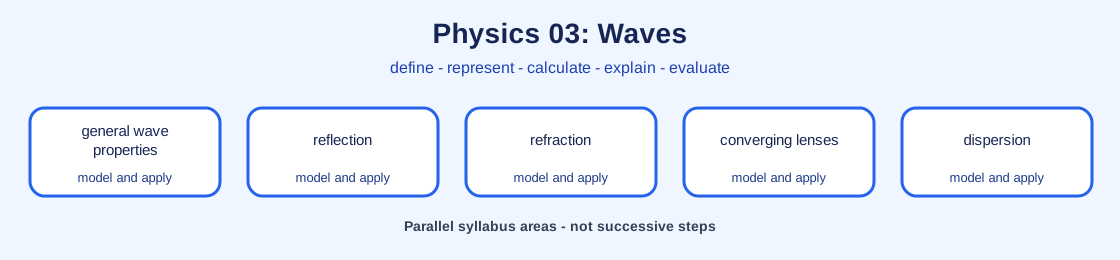
Physics P3 of Cambridge IGCSE Co-ordinated Sciences 0654 covers general wave properties, reflection, refraction, converging lenses, dispersion, the electromagnetic spectrum and sound.
General Properties of Waves
Q: What does Cambridge IGCSE Physics Notes 3.1: General Properties of Waves cover? A: It follows official Cambridge Physics section 3.1 for syllabuses 0625 and 0972, with Core ideas separated from Supplement depth.
Waves transfer energy without net transfer of matter and are described by amplitude, wavelength, frequency, period, and speed.
The ideas that organise this section
Classify waves by the direction of vibration relative to travel.
Frequency is set by the source, while speed and wavelength respond to the medium.
Diffraction is most noticeable when wavelength is comparable with the gap or obstacle size.
Core route
Core candidates should be ready to describe, calculate, interpret, and apply the following:
Describe transverse and longitudinal waves and use wavefront diagrams.
Calculate wave speed, frequency, wavelength, and period.
Describe reflection, refraction, and diffraction using ripple-tank or other examples.
Supplement route
Extended candidates study all Core content and add the following depth:
Explain refraction as a speed change while frequency remains constant.
Relate diffraction strength to wavelength and gap size.
Use displacement-distance and displacement-time graphs without confusing their horizontal axes.
Formula route
Relationship: wave speed = frequency x wavelength.
Relationship: frequency = 1 / period.
Write the relationship before substituting. Convert units first, keep extra figures during working, and round only the final answer to sensible precision.
Worked reasoning example
When water waves enter shallower water, their speed and wavelength decrease while frequency stays fixed by the source.
For explanation questions, state the physical principle, apply it to the named system, then give the consequence. A formula or keyword by itself is not a complete explanation.
A reliable answer method
Identify the quantity, law, graph feature, or physical model being tested.
Check this topic from memory
Attempt the matching topic bank before reopening the notes. Use each missed idea to decide what to review next.
Mark a positive direction or label the diagram when direction matters.
Write the equation or principle before inserting data.
Keep units consistent and show the main substitution.
Check whether the magnitude, direction, trend, and unit are physically reasonable.
Common mistakes
Saying particles travel from source to receiver with the wave.
Changing frequency at a boundary.
Using amplitude as wavelength.
Light
Q: What does Cambridge IGCSE Physics Notes 3.2: Light cover? A: It follows official Cambridge Physics section 3.2 for syllabuses 0625 and 0972, with Core ideas separated from Supplement depth.
Ray diagrams represent how light changes direction at surfaces and through lenses, allowing image position and optical behaviour to be predicted.
The ideas that organise this section
Measure angles from the normal, not from the surface.
Refraction occurs because speed changes at a boundary; frequency remains constant.
A converging lens can form real or virtual images depending on object position.
Core route
Core candidates should be ready to describe, calculate, interpret, and apply the following:
Apply the law of reflection and construct plane-mirror ray diagrams.
Describe refraction, converging lenses, image properties, and dispersion.
Use principal rays to locate images in standard lens arrangements.
Supplement route
Extended candidates study all Core content and add the following depth:
Calculate refractive index and critical angle and explain total internal reflection.
Use lens terminology and magnification quantitatively where required.
Explain optical fibres and other applications of internal reflection.
Formula route
Relationship: refractive index = sine of incidence angle / sine of refraction angle.
Write the relationship before substituting. Convert units first, keep extra figures during working, and round only the final answer to sensible precision.
Worked reasoning example
Light entering glass from air bends toward the normal because its speed decreases. On leaving glass for air it bends away from the normal.
For explanation questions, state the physical principle, apply it to the named system, then give the consequence. A formula or keyword by itself is not a complete explanation.
A reliable answer method
Identify the quantity, law, graph feature, or physical model being tested.
Mark a positive direction or label the diagram when direction matters.
Write the equation or principle before inserting data.
Keep units consistent and show the main substitution.
Check whether the magnitude, direction, trend, and unit are physically reasonable.
Common mistakes
Measuring angles from the boundary.
Drawing rays that bend without changing speed.
Calling every enlarged lens image real.
Electromagnetic Spectrum
Q: What does Cambridge IGCSE Physics Notes 3.3: Electromagnetic Spectrum cover? A: It follows official Cambridge Physics section 3.3 for syllabuses 0625 and 0972, with Core ideas separated from Supplement depth.
All electromagnetic waves are transverse and travel at the same speed in vacuum, but their frequencies determine their interactions, uses, and hazards.
The ideas that organise this section
Learn the spectrum order once, then reason inversely between wavelength and frequency.
Match a use to a physical property rather than memorising an isolated pairing.
Higher-frequency radiation can carry greater photon energy and may ionise matter.
Core route
Core candidates should be ready to describe, calculate, interpret, and apply the following:
State the spectrum order and common uses and hazards.
Recall that all electromagnetic waves travel at the same speed in vacuum.
Relate wavelength and frequency using wave speed.
Supplement route
Extended candidates study all Core content and add the following depth:
Explain communication choices through diffraction, penetration, bandwidth, atmosphere, and satellite paths.
Distinguish heating effects from ionising damage.
Apply spectrum information to unfamiliar technology or safety contexts.
Formula route
Relationship: wave speed = frequency x wavelength.
Write the relationship before substituting. Convert units first, keep extra figures during working, and round only the final answer to sensible precision.
Worked reasoning example
Radio waves are useful for long-range broadcasting because suitable wavelengths diffract around obstacles, while microwaves support line-of-sight satellite communication.
For explanation questions, state the physical principle, apply it to the named system, then give the consequence. A formula or keyword by itself is not a complete explanation.
A reliable answer method
Identify the quantity, law, graph feature, or physical model being tested.
Mark a positive direction or label the diagram when direction matters.
Write the equation or principle before inserting data.
Keep units consistent and show the main substitution.
Check whether the magnitude, direction, trend, and unit are physically reasonable.
Common mistakes
Saying electromagnetic waves require a medium.
Putting ultraviolet below visible light in frequency.
Calling all electromagnetic radiation ionising.
Sound
Q: What does Cambridge IGCSE Physics Notes 3.4: Sound cover? A: It follows official Cambridge Physics section 3.4 for syllabuses 0625 and 0972, with Core ideas separated from Supplement depth.
Sound is a longitudinal mechanical wave whose frequency determines pitch and whose amplitude relates to loudness.
The ideas that organise this section
Sound needs a medium because it is transmitted through particle vibrations.
Frequency and amplitude describe different perceptions: pitch and loudness.
Echo timing measures a round trip, so the one-way distance is half the total path.
Core route
Core candidates should be ready to describe, calculate, interpret, and apply the following:
Describe compressions and rarefactions and identify sound as longitudinal.
Relate frequency to pitch and amplitude to loudness.
Use echo or direct-timing methods to determine sound speed.
Supplement route
Extended candidates study all Core content and add the following depth:
Interpret oscilloscope traces for relative frequency and amplitude.
Explain why sound speed differs between media using particle interactions.
Apply reflection and ultrasound principles to measurement or imaging contexts.
Formula route
Relationship: speed = distance / time.
Relationship: frequency = 1 / period.
Write the relationship before substituting. Convert units first, keep extra figures during working, and round only the final answer to sensible precision.
Worked reasoning example
If an echo returns after a measured interval, the sound has travelled to the reflector and back, so the distance to the reflector uses half the total travel distance.
For explanation questions, state the physical principle, apply it to the named system, then give the consequence. A formula or keyword by itself is not a complete explanation.
A reliable answer method
Identify the quantity, law, graph feature, or physical model being tested.
Mark a positive direction or label the diagram when direction matters.
Write the equation or principle before inserting data.
Keep units consistent and show the main substitution.
Check whether the magnitude, direction, trend, and unit are physically reasonable.
Common mistakes
Using amplitude to describe pitch.
Forgetting the return journey in an echo calculation.
Saying sound travels through a vacuum.
Worked application
Water waves travel at 0.24 m/s with frequency 6.0 Hz, so their wavelength is 0.040 m from wave speed equals frequency times wavelength. When they enter shallower water, their speed and wavelength decrease while frequency stays fixed by the source. If the wavefront meets the boundary at an angle, the slower part changes direction first and the wave refracts. The same reasoning structure applies to light at a boundary, although the material and speed change differ. A ray diagram must show the normal, angles measured from that normal and the refracted direction. Stating only that the wave bends does not explain why its direction changes.
Common misconceptions and corrections
Using a remembered keyword without its physical link. State the principle, apply it to the named system and give the resulting change.
Substituting before checking units. Convert to a consistent set of units, write the relationship and then insert values.
Treating a diagram or graph as decoration. Label quantities, directions and scales so the representation carries evidence used in the answer.
Adding ideas from another syllabus topic. Answer within the named P3 outcomes unless the question explicitly supplies a cross-topic context.
Assessment guidance
Wave calculations require consistent units and a clear distinction between frequency, wavelength, amplitude and speed. Ray diagrams should use a ruler, arrows and normals, with angles measured from the normal. For a converging lens, distinguish real images that can be formed on a screen from virtual images that cannot. Electromagnetic-spectrum questions need the correct order, common wave speed in a vacuum and matched uses or hazards. Sound explanations should connect frequency to pitch and amplitude to loudness. When describing an experiment, state how distance and time are measured and how repeats reduce random error.
Retrieval practice
Define transverse and longitudinal waves and label amplitude and wavelength. Solve three wave-equation calculations, sketch reflection and refraction, and draw converging-lens rays for a real and a virtual image. Rebuild the electromagnetic spectrum in order with one use and hazard for each relevant region, then explain pitch, loudness, echoes and a method for measuring sound speed.
Theory and practical ownership
This theory note owns the physical models, relationships, calculations and explanations in P3. The dedicated Co-ordinated Sciences practical series owns apparatus choice, measurement procedure, tables, graph construction, uncertainty, safety and evaluation.