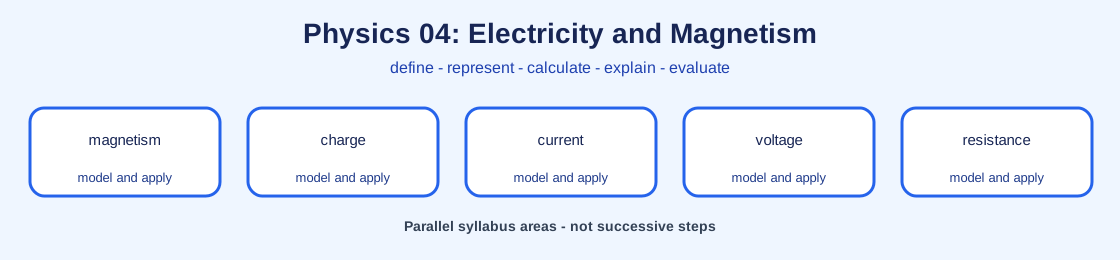
Physics P4 of Cambridge IGCSE Co-ordinated Sciences 0654 covers magnetism, charge, current, voltage, resistance, electrical energy and power, circuit components, series and parallel rules, electrical safety, induction, generators, electromagnets, motors and transformers.
Simple Magnetism
Q: What does Cambridge IGCSE Physics Notes 4.1: Simple Magnetism cover? A: It follows official Cambridge Physics section 4.1 for syllabuses 0625 and 0972, with Core ideas separated from Supplement depth.
Magnetic fields describe forces around magnets and currents, while material behaviour determines whether magnetism is temporary or retained.
The ideas that organise this section
Field direction outside a magnet is conventionally from north to south.
Induced magnetism can create attraction without the second object initially being a magnet.
Soft magnetic materials suit electromagnets; hard magnetic materials suit permanent magnets.
Core route
Core candidates should be ready to describe, calculate, interpret, and apply the following:
Describe attraction and repulsion and draw magnetic field patterns.
Use a plotting compass or iron filings to investigate a field.
Distinguish magnetic and non-magnetic materials and temporary and permanent behaviour.
Supplement route
Extended candidates study all Core content and add the following depth:
Explain induced magnetism and the choice of magnetic material for a device.
Interpret field strength from field-line spacing without treating lines as physical objects.
Formula route
This section is mainly qualitative. Use precise definitions, labelled diagrams, and cause-and-effect explanations.
Write the relationship before substituting. Convert units first, keep extra figures during working, and round only the final answer to sensible precision.
Worked reasoning example
An unmagnetised iron nail can be attracted to a magnet because the external field induces opposite polarity at the nearer end.
For explanation questions, state the physical principle, apply it to the named system, then give the consequence. A formula or keyword by itself is not a complete explanation.
A reliable answer method
Identify the quantity, law, graph feature, or physical model being tested.
Check this topic from memory
Attempt the matching topic bank before reopening the notes. Use each missed idea to decide what to review next.
Mark a positive direction or label the diagram when direction matters.
Write the equation or principle before inserting data.
Keep units consistent and show the main substitution.
Check whether the magnitude, direction, trend, and unit are physically reasonable.
Common mistakes
Using attraction alone as proof that two objects are permanent magnets.
Drawing field lines that cross.
Reversing the external field direction.
Electrical Quantities
Q: What does Cambridge IGCSE Physics Notes 4.2: Electrical Quantities cover? A: It follows official Cambridge Physics section 4.2 for syllabuses 0625 and 0972, with Core ideas separated from Supplement depth.
Electrical quantities describe how charge moves and how energy is transferred: current is charge flow rate, voltage is energy per charge, and resistance links voltage to current.
The ideas that organise this section
Conventional current direction is opposite to electron flow in metals.
Electromotive force is energy supplied per charge; potential difference is energy transferred per charge in a component.
Resistance depends on the component and conditions, so not every current-voltage graph is linear.
Core route
Core candidates should be ready to describe, calculate, interpret, and apply the following:
Calculate charge, current, voltage, resistance, electrical energy, and power.
Describe current in metals and the effect of changing resistance or voltage.
Interpret simple current-voltage data and household energy use.
Supplement route
Extended candidates study all Core content and add the following depth:
Distinguish electromotive force from potential difference through energy transfer.
Explain non-ohmic behaviour through temperature or component response.
Apply electrical relationships across unfamiliar devices and data sets.
Formula route
Relationship: current = charge / time.
Relationship: voltage = energy transferred / charge.
Relationship: resistance = voltage / current.
Relationship: electrical power = current x voltage.
Relationship: electrical energy = power x time.
Write the relationship before substituting. Convert units first, keep extra figures during working, and round only the final answer to sensible precision.
Worked reasoning example
A filament lamp's resistance rises as it heats, so current no longer increases in direct proportion to voltage.
For explanation questions, state the physical principle, apply it to the named system, then give the consequence. A formula or keyword by itself is not a complete explanation.
A reliable answer method
Identify the quantity, law, graph feature, or physical model being tested.
Mark a positive direction or label the diagram when direction matters.
Write the equation or principle before inserting data.
Keep units consistent and show the main substitution.
Check whether the magnitude, direction, trend, and unit are physically reasonable.
Common mistakes
Calling current the amount of charge rather than its rate of flow.
Assuming resistance is always constant.
Confusing power with energy consumed.
Electric Circuits
Q: What does Cambridge IGCSE Physics Notes 4.3: Electric Circuits cover? A: It follows official Cambridge Physics section 4.3 for syllabuses 0625 and 0972, with Core ideas separated from Supplement depth.
Circuit behaviour follows conservation of charge and energy: current is shared at junctions, while potential differences across components account for energy transfers.
The ideas that organise this section
Current is the same throughout a series path and divides at parallel junctions.
Series potential differences add to the supply, while parallel branches share the same potential difference.
Component resistance can respond to temperature, light, or applied voltage.
Core route
Core candidates should be ready to describe, calculate, interpret, and apply the following:
Recognise and draw standard circuit symbols.
Apply series and parallel current and voltage rules.
Describe uses of diodes, LEDs, thermistors, LDRs, relays, and variable resistors.
Supplement route
Extended candidates study all Core content and add the following depth:
Calculate combined resistance for series and parallel networks within syllabus scope.
Analyse potential-divider circuits and sensor outputs.
Explain component action from current-voltage characteristics.
Formula route
Relationship: series resistance = first resistance + second resistance + ....
Relationship: parallel conductance = sum of branch conductances.
Write the relationship before substituting. Convert units first, keep extra figures during working, and round only the final answer to sensible precision.
Worked reasoning example
Adding a resistor in parallel reduces the total circuit resistance because it creates an additional path for charge flow.
For explanation questions, state the physical principle, apply it to the named system, then give the consequence. A formula or keyword by itself is not a complete explanation.
A reliable answer method
Identify the quantity, law, graph feature, or physical model being tested.
Mark a positive direction or label the diagram when direction matters.
Write the equation or principle before inserting data.
Keep units consistent and show the main substitution.
Check whether the magnitude, direction, trend, and unit are physically reasonable.
Common mistakes
Placing an ammeter in parallel or a voltmeter in series.
Saying current is used up by components.
Assuming series and parallel resistance rules are interchangeable.
Electrical Safety
Q: What does Cambridge IGCSE Physics Notes 4.4: Electrical Safety cover? A: It follows official Cambridge Physics section 4.4 for syllabuses 0625 and 0972, with Core ideas separated from Supplement depth.
Electrical safety devices limit current or provide a low-resistance fault path so exposed conducting parts do not remain dangerously live.
The ideas that organise this section
The live wire presents the main shock hazard because it is at high potential relative to earth.
A fuse or circuit breaker must interrupt the live connection when current becomes excessive.
Earthing and double insulation are alternative protection strategies for different appliance constructions.
Core route
Core candidates should be ready to describe, calculate, interpret, and apply the following:
Identify live, neutral, and earth functions and common electrical hazards.
Explain fuse and circuit-breaker operation and select a suitable current rating.
Calculate power and energy in household devices.
Supplement route
Extended candidates study all Core content and add the following depth:
Explain how an earth wire and fuse work together during a fault.
Compare protection by earthing, double insulation, and residual-current devices when presented.
Reason about cable heating using current and resistance.
Formula route
Relationship: power = current x voltage.
Relationship: energy transferred = power x time.
Write the relationship before substituting. Convert units first, keep extra figures during working, and round only the final answer to sensible precision.
Worked reasoning example
If a live wire touches a metal case, the earth wire provides a low-resistance path, producing a large current that operates the protective device quickly.
For explanation questions, state the physical principle, apply it to the named system, then give the consequence. A formula or keyword by itself is not a complete explanation.
A reliable answer method
Identify the quantity, law, graph feature, or physical model being tested.
Mark a positive direction or label the diagram when direction matters.
Write the equation or principle before inserting data.
Keep units consistent and show the main substitution.
Check whether the magnitude, direction, trend, and unit are physically reasonable.
Common mistakes
Putting the fuse in the neutral wire.
Saying the earth wire normally carries current.
Choosing a fuse rating below the appliance's normal operating current.
Electromagnetic Effects
Q: What does Cambridge IGCSE Physics Notes 4.5: Electromagnetic Effects cover? A: It follows official Cambridge Physics section 4.5 for syllabuses 0625 and 0972, with Core ideas separated from Supplement depth.
Electromagnetic devices connect currents, magnetic fields, forces, and changing magnetic flux to generate motion or electrical energy.
The ideas that organise this section
A changing magnetic field through a conductor can induce an electromotive force.
A current-carrying conductor in a magnetic field experiences a force.
Transformers require alternating current because induction requires changing magnetic flux.
Core route
Core candidates should be ready to describe, calculate, interpret, and apply the following:
Describe electromagnetic induction and factors that increase induced voltage.
Describe magnetic fields around currents and the operation of a simple motor or generator.
Use transformer turns and voltage ideas in standard contexts.
Supplement route
Extended candidates study all Core content and add the following depth:
Apply direction rules consistently for force, field, current, and induced effects.
Calculate transformer relationships and explain high-voltage power transmission.
Link generator output to coil rotation and changing flux direction.
Formula route
Relationship: primary voltage / secondary voltage = primary turns / secondary turns.
Relationship: input power = output power for an ideal transformer.
Write the relationship before substituting. Convert units first, keep extra figures during working, and round only the final answer to sensible precision.
Worked reasoning example
Power is transmitted at high voltage so the current is smaller for the same power, reducing heating losses in transmission cables.
For explanation questions, state the physical principle, apply it to the named system, then give the consequence. A formula or keyword by itself is not a complete explanation.
A reliable answer method
Identify the quantity, law, graph feature, or physical model being tested.
Mark a positive direction or label the diagram when direction matters.
Write the equation or principle before inserting data.
Keep units consistent and show the main substitution.
Check whether the magnitude, direction, trend, and unit are physically reasonable.
Common mistakes
Claiming a stationary magnet always induces current in a stationary coil.
Using a transformer with direct current.
Reversing turns and voltage ratios.
Worked application
A 12 V supply drives 0.40 A through a lamp for 5.0 minutes. Its resistance is 30 ohms, its power is 4.8 W and the transferred electrical energy is 1440 J after converting five minutes to 300 seconds. In a parallel circuit each branch has the full 12 V supply, while branch currents add to the supply current. A fuse must be placed in the live wire and rated just above the normal operating current so excessive current melts it and disconnects the appliance. These linked statements use three different ideas: component behaviour, circuit conservation rules and protection from heating caused by an abnormally large current.
Common misconceptions and corrections
Using a remembered keyword without its physical link. State the principle, apply it to the named system and give the resulting change.
Substituting before checking units. Convert to a consistent set of units, write the relationship and then insert values.
Treating a diagram or graph as decoration. Label quantities, directions and scales so the representation carries evidence used in the answer.
Adding ideas from another syllabus topic. Answer within the named P4 outcomes unless the question explicitly supplies a cross-topic context.
Assessment guidance
Circuit diagrams must use recognised symbols and place ammeters in series and voltmeters in parallel. State whether resistance is constant before applying a straight-line current-voltage model to a component. In series and parallel questions, write the relevant current and voltage rules before calculating. Safety answers need a fault, its effect and the protective response. Electromagnetic-induction explanations must mention changing magnetic flux or a conductor cutting field lines, then state how speed, field strength or turns affect the induced voltage. Transformer calculations apply only to alternating current and should be paired with power-loss reasoning when transmission is discussed.
Retrieval practice
Sketch magnetic fields around a bar magnet and current-carrying wire. Define charge, current, potential difference and resistance, then solve linked resistance, power and energy questions. Build series and parallel circuit rule tables, explain fuse, circuit breaker and earthing, and rehearse induction, generator, motor and transformer principles with the direction or factor changes clearly stated.
Theory and practical ownership
This theory note owns the physical models, relationships, calculations and explanations in P4. The dedicated Co-ordinated Sciences practical series owns apparatus choice, measurement procedure, tables, graph construction, uncertainty, safety and evaluation.