

Co-ordinated Sciences Physics P6: Space Physics
Cambridge IGCSE Co-ordinated Sciences 0654 Physics P6 notes with worked examples, misconceptions and assessment guidance.
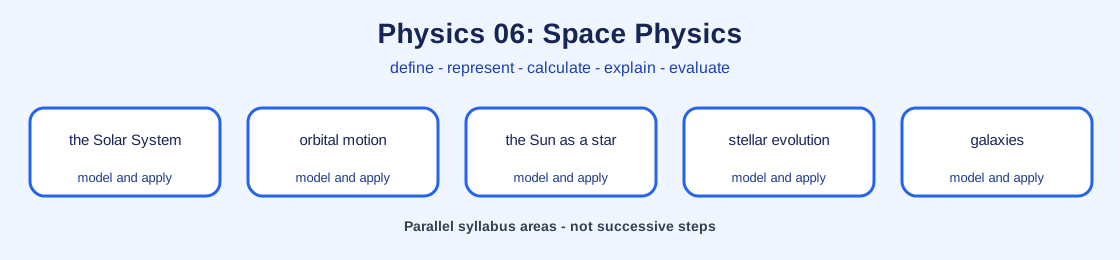
Physics P6 of Cambridge IGCSE Co-ordinated Sciences 0654 covers the Solar System, orbital motion, the Sun as a star, stellar evolution, galaxies, redshift and evidence for an expanding Universe.
Earth and the Solar System
Q: What does Cambridge IGCSE Physics Notes 6.1: Earth and the Solar System cover?
A: It follows official Cambridge Physics section 6.1 for syllabuses 0625 and 0972, with Core ideas separated from Supplement depth.
Solar-System motion is governed by gravity, with rotation explaining day, orbit explaining year, and axial tilt explaining seasons.
The ideas that organise this section
- Separate rotation on an axis from revolution in an orbit.
- Seasons result from axial tilt and changing sunlight angle, not large changes in Earth-Sun distance.
- Gravity supplies the inward force required for orbital motion.
Core route
Core candidates should be ready to describe, calculate, interpret, and apply the following:
- Describe Earth, Moon, and Solar-System structure and motions.
- Explain day, year, Moon phases, and seasons at the required qualitative level.
- Describe planets, minor planets, comets, and satellites.
Supplement route
Extended candidates study all Core content and add the following depth:
- Use orbital speed, radius, and period relationships.
- Explain changing comet speed qualitatively through gravitational energy changes.
- Relate gravitational field strength and orbital behaviour to mass and distance.
Formula route
- Relationship: orbital speed = 2 x pi x orbital radius / period.
Write the relationship before substituting. Convert units first, keep extra figures during working, and round only the final answer to sensible precision.
Worked reasoning example
A planet in a smaller orbit generally travels faster because the Sun's gravitational field is stronger closer to the Sun.
For explanation questions, state the physical principle, apply it to the named system, then give the consequence. A formula or keyword by itself is not a complete explanation.
A reliable answer method
- Identify the quantity, law, graph feature, or physical model being tested.
- Mark a positive direction or label the diagram when direction matters.
Check this topic from memory
Attempt the matching topic bank before reopening the notes. Use each missed idea to decide what to review next.
Start the topic quiz