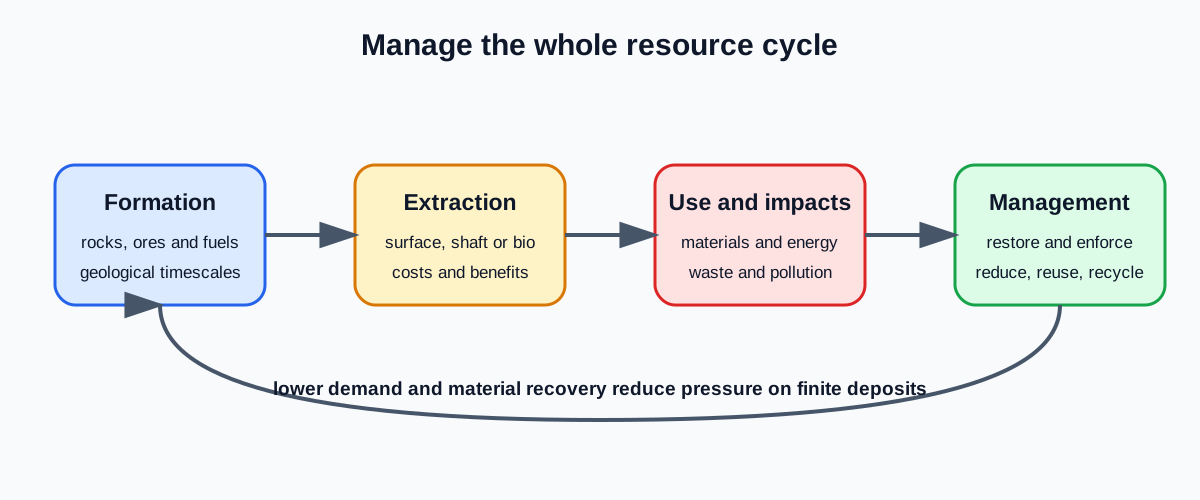
Cambridge IGCSE Environmental Management 0680 Topic 1 covers rock formation and permeability, mineral extraction, sustainable mineral management, energy resources and demand, energy conservation and new technologies, and fracking. These notes follow the official 2027 to 2029 boundary; investigation design remains in the separate fieldwork hub.
1. Rock formation and the rock cycle
Igneous rocks crystallise from molten material. Granite cools slowly underground and has large crystals; basalt cools rapidly at or near the surface and has small crystals. Sedimentary rocks form when weathered material is eroded, transported, deposited, compacted and cemented. Required examples are limestone, sandstone and shale. Metamorphic rocks form when existing rock is changed by heat and pressure without melting: limestone can become marble, while shale can become slate.
The rock cycle connects these processes. Weathering breaks rock down in place; erosion removes it; transportation moves particles; sedimentation or deposition lays them down. Compaction and cementation form sedimentary rock. Melting followed by crystallisation forms igneous rock. Heat and pressure cause metamorphism.
Permeability is the ability of water to pass through pore spaces in rock or soil. Most sandstone and limestone are permeable; igneous and metamorphic rocks and shale are generally impermeable in this syllabus classification. Porosity and permeability are related but not identical: pores must be connected for water to pass through effectively.
2. Ores and extraction methods
An ore is rock containing minerals and metals. Whether extraction is worthwhile depends on the useful concentration and economic conditions, not merely the presence of metal.
Surface methods include opencast, open-pit, open-cut and strip mining. They suit accessible deposits near the surface and allow large machinery, but disturb broad areas. Deep or shaft mining reaches deposits underground, reducing some surface footprint while increasing construction, ventilation, safety and transport demands.
Phytomining uses plants that absorb metal compounds; harvested biomass is processed to recover metal. Bioleaching uses microorganisms to convert metal compounds into soluble forms. These biological methods can work with low-grade ores and use less energy, but are slow and require controlled treatment of solutions and residues.
Extraction decisions consider exploration evidence, geology, terrain and access, deposit quantity and ore grade, climate, environmental impact assessment, supply and demand, costs and expected profit. A high-grade deposit can remain unsuitable if access, political conditions or environmental damage make the project unacceptable.
Check this topic from memory
Attempt the matching topic bank before reopening the notes. Use each missed idea to decide what to review next.
Extraction can remove habitat, reduce biodiversity and cause dust, noise, visual intrusion, contaminated runoff, acid drainage, heavy-metal pollution, high water use and large waste volumes. Social and economic effects can include jobs, skills, roads, services, export income and tax revenue, but also displacement, unsafe work, boom-and-bust dependence and unequal distribution of benefits.
Restoration may replace overburden and topsoil, improve soil, use bioremediation to reduce pollutants and establish vegetation or trees. Former workings can become lakes, landfill sites, recreation areas or nature reserves. Success depends on slope stability, water quality, soil depth, native species, monitoring, funding and long-term responsibility.
Repurposing is not automatically restoration. A lake may support recreation yet retain contaminated water or unstable banks. Evaluate each strategy against environmental recovery, safety, local needs, cost and time.
4. Sustainable mineral management
A finite resource is used faster than it is replaced. Sustainable management meets present needs without compromising future generations' ability to meet theirs.
Reduce and reuse lower demand before waste is created. Recycling recovers material but depends on collection access, separation, product design, education, markets and energy requirements. More efficient extraction can obtain more useful material per tonne of ore, although greater efficiency can also make continued depletion cheaper.
Legislation, enforcement, depletion controls and alternative materials can reduce damage and extend reserves. Rules without monitoring or penalties may fail. Alternatives can shift impacts elsewhere, so compare their full resource and energy requirements rather than assuming substitution is harmless.
5. Fossil fuels and energy-resource classes
Coal forms from buried plant material changed by pressure and heat. Petroleum and natural gas form mainly from buried marine organic matter transformed over geological time and trapped in porous rock beneath impermeable layers.
Renewable resources in the syllabus are bioethanol, biomass, biogas, wood, geothermal, hydro-electric, tidal, wave, solar and wind. Non-renewable resources are fossil fuels and nuclear power using uranium.
Fossil and biomass fuels release energy by combustion to heat water, drive turbines and generators. Nuclear fission provides heat for the same steam-turbine sequence. Hydroelectric, tidal and wave systems use moving water; wind turns turbines; geothermal heat produces steam or transfers heat; solar photovoltaic cells convert light directly to electricity.
Compare reliability, controllability, construction and operating cost, resource location, land and water use, emissions, waste, ecosystem effects and energy density. Renewable does not mean impact-free, and non-renewable does not mean identical pollution across technologies.
6. Energy demand and management
Demand varies with transport, personal and national wealth, climate, population, industry, disrupted or unreliable supply and resource scarcity. Wealth can raise ownership and travel while also funding efficiency. Cold and hot climates increase heating or cooling demand.
Management includes reducing consumption, insulation, efficient devices and vehicles, electrically propelled vehicles, education, transport policy, battery storage, use of existing resources and development of new resources. Storage helps balance variable supply but requires materials, capacity and infrastructure.
Blue hydrogen is produced from natural gas and can reduce emissions only if carbon management is effective; it remains linked to fossil extraction. Green hydrogen uses renewable electricity to split water in an electrolyser and avoids direct fossil feedstock. Its lifecycle emissions depend strongly on the electricity source, while cost and scale also depend on electrolyser efficiency, equipment and infrastructure. Ground-source and air-source heat pumps transfer existing heat rather than creating it by combustion; performance depends on installation, electricity source, climate and building suitability.
7. Fracking
Fracking extracts natural gas or petroleum from shale by hydraulic fracturing. A well is drilled and high-pressure fluid fractures rock so hydrocarbons can flow.
Benefits may include domestic supply, jobs, tax revenue, reduced imports and gas that emits less carbon dioxide than coal when burned per unit of electricity. Limitations include water demand, traffic, noise, landscape disturbance, wastewater, possible groundwater contamination through failures, induced seismicity and methane leakage. Climate conclusions depend on leakage, displaced fuel and time horizon.
Worked example: choosing and managing an extraction project
A company finds a moderate-grade copper deposit beneath woodland near a town. Open-pit mining offers high recovery and 400 jobs, but removes habitat, creates dust and leaves waste rock above a river. A sound decision first tests ore grade, slope and water pathways, then compares revenue and local infrastructure benefits with biodiversity loss, water-treatment cost and long-term liability. If approved, the plan should separate topsoil, contain runoff, monitor metals upstream and downstream, restore stable slopes and fund native planting before closure. Recycling copper and improving product collection reduce future primary demand. The judgement is conditional: employment does not cancel pollution, while restoration promises without finance, measurable criteria and enforcement are weak evidence.
Common misconceptions and how to correct them
Calling weathering and erosion identical. Weathering breaks down in place; erosion removes material.
Saying sedimentary rocks crystallise from magma. They form through deposition, compaction and cementation.
Equating porosity with permeability. Water needs connected pore spaces.
Defining ore as pure metal. Ore is rock containing useful minerals or metals.
Assuming all mining is surface extraction. Deposits may require shaft or biological methods.
Calling biological extraction impact-free. It still uses land, time and chemical processing.
Considering ore grade alone. Access, climate, impacts, demand and cost also matter.
Listing jobs as proof a mine is sustainable. Weigh distribution and long-term environmental costs.
Calling any post-mining use restoration. Repurposing may not recover ecological function.
Treating recycling as unlimited. Collection, contamination, energy and material losses constrain it.
Calling a renewable resource impact-free. All systems have location and lifecycle effects.
Classifying nuclear power as renewable. Uranium is finite in this syllabus.
Assuming electricity is itself a primary resource. It is generated from energy sources.
Saying blue and green hydrogen are identical. Their feedstocks and emissions differ.
Claiming heat pumps generate heat from nothing. They transfer heat using electricity.
Calling natural gas carbon-free. Combustion and methane leakage produce climate impacts.
Use named rocks, processes, extraction methods and energy technologies from the syllabus. For “describe”, give an accurate sequence or feature; for “explain”, connect cause to consequence; for “discuss”, balance benefits and limitations before a conditional judgement. Build impact chains that identify source, pathway, receptor and consequence. Compare management strategies using effectiveness, feasibility, cost, timescale, enforcement and unintended effects. Detailed examples should support reasoning rather than replace it. Keep field measurements and sampling methods in the investigation context, and never claim that one benefit automatically outweighs cumulative environmental and social costs.
Retrieval practice
Reconstruct the rock cycle and classify the named rocks by formation and permeability. Compare surface, subsurface and biological extraction for two deposits. Build environmental, social and economic impact chains and evaluate restoration options. Classify every listed energy resource, trace how each generates electricity, compare hydrogen and heat-pump strategies, explain four energy-demand factors, and write a balanced fracking judgement with explicit conditions.