

Cambridge IGCSE Environmental Management 2: Land
Cambridge IGCSE Environmental Management 0680 notes on land.
Cambridge IGCSE Environmental Management 0680 Topic 2 covers soil and crop growth, food production and yield, unsustainable agricultural impacts, soil erosion and management. These notes follow official sections 2.1 to 2.3 for 2027 to 2029; sampling and measurement procedures remain in the fieldwork hub.
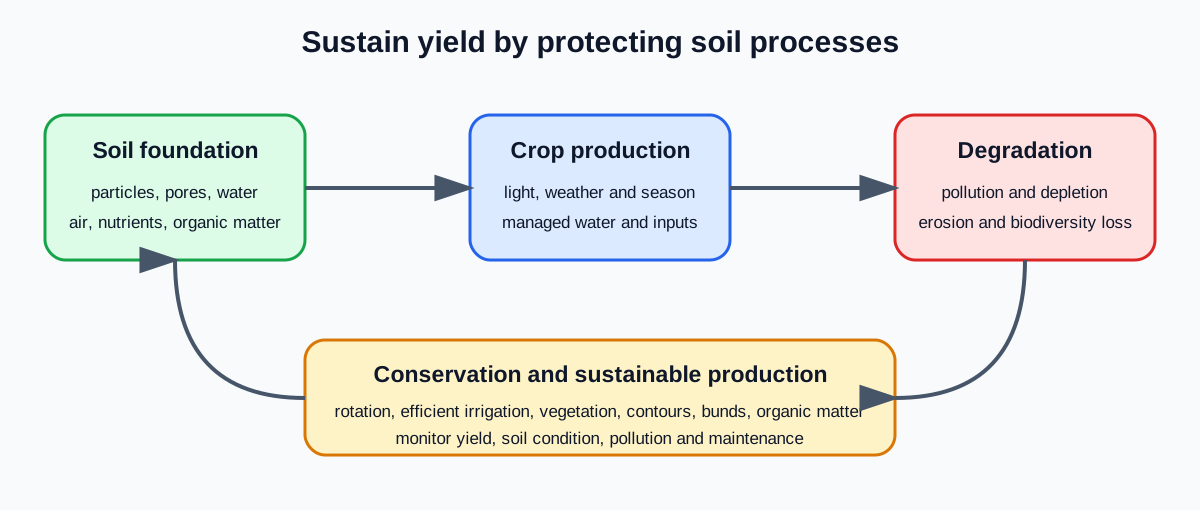
1. Soil composition and crop growth
Soil contains mineral particles, organic components, gases and water. Mineral particles are sand, silt and clay. Organic components include living plants, animals, fungi and bacteria plus matter formed through decomposition. Cambridge does not require percentage compositions.
Sand has large particles and drains rapidly but retains fewer nutrients. Clay has small particles, holds water and nutrients but may drain poorly and be difficult to cultivate. Silt is intermediate. Pore spaces contain air and water; roots need oxygen for respiration as well as water uptake.
Plants require nitrate ions for amino acids and proteins, phosphate ions for energy transfer and growth, and potassium ions for enzyme activity and water regulation. Soil pH affects nutrient availability and organism activity. Excessively acidic or alkaline conditions can reduce uptake even when nutrients are present.
Loam combines particle sizes and pore spaces, retains moisture and nutrients, allows excess water to drain, contains organic matter and inorganic ions, and is comparatively easy to cultivate. It is a balanced medium, not a single particle type.
2. Weather, seasons and crop conditions
Weather is the day-to-day condition of the atmosphere at a location. Climate describes longer-term patterns. Wet and dry seasons affect water availability, planting and harvest timing, erosion, pests and disease.
Crop growth depends on the length of the growing season, suitable weather and daylight hours. Photosynthesis requires light, carbon dioxide, water, chlorophyll and suitable temperature. Too little water closes stomata and restricts growth; waterlogging reduces root oxygen. Temperatures below or above the optimum slow enzyme-controlled reactions. Optimum conditions vary among crops, so avoid one universal temperature claim.
3. Types of agriculture
Arable farming grows crops; pastoral farming raises livestock; mixed farming combines both. Subsistence production mainly feeds the farmer or household, while commercial production primarily supplies markets. Intensive agriculture uses high inputs per unit area. Monoculture grows one crop over a large area or repeatedly.
These categories overlap. A commercial farm may be mixed and intensive. Monoculture can simplify mechanisation but reduces diversity and can encourage pest spread, soil depletion and chemical dependence.
Check this topic from memory
Attempt the matching topic bank before reopening the notes. Use each missed idea to decide what to review next.
Start the topic quiz