

Cambridge IGCSE Environmental Management 4: The atmosphere and human activities
Cambridge IGCSE Environmental Management 0680 notes on the atmosphere and human activities.
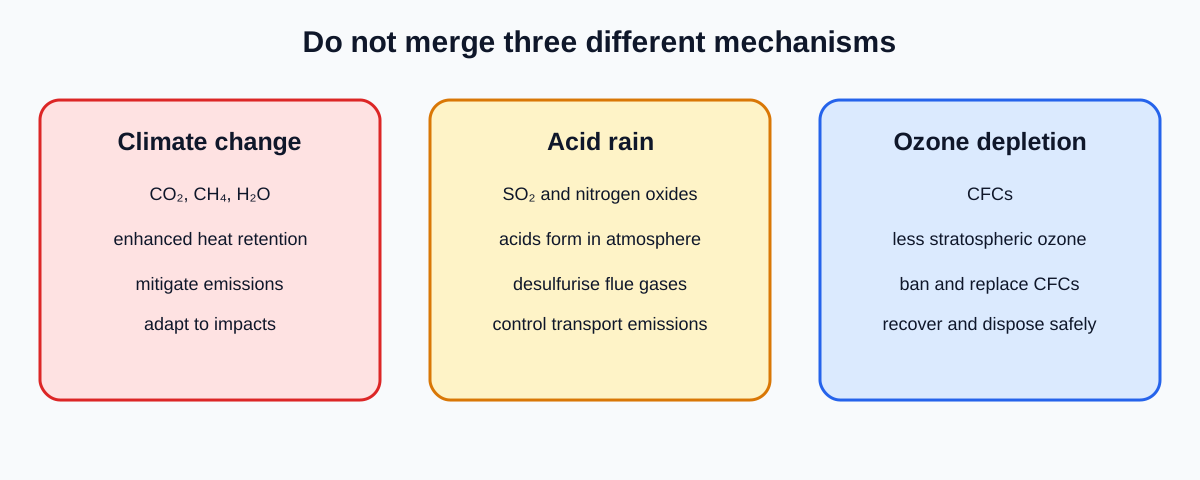
Cambridge IGCSE Environmental Management 0680 Topic 4 covers atmospheric structure, climate change, acid rain and ozone depletion. These are separate processes with different causes, impacts and management strategies.
1. Atmospheric structure and composition
From the surface upward, the required layers are the troposphere, stratosphere, mesosphere and thermosphere. The ozone layer lies in the lower stratosphere. Clean air contains approximately 78% nitrogen and 21% oxygen, with smaller amounts of argon, carbon dioxide and variable water vapour.
Weather describes day-to-day atmospheric conditions. Climate describes weather conditions in a location based on observations over many years.
2. Natural and enhanced greenhouse effects
Solar radiation passes through the atmosphere. Some is reflected to space and some is absorbed by land and oceans, warming Earth. Greenhouse gases and clouds absorb radiation and re-emit thermal energy, including toward the surface. This natural greenhouse effect keeps Earth warm enough for life.
A greenhouse gas absorbs radiation and emits the energy as heat. Carbon dioxide, water vapour and methane are required examples. Human activity increases greenhouse-gas concentrations through fossil-fuel combustion, methane from cattle, manure and rice fields, reduced carbon-dioxide removal after deforestation, methane release from drained wetlands, carbon dioxide from heating limestone during cement production, and rising population and energy use.
The enhanced greenhouse effect strengthens warming and can drive climate change. It must not be confused with ozone depletion or acid rain.
3. Climate impacts and response
Impacts include warmer land and oceans, melting ice and permafrost, sea-level rise, ocean acidification, disrupted food chains, habitat and biodiversity loss, forced migration, more severe extreme events, floods, droughts, wildfires, altered crop yields, pests, invasive species and food shortages. ENSO, El Niño and La Niña are explicitly outside this syllabus requirement.
Mitigation reduces causes or carbon footprints. Examples include reducing fossil-fuel use and livestock farming, sustainable food choices, efficiency, reforestation, afforestation, carbon sequestration, transport policy, international agreements, taxation, research, climate models and AI-supported prediction and strategy development.
Adaptation alters behaviour, practices or infrastructure to cope with impacts. Examples include climate-resistant crops, flood defences, restrictions on coastal or floodplain building, and suitable building design and materials. Mitigation and adaptation are complementary, not interchangeable.
4. Acid rain
Check this topic from memory
Attempt the matching topic bank before reopening the notes. Use each missed idea to decide what to review next.
Start the topic quiz