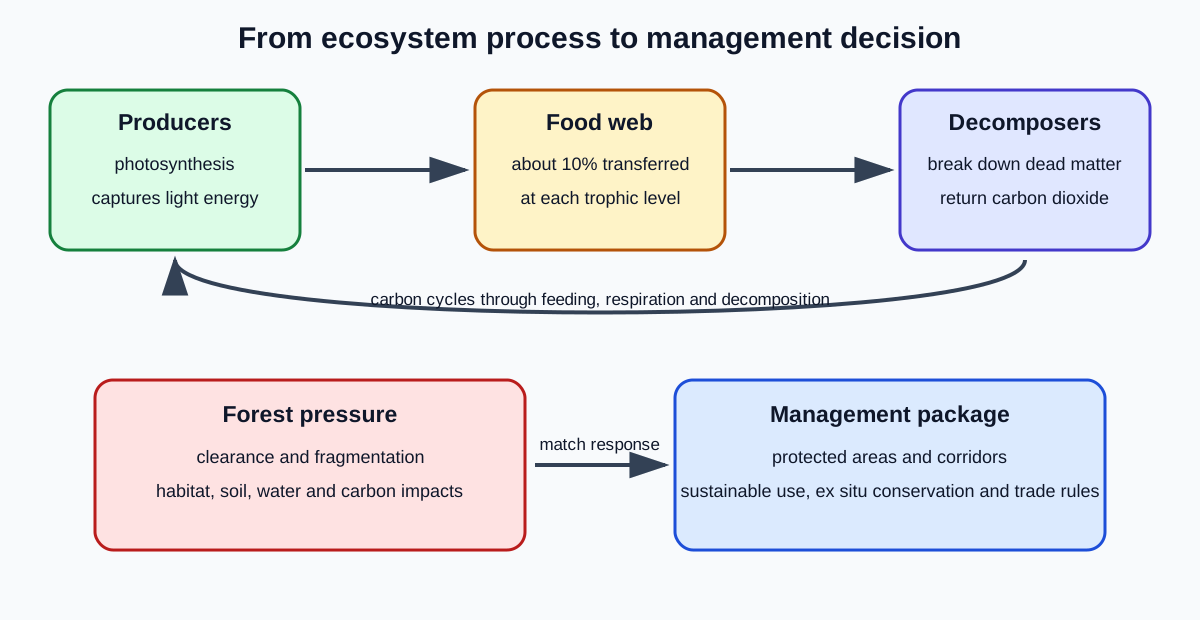
Cambridge IGCSE Environmental Management 0680 Topic 5 covers ecosystems, forest ecosystems, biodiversity management and fieldwork. These theory notes follow official sections 5.1 to 5.3 for 2027 to 2029. Section 5.4 investigation design, sampling strategies and sampling techniques belongs to the separate Environmental Management fieldwork hub.
1. Ecosystem organisation
An ecosystem contains living organisms, their non-living surroundings and the interactions between them. A habitat is the place where an organism lives. A species is a group of organisms that can reproduce to produce fertile offspring. A population is all members of one species in an area, while a community contains the populations of different species living and interacting there. A niche describes an organism's role in its ecosystem, including how it uses resources and interacts with other organisms.
Predators kill and eat prey. An apex predator has no natural predator in its food chain. These terms describe feeding relationships, not fixed labels: an animal can be a predator of one species and prey for another.
Biotic components are living. Producers make organic food, primary consumers feed on producers, secondary consumers feed on primary consumers, tertiary consumers feed at the next level, and decomposers break down dead material and waste. Abiotic components are non-living conditions, including temperature, water, oxygen, carbon dioxide, salinity, light and pH. A change in one component can affect many populations because the components are connected.
2. Interactions, pollination and photosynthesis
Competition occurs when organisms require the same limited resource, such as light, food, water, space or mates. Competition may occur within one species or between species. A native species occurs naturally in an area. An invasive species spreads outside its natural range and causes ecological, environmental or economic harm. Non-native does not automatically mean invasive: the evidence must show spread and harmful effects.
Pollination is the transfer of pollen from an anther to a stigma. Insect pollination occurs when an insect pollinator carries pollen between flowers; wind pollination uses moving air. Pollination allows fertilisation, followed by seed and fruit formation. Detailed flower-part structure beyond the named anther and stigma is not required by this syllabus.
In photosynthesis, chlorophyll captures light energy so a producer can synthesise glucose from carbon dioxide and water:
Check this topic from memory
Attempt the matching topic bank before reopening the notes. Use each missed idea to decide what to review next.
Sunlight supplies energy, while chlorophyll captures it. Photosynthesis introduces chemical energy into an ecosystem and removes carbon dioxide from the atmosphere.
3. Energy flow and ecological pyramids
A food chain shows one feeding pathway. A food web links several pathways, so it better represents the interdependence within a community. A trophic level is a feeding position: producer, primary consumer, secondary consumer or tertiary consumer.
For this syllabus, use the rule that approximately 10% of energy passes from one trophic level to the next. Much of the remaining energy is used or lost during movement, respiration, digestion and excretion. Energy therefore flows through an ecosystem and becomes less available at successive trophic levels. It is not recycled in the same way as carbon.
Suppose producers contain 80 000 kJ of energy. Applying the 10% rule gives about 8 000 kJ to primary consumers, 800 kJ to secondary consumers and 80 kJ to tertiary consumers. This reduction helps explain why food chains are usually short and why fewer organisms can be supported near the top.
A pyramid of energy shows energy available at each trophic level and is always upright. A pyramid of numbers shows the number of organisms. It can be inverted, for example when one large tree supports many insects. Always read the label and units before interpreting a pyramid.
4. Respiration and the carbon cycle
Aerobic respiration breaks down glucose in the presence of oxygen to release energy. Carbon dioxide and water are waste products:
glucose+oxygen→carbon dioxide+water
Photosynthesis and respiration are related but not opposite descriptions of the same event. Photosynthesis stores captured light energy in glucose; respiration releases usable energy from glucose. Plants respire as well as photosynthesise.
In the carbon cycle, photosynthesis moves carbon dioxide into producer biomass. Feeding transfers carbon compounds through food chains. Respiration by producers, consumers and decomposers returns carbon dioxide to the atmosphere. Decomposition transfers carbon from dead organisms and waste, while some buried material can eventually form fossil fuels. Combustion of biomass and fossil fuels releases carbon dioxide. A complete carbon-cycle explanation names both the carbon store or organism and the process that transfers carbon.
5. Forest ecosystems under pressure
Deforestation can result from logging and timber extraction, subsistence and commercial farming, roads and settlements, rock, ore and mineral extraction, hydroelectric power stations and climate change. Causes often reinforce one another. A new road may make logging and settlement easier, while drought and fire linked to climate change may reduce forest recovery.
Impacts include habitat loss, biodiversity loss and genetic depletion. Removing vegetation exposes soil to erosion and may contribute to desertification. Eroded material can silt rivers and reservoirs. Lower interception and water uptake can increase surface runoff and flood risk. Fewer trees store carbon, while burning or decomposition releases carbon dioxide, contributing to global warming. Reduced transpiration can also alter rainfall patterns.
Do not present every impact as inevitable or equal. Its severity depends on forest type, area cleared, method, rainfall, slope, soil, recovery and management. Strong answers build a causal chain, such as tree removal to reduced interception, greater surface runoff, soil erosion, river silting and increased flood risk.
6. Sustainable forest management
Sustainable forest management balances the needs of the environment, wildlife and humans while conserving forests for future generations. Forests regulate climate by acting as carbon sinks and carbon stores. They contribute to the water cycle through interception, water uptake and transpiration, reduce surface runoff and flood risk, and protect soil from erosion.
Forests also preserve genetic resources and supply food, medicines and raw materials. Recreation, ecotourism and education can create value without complete clearance, although visitor pressure and unequal distribution of income still need management. Sustainable management therefore involves choices about harvesting, protection, restoration, monitoring and community needs rather than simply banning all forest use.
7. Managing biodiversity and genetic resources
Conservation strategies can work in situ, within natural habitats, or ex situ, outside them. National parks, reserves and wildlife corridors protect habitats and movement routes. Sustainable harvesting and sustainable forestry allow use while limiting depletion. Ecotourism may provide income and an incentive for protection, but poorly managed tourism can disturb wildlife and exclude local communities.
Seed banks preserve plant genetic material. Zoos and captive-breeding programmes can increase populations and support reintroduction, but they are costly, hold limited genetic diversity and do not preserve a whole ecosystem. International cooperation and regulation of trade can reduce pressure from illegal or unsustainable animal trade, but only when rules are monitored and enforced across countries.
Threat categories communicate risk. A threatened species faces a risk of extinction, an endangered species faces a particularly high risk, and an extinct species has no living individuals. Classification can guide priorities, but conservation decisions must also consider habitat function, genetic diversity, feasibility, local livelihoods and available evidence.
Worked example: choosing a forest biodiversity plan
A tropical forest is being fragmented by farms and a new road. An endangered mammal needs a large territory, local households depend on forest products, and illegal wildlife trade crosses a national border. A suitable package would protect core habitat through reserves, reconnect fragments with wildlife corridors, regulate rather than abruptly remove sustainable local harvesting, and coordinate cross-border trade enforcement. Ecotourism could fund monitoring if visitor numbers and community revenue are managed. Captive breeding alone would be insufficient because it does not protect habitat or the wider food web. The final judgement should compare ecological effectiveness, cost, enforcement, timescale and effects on local people, then explain why several complementary strategies address different pressures.
Common misconceptions and how to correct them
Treating habitat, population and community as synonyms. Habitat is a place, population is one species, and community contains interacting populations.
Calling every non-native species invasive. Invasive species spread and cause harm; origin alone is insufficient.
Assuming an apex predator eats only large prey. The term describes its position, not prey size.
Saying plants photosynthesise but do not respire. Plants carry out both processes.
Saying energy is recycled through food chains. Energy flows and becomes less available; carbon cycles.
Drawing every pyramid upright. Energy pyramids are upright, but pyramids of numbers can be inverted.
Saying the missing 90% of energy is destroyed. It is transferred during life processes and ultimately dissipated as heat or leaves in waste.
Treating deforestation as only a biodiversity issue. It can alter soil, rivers, flood risk, climate and livelihoods.
Calling a forest a carbon sink and carbon store without distinction. A sink absorbs carbon; a store holds it.
Assuming protected areas guarantee conservation. Boundaries need suitable design, funding, monitoring and enforcement.
Claiming captive breeding protects an ecosystem. It supports selected species outside the habitat and must connect to habitat conservation.
Treating all ecotourism as sustainable. Visitor pressure, transport, revenue distribution and local participation affect outcomes.
Assessment guidance
Use the precise ecosystem term requested and link changes through a mechanism. For food-chain calculations, show each 10% transfer and retain the energy unit. Check whether a diagram is a pyramid of numbers or energy before explaining its shape. Carbon-cycle answers should name the transfer process, not draw unlabelled arrows. For deforestation questions, connect a named cause to a sequence of environmental or human impacts. In a “discuss” question, balance the benefits and limitations of each conservation strategy, apply them to the stated ecosystem and finish with a conditional judgement. Questions on investigation planning, random or systematic sampling, quadrats, transects, traps, nets, drones and automated sampling belong to section 5.4 and are developed in the separate fieldwork notes.
Retrieval practice
Define habitat, species, population, community and niche without notes. Build a food web, identify every trophic level and calculate three 10% energy transfers. Reconstruct the carbon cycle using all six required processes. Then explain two deforestation chains and choose a justified conservation package for a forest with competing ecological and human needs.