

Cambridge IGCSE International Mathematics 1: Number
Cambridge IGCSE International Mathematics 0607 notes on number.
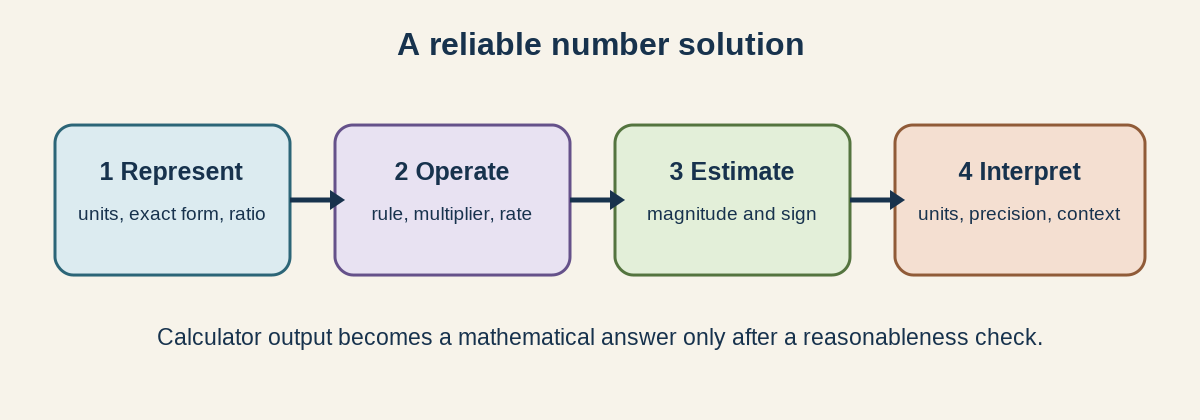
Cambridge IGCSE International Mathematics 0607 Topic 1 develops number sense for exact work, estimation and contextual modelling. Extended candidates study all Core content plus fractional indices, reverse percentages, exponential growth and decay, and surds. The syllabus expects fluency both with and without a graphic display calculator, so a calculator result must still be interpreted and checked.
1. Number types, factors and sets
Natural numbers include zero in this syllabus. Integers extend in both positive and negative directions. Rational numbers can be written as a fraction of integers, while irrational numbers cannot. Prime, square, cube and triangular numbers describe different structures, so classify a value using a definition rather than its appearance.
Prime factorisation supports highest common factor and lowest common multiple. For example, 72 = 2³ × 3² and 60 = 2² × 3 × 5. The HCF uses the smaller power of each shared prime, while the LCM uses the largest power appearing in either number.
Set work uses membership, subset, union, intersection and complement. Core Venn diagrams contain at most two sets; Extended diagrams may contain three. Fill the intersection first, then exclusive regions, then the complement. Check that every region totals to the universal set.
2. Fractions, decimals, percentages and ordering
Fractions, decimals and percentages are alternative representations of the same proportion. Convert deliberately: divide numerator by denominator for a decimal, then multiply by 100 for a percentage. Simplify exact fractions before giving a final answer unless the context requires another form.
When ordering mixed forms, convert them to one common representation or compare exact cross-products. Negative values need particular care: -0.7 is smaller than -0.4 because it lies further left on the number line.
Use brackets and the conventional order of operations. A minus sign attached to a number is part of that value. Distinguish (-3)² = 9 from -3² = -9.
3. Powers, roots, indices and standard form
Square and cube roots reverse powers. Index rules follow from repeated multiplication: multiplying like bases adds indices, division subtracts indices, and raising a power to a power multiplies indices. A zero index gives 1 for a non-zero base, and a negative index represents a reciprocal. Extended candidates also use fractional indices, where the denominator names a root and the numerator names a power.
Standard form is A × 10ⁿ with 1 ≤ A < 10 and integer n. Multiplication combines the A values and adds powers of ten; division divides A values and subtracts powers. Renormalise the result so its first factor remains in the required interval.
4. Ratio, rates and proportion
A ratio compares quantities in the same units. Convert units first, simplify every part by a common factor, and preserve the order stated. To divide an amount in a ratio, add the ratio parts, find one part, then scale.
Rates compare unlike units, such as dollars per hour, litres per minute or kilometres per hour. Average speed is total distance divided by total time, not usually the average of separate speeds. Convert minutes to fractions of an hour before substituting.
5. Percentages, money and repeated change
A percentage multiplier makes change visible. Increasing by 8% multiplies by 1.08; decreasing by 8% multiplies by 0.92. Simple interest uses the original principal each period, while compound interest updates the principal after every period. Extended candidates reverse a percentage by dividing by the multiplier, not by subtracting the stated percentage from the final value.
Repeated percentage change is exponential because the same multiplier acts on a changing quantity. A population increasing by 3% per year follows initial value × 1.03ⁿ. Depreciation of 15% per year uses 0.85ⁿ. The syllabus does not require the constant e.
Money answers need currency units and normally two decimal places. Exchange-rate questions depend on the direction of the quoted rate, so write the unit relationship before choosing multiplication or division.
6. Estimation, accuracy, time and calculator use
Round only the final calculator answer unless the question asks for an estimate. Decimal places count digits after the decimal point; significant figures begin at the first non-zero digit. Estimation checks magnitude and can expose a mistyped key or impossible unit conversion.
Time is not base ten. Convert 2 hours 30 minutes to 2.5 hours, but interpret a calculator display of 3.25 hours as 3 hours 15 minutes. Timetables and time-zone problems are safest on a timeline that records date changes.
7. Extended surds
A surd is an exact irrational root. Simplify by extracting square factors, such as √72 = √(36 × 2) = 6√2. Combine only like surds. Rationalising a denominator removes a surd from the denominator by multiplying by a suitable surd or conjugate. Keep the exact surd form when requested rather than replacing it with an early decimal approximation.
Worked example: choosing a complete numerical model
A laptop has list price $1,250. A shop gives a 12% discount, then adds 9% tax. The discounted price is 1250 × 0.88 = $1,100. Tax is applied to that new amount, so the final price is 1100 × 1.09 = $1,199. The two percentage changes cannot be replaced by a net 3% decrease because their multipliers act successively: 0.88 × 1.09 = 0.9592, a 4.08% decrease from list price. An estimate, 1250 × 0.9 × 1.1 ≈ 1238, confirms the answer's magnitude. To recover the list price from $1,199, divide by both multipliers rather than adding percentages backwards.
Common misconceptions and how to correct them
- Assuming one is prime. A prime has exactly two positive factors; one has only one.
- Using the largest shared exponent for an HCF. HCF uses smaller shared prime powers.
- Adding fractions without a common denominator. Rewrite equivalent fractions first.
- Reading a negative index as a negative value. It creates a reciprocal.
- Leaving standard form with A outside 1 ≤ A < 10. Renormalise A and adjust the power.
- Dividing a ratio amount by one ratio number. Divide by the sum of all parts.
- Averaging two journey speeds directly. Use total distance divided by total time.
- Adding repeated percentage changes. Multiply successive percentage multipliers.
- Reversing an increase by subtracting the percentage. Divide the final amount by the multiplier.
- Treating 2 hours 30 minutes as 2.30 hours. Convert minutes using 60.
- Rounding intermediate calculator values. Store full precision until the final answer.
- Converting an exact surd to a decimal too early. Preserve exact form through the calculation.
Assessment guidance
Paper 1 or 2 may test exact arithmetic and estimation without a calculator, while Papers 3 or 4 require a graphic display calculator and Papers 5 or 6 place number skills inside an investigation or model. Show the multiplier, unit conversion or prime-factor structure that justifies an answer. State units and sensible precision, and compare a calculator value with an estimate. In multi-step financial questions, label the amount after each change. For Extended surd work, give exact simplified form unless a decimal accuracy is requested. A correct display without interpretable working may not demonstrate the required method.
Retrieval practice
Classify ten values as integer, rational or irrational. Find an HCF and LCM by prime factors, complete a two-set Venn diagram, order mixed fractions and decimals, and calculate one rate with a unit conversion. Then solve a repeated percentage change, reverse it, simplify and rationalise two surds, and explain how an estimate checks each calculator answer.
Check this topic from memory
Attempt the matching topic bank before reopening the notes. Use each missed idea to decide what to review next.
Start the topic quiz