

Cambridge IGCSE International Mathematics 2: Algebra
Cambridge IGCSE International Mathematics 0607 notes on algebra.
Cambridge IGCSE International Mathematics 0607 Topic 2 covers expressions, manipulation, equations, inequalities, sequences and algebraic models. Extended content adds fuller factorisation and algebraic fractions, quadratics, fractional equations, two-variable inequality regions, more general sequences and direct or inverse proportion.
1. Expressions, substitution and manipulation
A variable represents a number that may change or remain unknown. An expression has no equality sign; an equation asserts that two expressions are equal; a formula connects several quantities. Substitute with brackets so that negative values and powers retain their intended structure.
Collect only like terms. Expand by multiplying every term inside a bracket. Factorising reverses expansion and should be complete. Core candidates extract common factors and expand products including two linear brackets. Extended candidates also handle multiple brackets, grouping, difference of two squares, perfect-square forms, quadratics and some cubic expressions.
An identity is true for all permissible values, while an equation is true only for its solutions. Expanding both sides can prove an identity; solving it as though it had one value misses the point.
2. Algebraic fractions and indices
An algebraic fraction follows the same rules as a numerical fraction. Factor before cancelling, and cancel factors rather than separate terms. State excluded values when a denominator could be zero. To add fractions, build a common denominator; to divide, multiply by the reciprocal.
Index laws apply only to matching bases. Extended work includes negative and fractional indices and equations that can be rewritten with a common base. For example, 3²ˣ = 3⁴ implies 2x = 4. Do not take logarithms where a common-base comparison solves the syllabus task directly.
3. Linear, simultaneous and quadratic equations
Solving an equation means applying equivalent operations to both sides until the unknown is isolated. Clear brackets carefully, collect variable terms, and check the result by substitution.
Simultaneous linear equations describe the intersection of two lines. Elimination aligns coefficients; substitution expresses one variable through the other. Both methods should lead to the same ordered pair, which must satisfy both original equations.
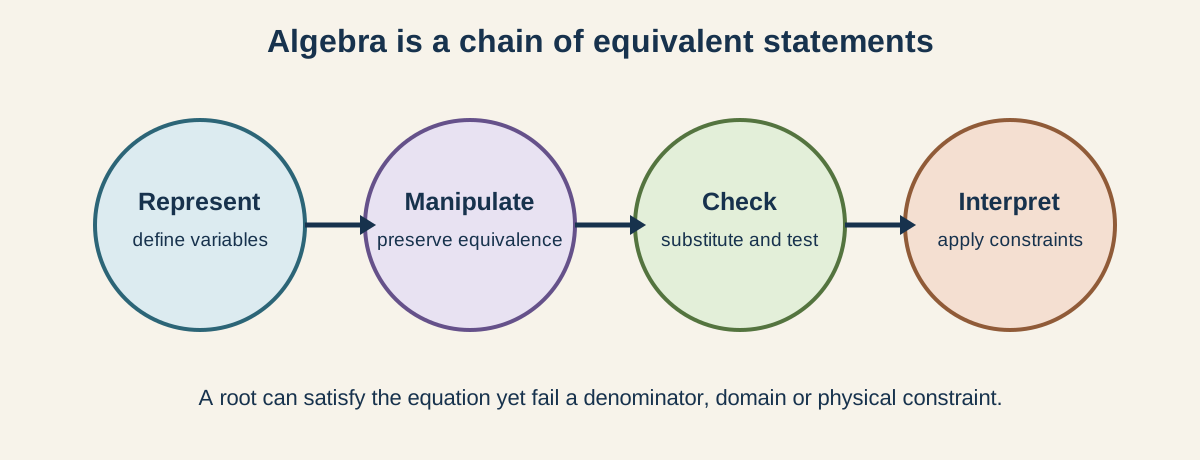
Extended candidates solve fractional equations, quadratics by factorisation, the quadratic formula or a graphic display calculator, and unfamiliar equations graphically. Multiplying through a fractional equation can introduce a forbidden denominator value, so check every proposed solution. Quadratic solutions may need exact surd form.
Changing the subject uses inverse operations while preserving equivalence. Core formulas have the subject once without its power or root. Extended formulas may contain the subject twice or under a power or root, requiring collection, factorisation or an inverse power.
Check this topic from memory
Attempt the matching topic bank before reopening the notes. Use each missed idea to decide what to review next.
Start the topic quiz