

Cambridge IGCSE International Mathematics 3: Functions
Cambridge IGCSE International Mathematics 0607 notes on functions.
Cambridge IGCSE International Mathematics 0607 Topic 3 connects formulas, mappings and graphs. Core candidates recognise linear and quadratic graphs, use a graphic display calculator and apply function notation. Extended candidates add more graph families, domain and range, inverses, composites, quadratic reconstruction, asymptotes, translations and logarithms.
1. A function as a mapping
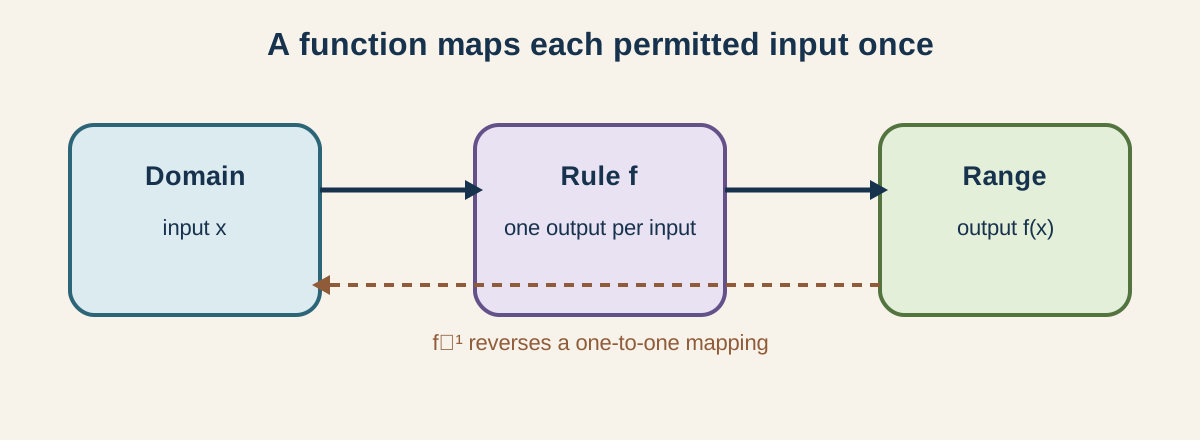
A function assigns each permitted input exactly one output. The domain is the set of permitted inputs and the range is the set of outputs actually produced. Function notation f(x) names both a rule and its output at x. It does not mean f multiplied by x.
Evaluate a function by substituting the whole input with brackets. If f(x) = 3x - 5, then f(-2) = 3(-2) - 5 = -11. Solving f(x) = 7 reverses the question: find the input whose output is 7.
Core candidates may use mapping diagrams but are not required to find inverse or composite functions. Extended candidates find inverse functions and form composites. The syllabus defines gf(x) as g(f(x)), so the right-hand function acts first.
2. Recognising graph families
Core graph recognition covers straight lines and parabolas. A linear function has constant gradient. A quadratic has one turning point and vertical line symmetry.
Extended recognition also includes cubic, reciprocal, exponential and trigonometric graphs. A cubic may have rotational features and up to two turning points. A reciprocal graph has separated branches and approaches asymptotes. Exponential growth stays positive and increases when its base exceeds 1; exponential decay decreases when its base lies between 0 and 1. For sine and cosine, amplitude controls vertical size and the coefficient of x controls period. Tangent has repeating branches and vertical asymptotes.
Use intercepts, symmetry, turning points, end behaviour and asymptotes together. One visual feature alone may not identify all parameters.
3. Graphic display calculator work
Candidates use a graphic display calculator to sketch a graph, build a value table, plot points, find zeros, turning points, intersections and a quadratic vertex. The tool may be applied to unfamiliar functions, so window choice matters. A poor viewing window can hide a root or make a curve appear flat.
Record the mathematical result rather than only a screenshot or decimal display. For an intersection, give both coordinates if the problem asks for a point. Check the value in the original equations and round only as requested.
4. Inverse and composite functions
An inverse function reverses the original mapping. Write y = f(x), exchange x and y, then rearrange for y. The domain may need restriction before an inverse is itself a function. The notation f⁻¹(x) means inverse, not reciprocal.
Check this topic from memory
Attempt the matching topic bank before reopening the notes. Use each missed idea to decide what to review next.
Start the topic quiz