

Cambridge IGCSE Mathematics Notes 1: Number
Cambridge IGCSE Mathematics 0580 and 0980 notes on number, fractions, percentages, ratio, bounds, standard form and financial calculations.
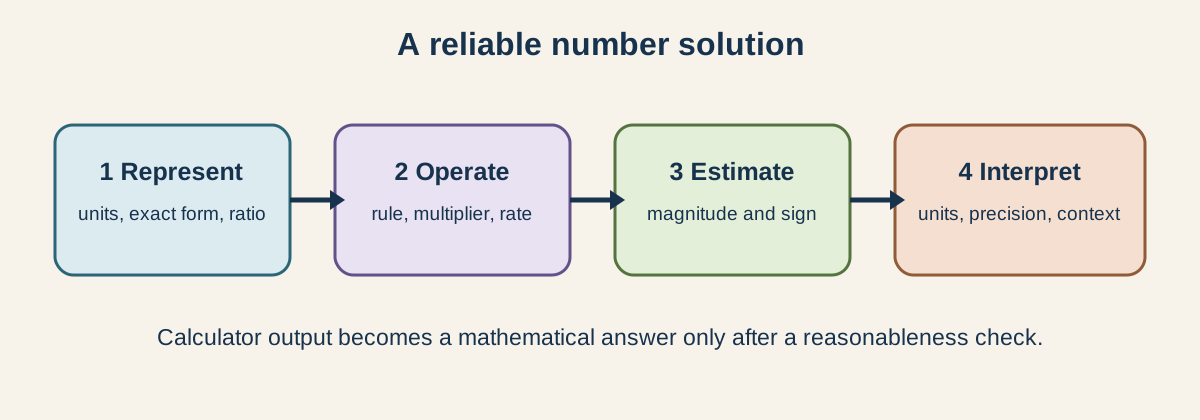
Cambridge IGCSE Mathematics 0580 Topic 1 develops number sense for exact work, estimation and contextual modelling. Extended candidates study all Core content plus fractional indices, reverse percentages, exponential growth and decay, and surds. The syllabus expects fluency both with and without a scientific calculator, so a calculator result must still be interpreted and checked.
1. Number types, factors and sets
Natural numbers include zero in this syllabus. Integers extend in both positive and negative directions. Rational numbers can be written as a fraction of integers, while irrational numbers cannot. Prime, square, cube and triangular numbers describe different structures, so classify a value using a definition rather than its appearance.
Prime factorisation supports highest common factor and lowest common multiple. For example, 72 = 2³ × 3² and 60 = 2² × 3 × 5. The HCF uses the smaller power of each shared prime, while the LCM uses the largest power appearing in either number.
Set work uses membership, subset, union, intersection and complement. Core Venn diagrams contain at most two sets; Extended diagrams may contain three. Fill the intersection first, then exclusive regions, then the complement. Check that every region totals to the universal set.
2. Fractions, decimals, percentages and ordering
Fractions, decimals and percentages are alternative representations of the same proportion. Convert deliberately: divide numerator by denominator for a decimal, then multiply by 100 for a percentage. Simplify exact fractions before giving a final answer unless the context requires another form.
When ordering mixed forms, convert them to one common representation or compare exact cross-products. Negative values need particular care: -0.7 is smaller than -0.4 because it lies further left on the number line.
Use brackets and the conventional order of operations. A minus sign attached to a number is part of that value. Distinguish (-3)² = 9 from -3² = -9.
3. Powers, roots, indices and standard form
Square and cube roots reverse powers. Index rules follow from repeated multiplication: multiplying like bases adds indices, division subtracts indices, and raising a power to a power multiplies indices. A zero index gives 1 for a non-zero base, and a negative index represents a reciprocal. Extended candidates also use fractional indices, where the denominator names a root and the numerator names a power.
Standard form is A × 10ⁿ with 1 ≤ A < 10 and integer n. Multiplication combines the A values and adds powers of ten; division divides A values and subtracts powers. Renormalise the result so its first factor remains in the required interval.
4. Ratio, rates and proportion
Check this topic from memory
Attempt the matching topic bank before reopening the notes. Use each missed idea to decide what to review next.
Start the topic quiz