

Cambridge IGCSE Mathematics Notes 2: Algebra and Graphs
Cambridge IGCSE Mathematics notes on expressions, equations, sequences, functions, variation and graph interpretation.
Cambridge IGCSE Mathematics 0580 Topic 2 covers expressions, manipulation, equations, inequalities, sequences and algebraic models. Extended content adds fuller factorisation and algebraic fractions, quadratics, fractional equations, two-variable inequality regions, more general sequences and direct or inverse proportion.
1. Expressions, substitution and manipulation
A variable represents a number that may change or remain unknown. An expression has no equality sign; an equation asserts that two expressions are equal; a formula connects several quantities. Substitute with brackets so that negative values and powers retain their intended structure.
Collect only like terms. Expand by multiplying every term inside a bracket. Factorising reverses expansion and should be complete. Core candidates extract common factors and expand products including two linear brackets. Extended candidates also handle multiple brackets, grouping, difference of two squares, perfect-square forms, quadratics and some cubic expressions.
An identity is true for all permissible values, while an equation is true only for its solutions. Expanding both sides can prove an identity; solving it as though it had one value misses the point.
2. Algebraic fractions and indices
An algebraic fraction follows the same rules as a numerical fraction. Factor before cancelling, and cancel factors rather than separate terms. State excluded values when a denominator could be zero. To add fractions, build a common denominator; to divide, multiply by the reciprocal.
Index laws apply only to matching bases. Extended work includes negative and fractional indices and equations that can be rewritten with a common base. For example, 3²ˣ = 3⁴ implies 2x = 4. Do not take logarithms where a common-base comparison solves the syllabus task directly.
3. Linear, simultaneous and quadratic equations
Solving an equation means applying equivalent operations to both sides until the unknown is isolated. Clear brackets carefully, collect variable terms, and check the result by substitution.
Simultaneous linear equations describe the intersection of two lines. Elimination aligns coefficients; substitution expresses one variable through the other. Both methods should lead to the same ordered pair, which must satisfy both original equations.
Extended candidates solve fractional equations, quadratics by factorisation, the quadratic formula or a scientific calculator, and unfamiliar equations graphically. Multiplying through a fractional equation can introduce a forbidden denominator value, so check every proposed solution. Quadratic solutions may need exact surd form.
Changing the subject uses inverse operations while preserving equivalence. Core formulas have the subject once without its power or root. Extended formulas may contain the subject twice or under a power or root, requiring collection, factorisation or an inverse power.
4. Inequalities
An inequality describes a range. Reverse the inequality sign only when multiplying or dividing by a negative number. On a number line, open circles represent strict boundaries and closed circles represent included boundaries.
Extended candidates solve compound inequalities and represent linear inequalities in two variables. Cambridge's stated graph convention uses broken boundary lines for strict inequalities, solid lines for inclusive inequalities, and shading for unwanted regions unless the question directs otherwise. Test a simple point such as (0, 0) when uncertain about the side of a line.
5. Sequences
A term-to-term rule explains how to move between consecutive terms; an nth-term rule gives a term directly from its position. Core candidates recognise linear, simple quadratic and simple cubic sequences and may use differences. Constant first differences indicate a linear sequence; constant second differences indicate a quadratic pattern.
Extended candidates also handle exponential sequences and combinations of familiar patterns, using notation such as Tₙ. Check any proposed nth term against at least the first three positions. A rule that predicts only the next term is not automatically a valid general rule.
6. Extended proportion and model selection
Direct proportion has the form y = kf(x), where the specified function may be x, x², √x or x³. Inverse proportion has y = k/f(x). Find k from one complete data pair before predicting another value.
To choose the best variation model from data, transform the variables implied by each candidate and look for a constant ratio or a straight-line relationship through the origin. Context also matters: a numerical fit outside a physically meaningful domain may be unsuitable.
Functions and graph families
1. A function as a mapping
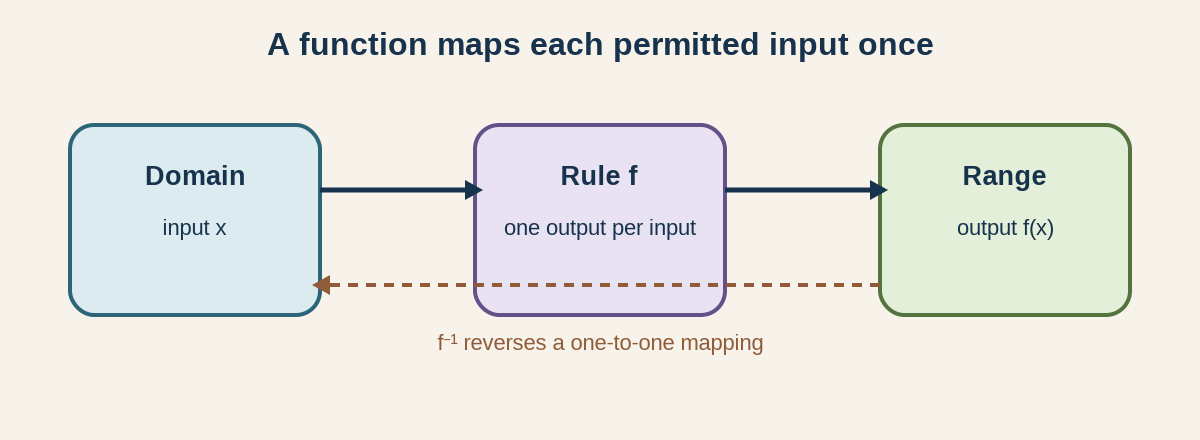
A function assigns each permitted input exactly one output. The domain is the set of permitted inputs and the range is the set of outputs actually produced. Function notation f(x) names both a rule and its output at x. It does not mean f multiplied by x.
Evaluate a function by substituting the whole input with brackets. If f(x) = 3x - 5, then f(-2) = 3(-2) - 5 = -11. Solving f(x) = 7 reverses the question: find the input whose output is 7.
Core candidates may use mapping diagrams but are not required to find inverse or composite functions. Extended candidates find inverse functions and form composites. The syllabus defines gf(x) as g(f(x)), so the right-hand function acts first.
2. Recognising graph families
Core graph recognition covers straight lines and parabolas. A linear function has constant gradient. A quadratic has one turning point and vertical line symmetry.
Extended recognition also includes cubic, reciprocal, exponential and trigonometric graphs. A cubic may have rotational features and up to two turning points. A reciprocal graph has separated branches and approaches asymptotes. Exponential growth stays positive and increases when its base exceeds 1; exponential decay decreases when its base lies between 0 and 1. For sine and cosine, amplitude controls vertical size and the coefficient of x controls period. Tangent has repeating branches and vertical asymptotes.
Use intercepts, symmetry, turning points, end behaviour and asymptotes together. One visual feature alone may not identify all parameters.
4. Inverse and composite functions
An inverse function reverses the original mapping. Write y = f(x), exchange x and y, then rearrange for y. The domain may need restriction before an inverse is itself a function. The notation f⁻¹(x) means inverse, not reciprocal.
For a composite, work from inside to outside. If f(x) = 2x + 1 and g(x) = x², then gf(x) = (2x + 1)², while fg(x) = 2x² + 1. Order changes the result. Cambridge does not require Extended candidates to find domain and range of composite functions in this syllabus.
5. Constructing quadratics
Different information suggests different forms. A quadratic with vertex (h, k) is y = a(x - h)² + k. A quadratic with roots p and q is y = a(x - p)(x - q). Substitute the additional point to determine a. When a = 1 is stated, the vertex or intercepts may determine the function without another point.
Check the result against every supplied feature. A sign error in a root factor moves the intercept to the wrong side of the axis.
6. Asymptotes and graph translations
An asymptote is a line approached by a graph. Extended candidates identify simple horizontal or vertical examples, including tangent asymptotes, but algebraic derivation of asymptotes is excluded.
For translations, y = f(x) + k moves the graph vertically by k. The transformation y = f(x + k) moves it horizontally by -k, so the inside direction appears reversed. The syllabus restricts k to an integer here. Track a known point to reason instead of memorising a sign without meaning.
Worked example: form an equation, solve it and interpret it
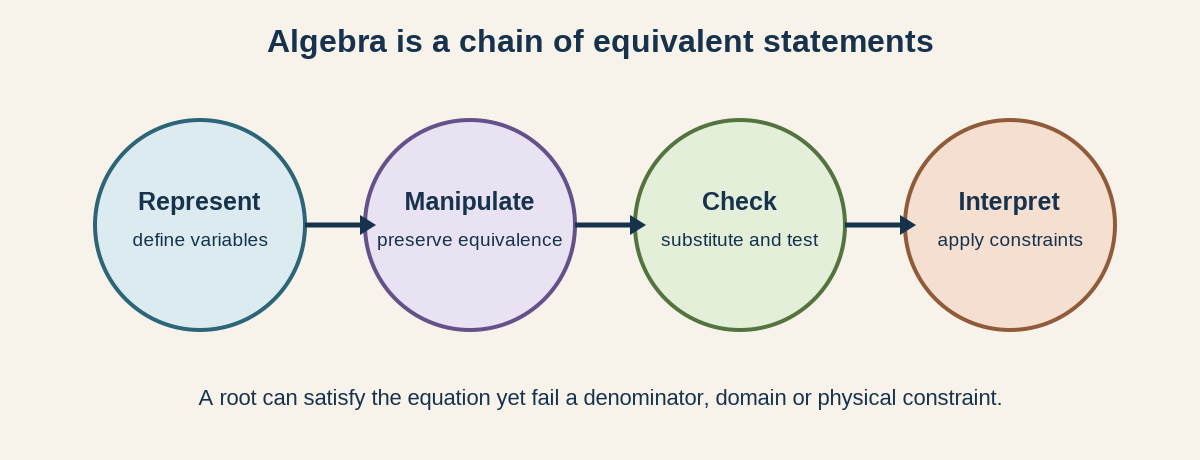
A rectangle is 3 cm longer than twice its width. Its area is 65 cm². Let the width be x cm, so the length is 2x + 3 and x(2x + 3) = 65. Rearranging gives 2x² + 3x - 65 = 0, which factorises as (2x + 13)(x - 5) = 0. Hence x = -6.5 or x = 5. Algebra produces two roots, but a physical width cannot be negative, so the model gives width 5 cm and length 13 cm. Substitution checks both the equation and context: 5 × 13 = 65. The rejected root is mathematically valid for the equation but invalid for the rectangle.
Common misconceptions and how to correct them
- Combining unlike terms. Terms must have identical variable parts and powers.
- Expanding only the first term in a bracket. Multiply every enclosed term.
- Cancelling terms across addition. Factor first and cancel common factors only.
- Ignoring denominator restrictions. Record values that make an original denominator zero.
- Changing an equation on only one side. Apply equivalent operations to both sides.
- Accepting both quadratic roots in every context. Test physical and stated constraints.
- Forgetting to reverse an inequality after division by a negative. The order reverses.
- Using a solid line for a strict inequality. Strict boundaries are broken or open.
- Calling a term-to-term pattern the nth term. An nth term must depend directly on n.
- Assuming constant second difference means its value is the n² coefficient. The coefficient is half that difference.
- Writing y proportional to x as y = x. Include and determine the constant k.
- Choosing a model from one pair of values. Compare several pairs and interpret context.
Assessment guidance
Non-calculator papers reward reliable symbolic manipulation, while calculator papers may require graph-based solutions to unfamiliar equations or inequalities. Show factorisation, balancing or substitution clearly enough that the method can be followed. Preserve exact values until a decimal accuracy is requested. For simultaneous equations, report an ordered pair and verify it in both equations. For graphical inequality regions, follow the specified line and shading conventions. In sequence or proportion questions, state the general rule, determine constants from the data, test the rule against further values and interpret whether the answer is meaningful in the original situation.
Retrieval practice
Simplify and factorise four expressions, then add and divide two algebraic fractions while stating restrictions. Solve a linear equation, simultaneous pair, quadratic and compound inequality. Derive nth terms from first and second differences. Finally, fit direct and inverse models to small data tables, explain how k was found, and reject any result that violates the context.
Theory ownership
This note owns the official Mathematics 0580 topic methods, representations and reasoning. Calculator technique supports the mathematics but does not replace exact working, justification or interpretation.
Return to the Cambridge IGCSE Mathematics hub.
Official source
Cambridge International, Mathematics 0580 syllabus for examinations in 2025, 2026 and 2027. Mathematics 0980 uses the same subject content with 9 to 1 grading.
Check this topic from memory
Attempt the matching topic bank before reopening the notes. Use each missed idea to decide what to review next.
Start the topic quiz