

Cambridge IGCSE Mathematics Notes 3: Coordinate Geometry
Cambridge IGCSE Mathematics notes on coordinates, gradients, line equations, parallel and perpendicular lines.
Cambridge IGCSE Mathematics 0580 Topic 4 links diagrams, algebra and Cartesian coordinates. Both tiers use coordinates, gradient, length, midpoint, straight-line equations and parallel lines. Extended candidates additionally find perpendicular gradients and equations, including perpendicular bisectors.
1. Coordinates and displacement
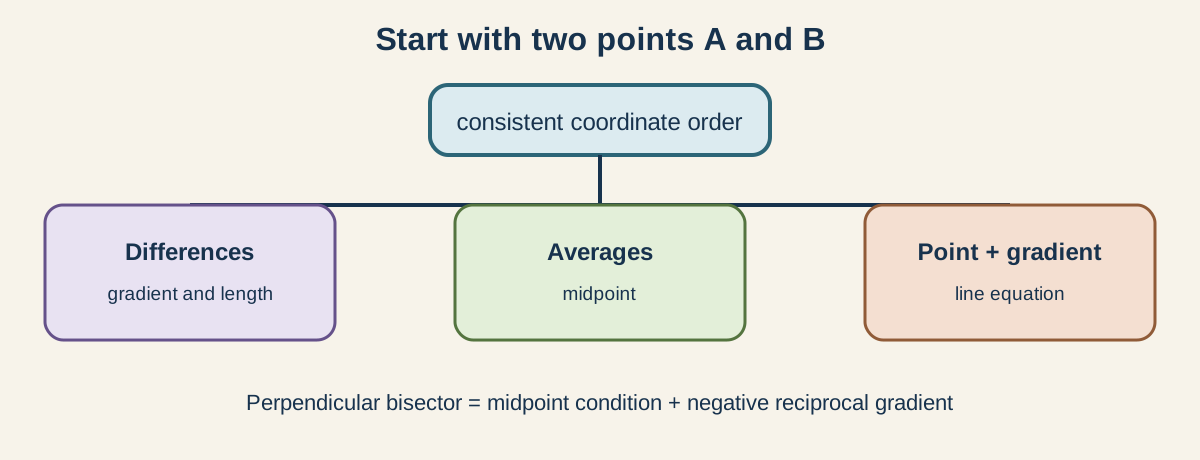
An ordered pair (x, y) records horizontal position first and vertical position second. Differences between coordinates describe displacement from one point to another. Keep a consistent subtraction order: if moving from A to B, use B minus A for both coordinates.
A plotted diagram is evidence but not proof of an exact coordinate result. Axes may use different scales, and a sketch need not be drawn to scale. Read labels and calculate from coordinates.
2. Gradient
Gradient measures vertical change per unit horizontal change:
gradient = change in y ÷ change in x
Using points (x₁, y₁) and (x₂, y₂), subtract in the same order in numerator and denominator. Reversing both orders leaves the ratio unchanged; reversing only one changes its sign incorrectly.
A positive gradient rises from left to right, a negative gradient falls, and zero gradient is horizontal. A vertical line has undefined gradient because its horizontal change is zero.
Gradient also has contextual meaning. On a distance-time graph it can represent speed; in a conversion graph it can represent a conversion factor. Attach units when the axes have units.
3. Length and midpoint
The distance between two points follows from Pythagoras:
length = square root of ((change in x)² + (change in y)²)
Keep the exact square-root form if requested, or round only at the end. The midpoint averages corresponding coordinates:
midpoint = ((x₁ + x₂) ÷ 2, (y₁ + y₂) ÷ 2)
Distance uses differences because it measures separation. Midpoint uses sums because it finds the coordinate halfway between endpoints. Confusing these structures is a common avoidable error.
4. Equations of straight lines
The form y = mx + c displays gradient m and y-intercept c. Other forms, including ax + by = c and x = k, remain valid and may be requested. Rearrange carefully when extracting gradient from a general equation.
To find a line through a known point with gradient m, use the point-gradient relationship y - y₁ = m(x - x₁), then simplify. Alternatively substitute the point into y = mx + c to find c. Check by substituting the point and confirming the gradient.
A vertical line cannot be written as y = mx + c. Its equation is x = k. A horizontal line has equation y = k.
Check this topic from memory
Attempt the matching topic bank before reopening the notes. Use each missed idea to decide what to review next.
Start the topic quiz