

Cambridge IGCSE Mathematics Notes 4: Geometry
Cambridge IGCSE Mathematics notes on angle facts, polygons, symmetry, similarity, congruence, constructions and circle theorems.
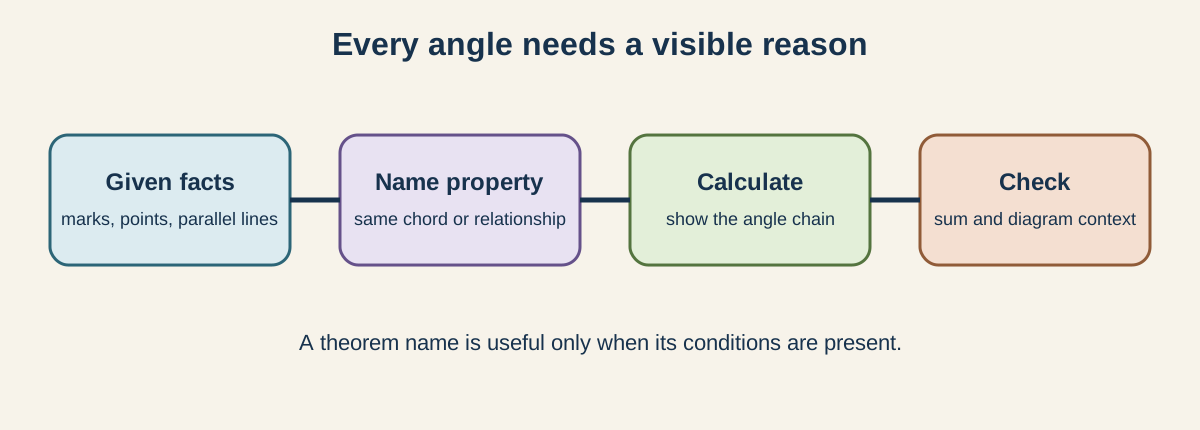
Cambridge IGCSE Mathematics 0580 Topic 5 covers geometric vocabulary, bearings, similarity, symmetry, angle reasoning and named circle properties. The Core and Extended lists for this topic are materially aligned. Candidates must calculate and give simple geometric explanations, so a bare angle value is often incomplete.
1. Language, notation and diagrams
Precise vocabulary separates points, lines, planes, vertices, faces, edges and surfaces. Triangles may be equilateral, isosceles, scalene or right-angled. Special quadrilaterals include square, rectangle, kite, rhombus, parallelogram and trapezium. Solids include prisms, pyramids, cylinders, cones, spheres, hemispheres, tetrahedra and frustums.
Circle language includes centre, radius, diameter, circumference, chord, tangent, major and minor arc, sector and segment. A sector is bounded by two radii and an arc; a segment is bounded by a chord and an arc.
Three-letter angle notation names the vertex with the middle letter. In angle ABC, B is the vertex. Read tick marks, arrow marks and right-angle squares as given information, but never infer equal lengths or parallel lines merely from appearance.
2. Constructions, measurement and bearings
Use a ruler for every straight edge. Measurement answers should respect the scale and reasonable instrument precision.
A three-figure bearing is measured clockwise from north and written with three digits from 000° to 360°. Draw a north line at the point from which the bearing is measured. “Bearing of A from B” means stand at B and look toward A. Reverse bearings differ by 180°, adjusted into the stated range.
3. Similarity
Similar figures have equal corresponding angles and proportional corresponding lengths. Establish the correspondence before forming ratios. Triangle similarity can be explained using angle facts, including equal angles from parallel lines.
If the linear scale factor from shape A to shape B is k, the area scale factor is k² and the volume scale factor is k³. Surface area also scales with k². Use matching dimensions and preserve direction: if a length ratio is B ÷ A, every related ratio must follow B ÷ A.
The syllabus does not expect candidates to prove congruence, even though congruent remains required vocabulary. Do not turn a similarity task into an unnecessary congruence proof.
4. Symmetry
Line symmetry reflects a two-dimensional figure onto itself. Rotational symmetry counts how many times a figure matches itself during a full turn; the starting position is included. Three-dimensional solids may have planes or axes of symmetry.
Symmetry supports deductions about regular polygons, isosceles triangles and circles. State the property used rather than writing “by symmetry” when a more precise description is available.
Check this topic from memory
Attempt the matching topic bank before reopening the notes. Use each missed idea to decide what to review next.
Start the topic quiz