

Cambridge IGCSE Mathematics Notes 5: Mensuration
Cambridge IGCSE Mathematics notes on perimeter, area, surface area, volume, arcs, sectors and compound shapes.
Cambridge IGCSE Mathematics 0580 Topic 6 covers metric units, perimeter, area, circles, arcs, sectors, surface area, volume and compound shapes or solids. The Core and Extended topic lists are aligned. Questions may require exact answers in terms of π, and formula availability varies, so candidates must know which elementary area formulas are not supplied.
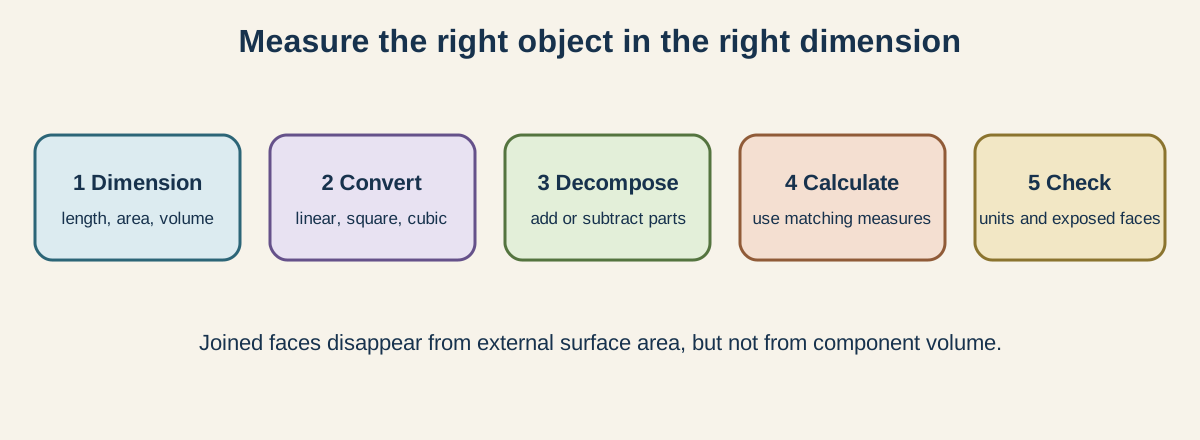
1. Dimensions and metric units
Length is one-dimensional, area is two-dimensional and volume is three-dimensional. This controls conversion factors. Since 1 m = 100 cm, 1 m² = 10,000 cm² and 1 m³ = 1,000,000 cm³. Square or cube the linear conversion factor rather than attaching a new unit label after an unchanged number.
Capacity connects to volume: 1 cm³ = 1 ml and 1000 cm³ = 1 litre. Therefore 1 m³ = 1000 litres. Convert every measurement to compatible units before using a formula.
A reasonableness check should ask whether a conversion made the numerical value larger or smaller. Expressing the same length in smaller units produces a larger number; converting an area compounds that change.
2. Perimeter and area
Perimeter is total boundary length. Area measures enclosed surface. For a rectangle, area is length × width. For a triangle, area is one half × base × perpendicular height. A parallelogram uses base × perpendicular height, and a trapezium uses one half × sum of parallel sides × perpendicular distance between them.
Except for the triangle area, these formulas are not supplied in Papers 1 to 4. Height must be perpendicular to the chosen base. A sloping side is not automatically the height.
For a compound plane shape, split it into non-overlapping familiar pieces or subtract a cut-out from a larger shape. Mark included outer edges before calculating perimeter, since internal construction lines do not belong to the boundary.
3. Circles, arcs and sectors
Circle circumference is 2πr and area is πr². These formulas are given. Check whether the stated length is a radius or diameter.
An arc or sector is a fraction of a full circle. For central angle θ in degrees:
arc length = θ ÷ 360 × 2πr
sector area = θ ÷ 360 × πr²
Major sectors use the reflex angle, or the full result minus the minor sector. A sector perimeter includes the arc and two radii. Keep π exact if requested.
4. Prisms and cylinders
A prism has a uniform cross-section. Its volume is cross-sectional area × length, and its total surface area combines two end faces with the rectangles formed along the cross-section boundary. A cylinder is a circular prism.
The volume of a prism and cylinder and the curved surface area of a cylinder are supplied. Still identify which surfaces are exposed in the actual object. An open container may omit one circular end; a joined compound solid may hide a face.
Check this topic from memory
Attempt the matching topic bank before reopening the notes. Use each missed idea to decide what to review next.
Start the topic quiz