

Cambridge IGCSE Mathematics Notes 6: Trigonometry
Cambridge IGCSE Mathematics notes on Pythagoras, right-triangle trigonometry, sine and cosine rules, bearings and three-dimensional problems.
Cambridge IGCSE Mathematics 0580 Topic 7 begins with Pythagoras and right-triangle trigonometry at Core. Extended candidates also study exact values, trigonometric graphs and equations, non-right triangles, the ambiguous sine-rule case, and three-dimensional problems including the angle between a line and a plane.
1. Pythagoras' theorem
For a right-angled triangle, the square of the hypotenuse equals the sum of the squares of the other two sides. The hypotenuse is opposite the right angle and is the longest side. Rearrange before substituting when finding a shorter side.
The theorem also finds distance between grid points and works with circle chords. A perpendicular from a circle's centre to a chord bisects the chord, creating a right triangle with radius as hypotenuse.
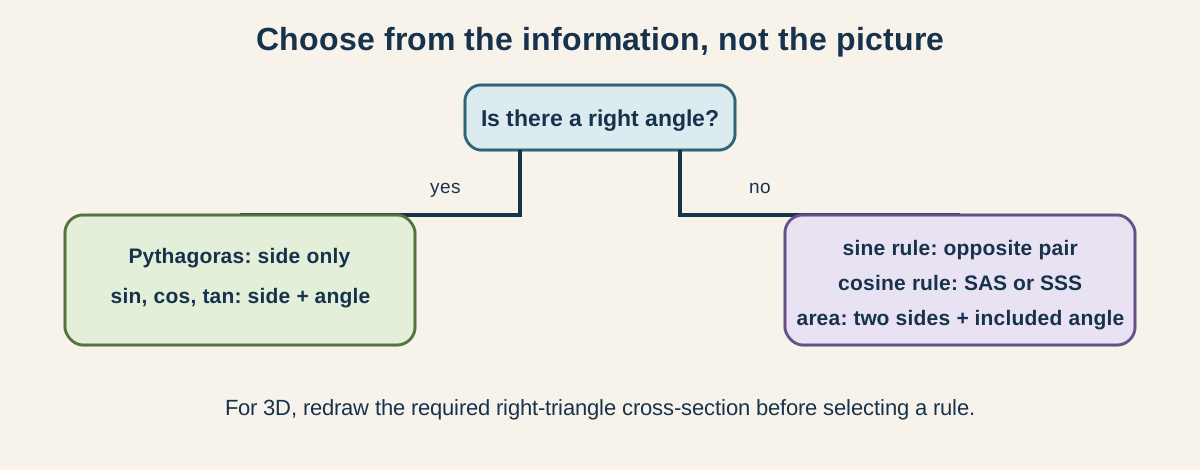
Pythagoras applies only after a right angle is established. A diagram that looks rectangular is insufficient evidence.
2. Right-triangle trigonometry
Relative to acute angle θ:
- sine θ = opposite ÷ hypotenuse;
- cosine θ = adjacent ÷ hypotenuse;
- tangent θ = opposite ÷ adjacent.
Label the sides from the chosen angle, then select the ratio containing the known and required sides. To find an angle, use the appropriate inverse trigonometric function. Cambridge states angle answers in degrees and normally to one decimal place in this section.
Core problems may combine bearings with right triangles. Extended candidates also use angles of elevation and depression and the fact that perpendicular distance from a point to a line is the shortest distance.
3. Exact values in Extended content
Extended candidates know exact sine and cosine values at 0°, 30°, 45°, 60° and 90°, plus tangent at 0°, 30°, 45° and 60°. Exact values such as √3/2 preserve structure and should not be replaced by decimals unless requested.
Use the symmetry of a unit-circle or special-triangle model to rebuild values instead of memorising an unconnected list. Tangent equals sine divided by cosine, so tangent is undefined at 90°.
4. Trigonometric graphs and equations
For 0° ≤ x ≤ 360°, Extended candidates recognise and sketch y = sin x, y = cos x and y = tan x. Sine and cosine repeat every 360°; tangent repeats every 180° and has vertical asymptotes where cosine is zero.
To solve an equation, first find a reference angle, then use the signs and symmetry of the graph to list every solution in the stated interval. A calculator's inverse function usually returns only one principal value. Plotting or sketching the graph prevents missing additional solutions.
Check this topic from memory
Attempt the matching topic bank before reopening the notes. Use each missed idea to decide what to review next.
Start the topic quiz