

Cambridge IGCSE Mathematics Notes 7: Transformations and Vectors
Cambridge IGCSE Mathematics notes on transformations, vector notation, vector arithmetic and geometric proofs.
Cambridge IGCSE Mathematics 0580 Topic 8 covers reflection, rotation, enlargement and translation. Core questions use restricted centres, axes and positive or fractional enlargement factors without combinations. Extended questions may combine or reverse transformations, use negative scale factors, and add two-dimensional vector arithmetic and magnitude.
1. Describe a transformation completely
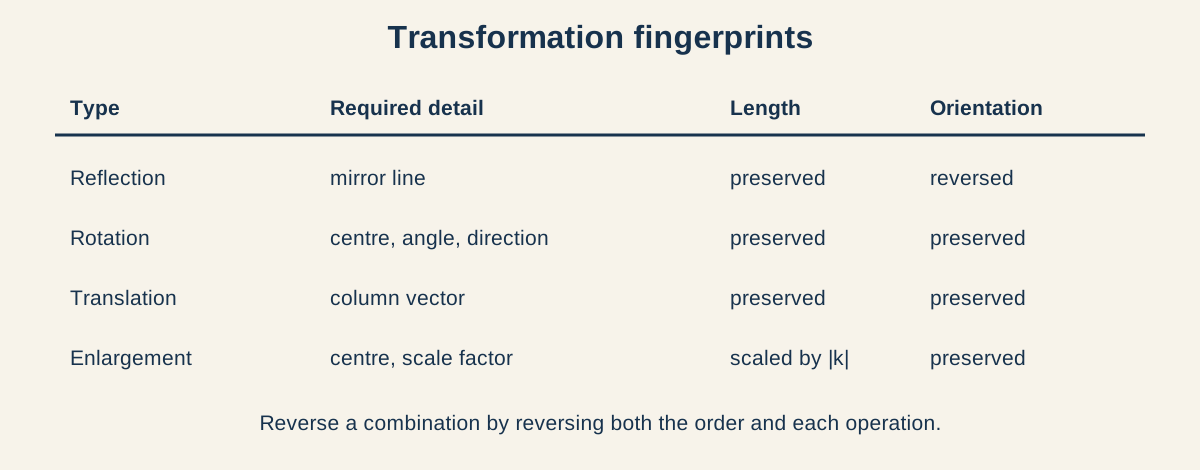
A complete reflection needs its mirror line. A complete rotation needs centre, angle and direction. An enlargement needs centre and scale factor. A translation needs a column vector. Naming only “rotation” or “enlargement” is incomplete.
Compare corresponding vertices systematically. Equal displacement from every vertex signals a translation. Equal distances from one centre suggest rotation. Lines joining a point to its image through one centre support enlargement. Perpendicular-bisected point-image segments identify a reflection axis.
Use a ruler for straight edges as required by the syllabus.
2. Reflection
The mirror line is the perpendicular bisector of every point-image segment. Points on the mirror line remain fixed. Reflection preserves lengths and angles but reverses orientation.
Core reflection axes are vertical or horizontal. Extended reflection may use any straight line. To construct accurately, move each vertex perpendicularly to the axis and place its image the same distance on the other side.
The reverse of a reflection is the same reflection.
3. Rotation
A rotation moves every point through the same angle about one centre, preserving distance from that centre. Angles are multiples of 90° in this syllabus. Core centres are the origin, a vertex or an edge midpoint; Extended centres may be more general.
The inverse rotation uses the same centre and angle magnitude but opposite direction. A 90° clockwise rotation can also be described as 270° anticlockwise, but use the clearest requested form.
4. Enlargement
An enlargement with centre O and scale factor k maps each point along the line through O, with image displacement k times the original displacement. Lengths scale by |k|, areas by k² and orientation is preserved. A negative factor places each image point on the opposite side of the centre from its object point.
Core scale factors are positive or fractional. Extended also includes negative factors. A factor between 0 and 1 reduces the shape but remains an enlargement transformation. A negative factor places the image on the opposite side of the centre and reverses its direction from O.
To find the centre, extend lines joining corresponding vertices until they meet. The reverse enlargement has the same centre and reciprocal scale factor.
Check this topic from memory
Attempt the matching topic bank before reopening the notes. Use each missed idea to decide what to review next.
Start the topic quiz