

IGCSE Physics Practical Skills 10: Electromagnetic Induction and Forces
Cambridge IGCSE Physics practical notes on coils, magnets, induced voltage, magnetic fields, force on conductors, variables, graphs, and safe evaluation.
Q: What does IGCSE Physics Practical Skills 10: Electromagnetic Induction and Forces cover?
A: It gives a complete Paper 5 and Paper 6 preparation route for the named skill, including apparatus, variables, data, safety, and evaluation.
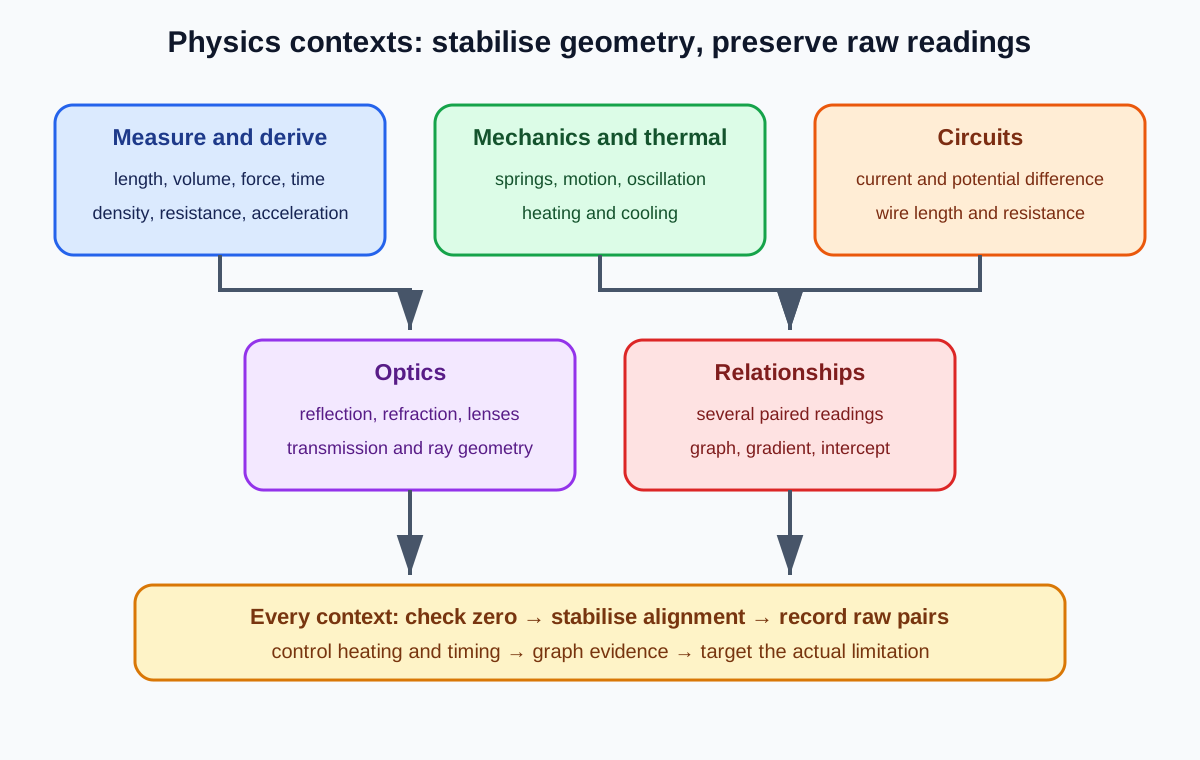
Aim
Investigate how motion, field strength, coil turns, or current affects induced voltage or magnetic force.
Apparatus and setup
- coil, bar magnet, sensitive meter, and connecting leads
- low-voltage supply, switch, and current-limiting resistor
- straight conductor, magnets, stand, and balance or force indicator where supplied
- ruler, stopwatch, and fixed guides for reproducible motion
Draw the apparatus as a working scientific diagram: use straight lines, label the parts that affect the method, and show where measurements are taken. Do not add decorative detail.
Method
- Choose either an induction or force investigation and draw the apparatus clearly.
- For induction, move the magnet or coil through the same path while changing one factor such as speed or coil turns.
- Record peak meter deflection and direction using a consistent motion rule.
- For force, keep conductor length and field geometry fixed while changing current or reversing direction.
- Repeat each condition and return the apparatus to the same starting position.
- Plot the measured response against the changed variable when enough quantitative readings are available.
Variables
- Independent variable: relative speed, coil turns, magnetic field condition, or current.
- Dependent variable: induced meter deflection or magnetic-force indicator.
- Controls: path, distance, conductor length in field, coil area, core, supply, and starting position.
A control variable is not just something kept the same. State how it is kept the same so another student could repeat the comparison.
Recording and processing results
Record direction as well as magnitude. If a peak deflection is brief, repeat the motion several times or use data logging when provided rather than estimating selectively.
Use one table for raw readings and calculated values when the relationship is simple. Put each unit in the heading, not in every cell. Preserve the instrument precision in raw data and round calculated values only at the end.
Check this topic from memory
Attempt the matching topic bank before reopening the notes. Use each missed idea to decide what to review next.
Start the topic quiz