

Cambridge IGCSE Statistics 1: Data and its collection
Cambridge IGCSE Statistics 0479 notes on data and its collection.
Cambridge IGCSE Statistics 0479 Topic 1 establishes how evidence is collected before any graph or calculation is trusted. The 2027 syllabus requires population, sample, census and representativeness; four named sampling methods; bias; random-number-table selection; open and closed questions; and qualitative, quantitative, discrete and continuous data. The qualification is available only in specified administrative zones and series, so centres must verify eligibility.
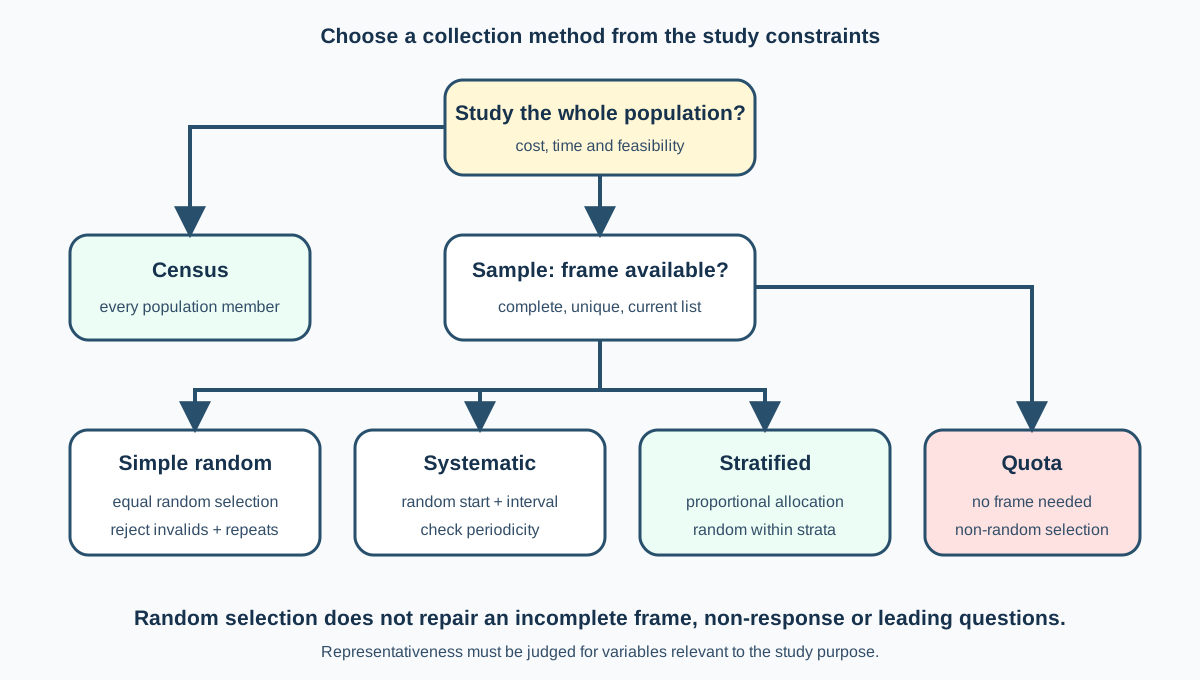
1. Population, census and sample
The population is the complete set about which a study seeks information. It may be people, objects, transactions or measurements. The population must be defined by place, time and inclusion rule, such as “all Year 10 students registered at the school on 1 September”.
A census collects information from every population member. It avoids sampling variation and can provide detailed subgroup data, but may be costly, slow and still affected by non-response, measurement error or outdated records.
A sample is a subset. It is usually faster and cheaper and can allow more careful measurement, but conclusions vary with which members are selected. Large does not automatically mean representative: a large biased sample can be worse than a smaller well-designed one.
A representative sample reflects relevant population characteristics sufficiently for the study purpose. Representativeness depends on the selection process and variables that matter, not merely on matching one convenient percentage.
2. Sampling frames
A sampling frame is a list or operational representation from which the sample is selected. Simple random, systematic and stratified sampling need a frame in this syllabus. Quota sampling does not.
A frame can be incomplete, duplicated or out of date. A school register excludes absent unregistered learners; a customer list excludes non-customers; a telephone directory excludes unlisted numbers. This coverage bias persists even if selection from the frame is perfectly random.
Number every frame member uniquely before using random numbers. Duplicate identifiers give some members extra selection chances.
3. Simple random sampling
In a simple random sample, every possible sample of the required size has an equal chance of selection. Number the population, read valid labels from a random-number table in a declared direction, reject out-of-range values and ignore repeats until the sample is complete.
If a population is numbered 001 to 240, read three-digit groups. Values 000 and 241 to 999 are invalid. If 073 appears twice, include that member only once for sampling without replacement.
Check this topic from memory
Attempt the matching topic bank before reopening the notes. Use each missed idea to decide what to review next.
Start the topic quiz