

Cambridge IGCSE Statistics 6: Transformations of data sets
Cambridge IGCSE Statistics 0479 notes on transformations of data sets.
Cambridge IGCSE Statistics 0479 Topic 6 examines how statistics change when data are translated, rescaled, extended, reduced, combined or standardised. The key distinction is between a change of location, which shifts values together, and a change of scale, which changes their separations.
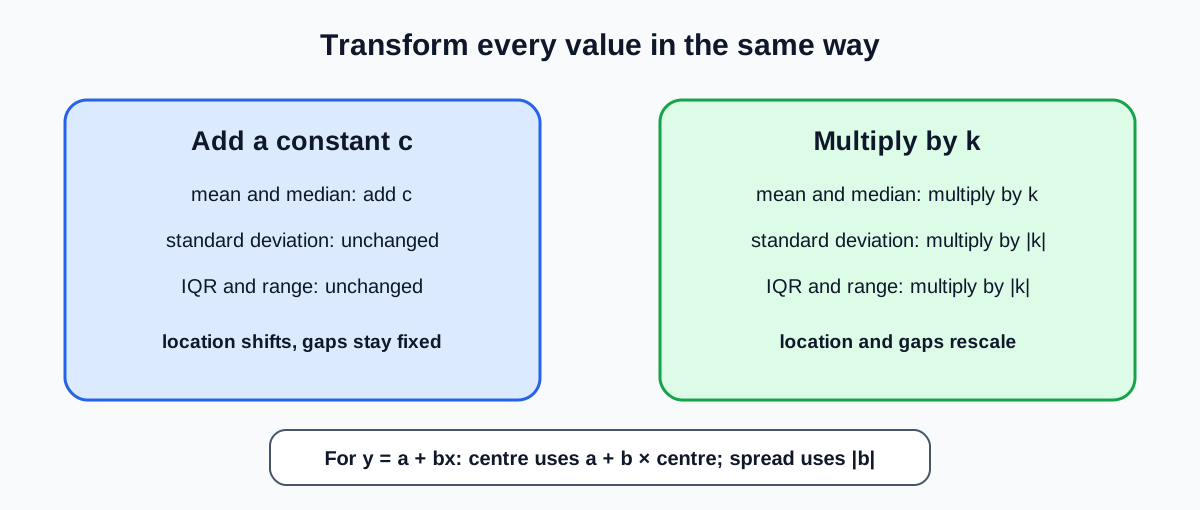
1. Adding a constant to every value
If a constant c is added to every observation:
- mean increases by c
- median increases by c
- standard deviation is unchanged
- interquartile range is unchanged
Every value moves the same distance, so location changes but pairwise gaps do not. Subtracting c has the corresponding effect. A temperature conversion of the form new value = old value + c shifts the scale without changing consistency.
The mode and all quartiles also shift by c when they are defined. Range is unchanged.
2. Multiplying every value by a constant
If every observation is multiplied by k:
- mean is multiplied by k
- median is multiplied by k
- standard deviation is multiplied by the absolute value of k
- interquartile range is multiplied by the absolute value of k
For positive k, order is preserved. For negative k, order reverses, so lower and upper quartiles exchange transformed roles, but non-negative spread measures scale by the absolute value. Variance would multiply by k squared, while standard deviation multiplies by the absolute value of k.
For a general linear transformation y = a + bx, transform centre by a + b times the original centre, and transform standard deviation or IQR by the absolute value of b. The added constant does not affect spread.
3. Adding or removing observations
There is no universal shortcut for introducing or removing individual values. Their effect depends on their magnitudes, positions and frequencies.
The mean rises when an added value is above the old mean, falls when it is below, and stays unchanged when it equals the old mean. The median may rise, fall or remain unchanged depending on how the new ordered position changes. Standard deviation can increase or decrease depending on how far the new value lies from the resulting mean.
For removal, reverse the reasoning through totals and ordered positions. Never claim that adding data automatically raises the mean or spread.
4. Combining means
For groups with sizes n1 and n2 and means m1 and m2:
Check this topic from memory
Attempt the matching topic bank before reopening the notes. Use each missed idea to decide what to review next.
Start the topic quiz