

Cambridge IGCSE Statistics 7: Probability
Cambridge IGCSE Statistics 0479 notes on probability.
Cambridge IGCSE Statistics 0479 Topic 7 covers probability notation, simple cases with and without replacement, complements, addition, mutually exclusive and independent events, simple conditional probability, and tree diagrams. Permutation and combination formulas are not required, nor is the formal conditional-probability formula.
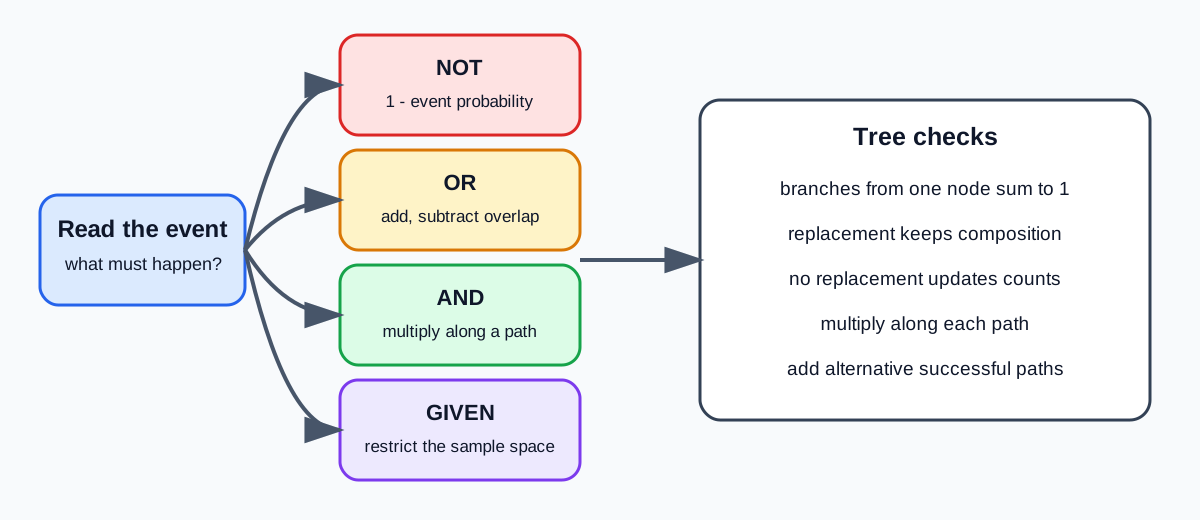
1. Probability language and notation
An experiment has possible outcomes. An event is a set of outcomes. Probabilities lie from 0 to 1 inclusive, where 0 means impossible and 1 means certain.
- P(A) means the probability of A.
- P(A′) means the probability that A does not occur.
- P(A ∩ B) means A and B both occur.
- P(A ∪ B) means A or B or both occur.
In probability, “or” is normally inclusive. The overlap belongs to both named events but must be counted once in their union.
For equally likely outcomes:
probability = favourable outcomes ÷ total possible outcomes
Do not use this shortcut when outcomes have unequal chances. Use the probabilities or data supplied.
2. Simple selections
List outcomes systematically with a table, ordered pairs or a tree. Cambridge does not require permutation or combination formulas, so clear enumeration is often sufficient.
With replacement, the first object is returned before the next selection. The composition and denominators remain unchanged. Without replacement, the total and possibly the favourable count decrease after the first selection. Branch probabilities must reflect what has already happened.
Fractions, decimals and percentages can all express probability. Keep exact fractions during multi-step work when possible and round only the final result.
3. Complements
An event and its complement exhaust all outcomes and cannot occur together:
P(A′) = 1 - P(A)
The complement is especially efficient for “at least one”. Calculate the probability of none and subtract from 1. Define the complement in words before calculating so the event is not reversed accidentally.
4. Addition rule
For any two events:
P(A ∪ B) = P(A) + P(B) - P(A ∩ B)
The intersection is subtracted because it was included in both individual probabilities. A Venn diagram can make this overlap visible.
Events are mutually exclusive when they cannot happen together, so their intersection probability is zero. Only then does the rule simplify to P(A ∪ B) = P(A) + P(B).
Mutual exclusivity concerns simultaneous occurrence, not whether probabilities influence one another.
Check this topic from memory
Attempt the matching topic bank before reopening the notes. Use each missed idea to decide what to review next.
Start the topic quiz