

Cambridge IGCSE Statistics 10: Index numbers
Cambridge IGCSE Statistics 0479 notes on index numbers.
Cambridge IGCSE Statistics 0479 Topic 10 covers price relatives, weighted aggregate index numbers using base-year expenditure weights, interpretation and use, and limitations when consumption weights change.
1. Price relatives
A price relative compares an item's price in a specified year with its price in the base year:
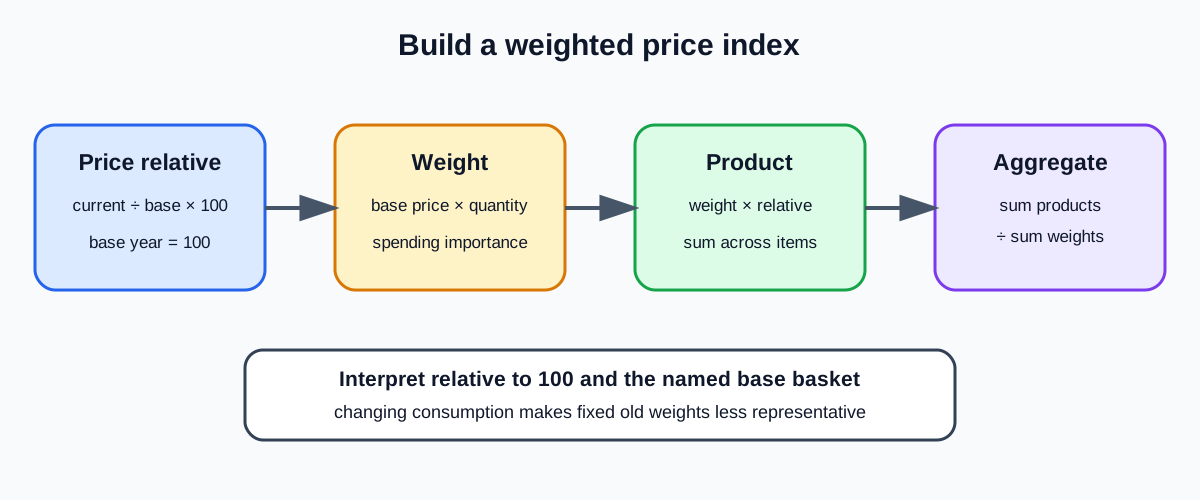
price relative = current-year price ÷ base-year price × 100
The base-year price relative is 100. A relative of 125 means the price is 25% above its base-year price. A relative of 84 means it is 16% below. The index itself is not a currency amount.
To recover a current price:
current price = price relative ÷ 100 × base price
To recover the base price, divide the current price by the relative as a multiplier. Retain the named base year because an index has no meaning without its reference.
2. Comparing index changes
An increase from index 120 to 132 is 12 index points but a 10% increase relative to 120. Do not call it a 12% increase automatically.
Index values with different base years cannot be compared directly until rebased. To rebase a series so a selected year's old index becomes 100:
new index = old index ÷ old index in new base year × 100
Rebasing changes the reference scale, not the underlying price movements.
3. Base-year expenditure weights
Different items matter unequally to a household or organisation. Cambridge specifies weights from base-year expenditure. For an item:
base-year expenditure = base-year price × base-year quantity
Weights may be these expenditure amounts, expenditure proportions or any proportional rescaling. Multiplying every weight by the same positive constant does not change the weighted mean.
Use base-year quantities, not current quantities, when the specified weighting system is base-year expenditure. Match every weight to its item.
4. Weighted aggregate index
Given price relatives r and weights w:
weighted aggregate index = sum of (weight × price relative) ÷ sum of weights
Create columns for item, price relative, weight and product. The result lies between the smallest and largest component relatives when all weights are positive.
A heavily weighted item influences the aggregate more strongly. The index is a weighted summary, not the simple average unless all weights are equal.
5. Interpreting and using an aggregate index
An aggregate index of 118 means the weighted basket's price level is 18% above the base-year level under the stated weights. It does not mean every item increased by 18%.
Check this topic from memory
Attempt the matching topic bank before reopening the notes. Use each missed idea to decide what to review next.
Start the topic quiz