

Pearson International A Level Biology Unit 2: Cells, Development, Biodiversity and Conservation
Pearson IAL Biology notes on cells, reproduction, development, plant structure, biodiversity and conservation.
Pearson Edexcel International A Level Biology Unit 2 is an externally assessed written unit. This note follows the official specification content and keeps theory ownership separate from the dedicated practical-skills hub. Experimental evidence can appear inside theory questions, but Units 3 and 6 remain the written practical-skills papers.
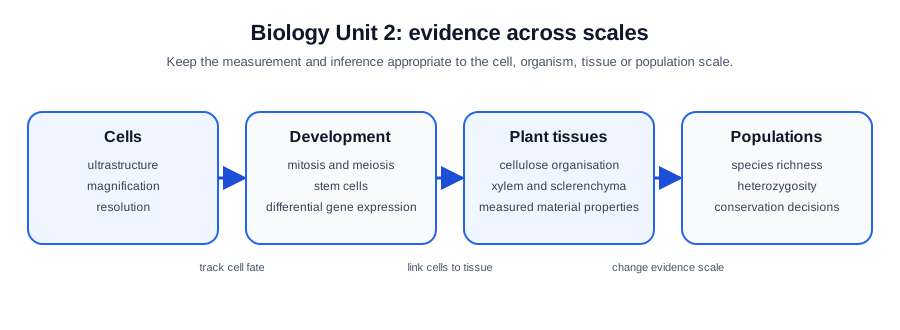
Official unit scope
- Cells and microscopy. Compare eukaryotic and prokaryotic ultrastructure, calculate magnification, distinguish magnification from resolution and recognise organelles in electron micrographs.
- Cell division and development. Track loci, chromosome behaviour and genetic variation through meiosis and fertilisation, then connect mitosis, mitotic index, stem cells, differential gene expression and alternative splicing to development.
- Plant structure and useful materials. Relate cellulose microfibrils, secondary thickening, xylem and sclerenchyma to support and transport, and evaluate plant fibres, starch, antimicrobial substances and drug testing in their evidence contexts.
- Biodiversity and conservation. Use classification, DNA and protein evidence, species richness, heterozygosity and Hardy-Weinberg reasoning, then evaluate adaptation, natural selection, zoos and seed banks without reducing conservation to population count alone.
The content is assessed through unfamiliar contexts as well as direct recall. Build explanations from first principles: identify the system, name the relevant quantities or structures, state the mechanism, connect cause to observation and limit the conclusion to the evidence supplied. A list of keywords is not a causal explanation.
Core reasoning and methods
- Choose magnification or resolution according to whether the task concerns apparent size or distinguishable detail.
- Track chromosome number and genetic variation separately through mitosis, meiosis and fertilisation.
- Evaluate conservation strategies by genetic diversity, population viability, habitat effects and practical constraints.
Quantitative work should begin with the governing relationship, followed by unit conversion, substitution, calculation and a reasonableness check. Keep additional significant figures during working and round at the end. Qualitative work needs the same discipline: compare like with like, identify a control or baseline, and distinguish an observed result from an inferred mechanism.
Graphs and tables are arguments in compressed form. Read axes, units, uncertainty indicators and scales before describing a trend. A valid conclusion identifies the relevant interval, direction and evidence. If data scatter or overlap weakens the claim, say so. Extrapolation beyond the measured range requires justification.
Check this topic from memory
Attempt the matching topic bank before reopening the notes. Use each missed idea to decide what to review next.
Start the topic quiz