

Pearson International A Level Biology Unit 5: Respiration, Internal Environment, Coordination and Gene Technology
Pearson IAL Biology notes on respiration, homeostasis, coordination and gene technology.
Pearson Edexcel International A Level Biology Unit 5 is an externally assessed written unit. This note follows the official specification content and keeps theory ownership separate from the dedicated practical-skills hub. Experimental evidence can appear inside theory questions, but Units 3 and 6 remain the written practical-skills papers.
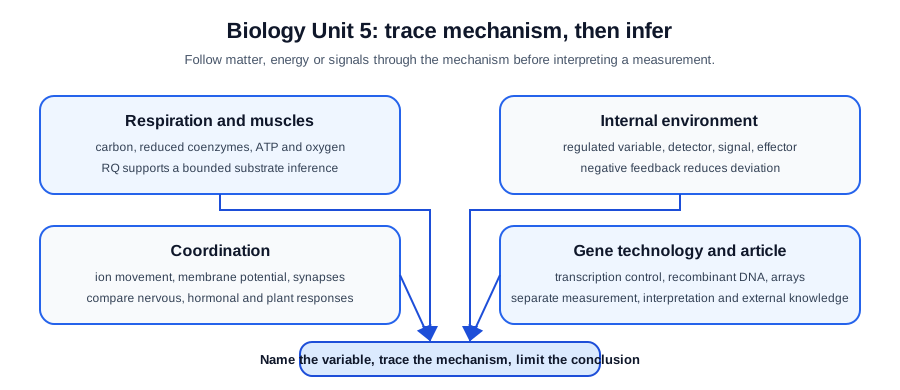
Official unit scope
- Respiration and muscles. Trace glycolysis, the link reaction, Krebs cycle and oxidative phosphorylation, distinguish aerobic from anaerobic outcomes, interpret respiratory quotient and connect ATP supply to muscle contraction and exercise evidence.
- Internal environment and feedback. Explain cardiac output, hormonal responses, positive and negative feedback, kidney structure, urea formation, selective reabsorption and osmoregulation without describing homeostasis as preventing all change.
- Coordination. Connect neurone, action-potential, myelin, synapse and reflex-arc structure to function, and compare nervous, hormonal and plant coordination, brain imaging and drug effects within the evidence supplied.
- Gene technology. Explain transcription control, recombinant DNA, genetically modified production, microarrays and bioinformatics while distinguishing what each method measures from the broader claim inferred.
- Pre-release scientific article. Analyse the article issued for the applicable examination series by separating its reported observations, methods, interpretations and external biological knowledge; no fixed article content is assumed here.
The content is assessed through unfamiliar contexts as well as direct recall. Build explanations from first principles: identify the system, name the relevant quantities or structures, state the mechanism, connect cause to observation and limit the conclusion to the evidence supplied. A list of keywords is not a causal explanation.
Core reasoning and methods
- Follow carbon, hydrogen and energy through stages of respiration instead of memorising disconnected yields.
- For homeostasis, name the variable, receptor, coordination signal, effector and negative-feedback response.
- Separate what a gene-technology method measures from what can be inferred from its output.
Quantitative work should begin with the governing relationship, followed by unit conversion, substitution, calculation and a reasonableness check. Keep additional significant figures during working and round at the end. Qualitative work needs the same discipline: compare like with like, identify a control or baseline, and distinguish an observed result from an inferred mechanism.
Check this topic from memory
Attempt the matching topic bank before reopening the notes. Use each missed idea to decide what to review next.
Start the topic quiz