

Pearson International A Level Biology Core Practical 3: Investigate temperature and alcohol effects on membrane permeability
Pearson IAL Biology practical notes on investigate temperature and alcohol effects on membrane permeability.
This guide explores temperature and alcohol treatments using beetroot pigment leakage. It is a practice design, not a claim to reproduce Pearson's prescribed procedure. Check the current course documents and your centre's risk assessment before choosing conditions or equipment.
Aim and scientific principle
Compare pigment leakage from matched beetroot tissue under different temperature or alcohol treatments. The optical reading is an indirect indicator of membrane damage under the stated conditions, not a direct measurement of a membrane permeability coefficient.
Begin by translating the title into a testable question. Identify what is deliberately changed, what is measured directly, what is calculated and what must remain controlled. Predict a relationship only after naming the mechanism. A prediction without a reason is weak; a reason without measurable variables cannot guide a practical design.
Apparatus and setup
Use matched beetroot cylinders or discs, a cork borer, ruler, water baths, an appropriate thermometer, specified alcohol solutions, tubes, a timer, forceps and a colorimeter with compatible cuvettes. Consider measuring range, resolution, uncertainty, calibration and suitability for the sample, not the instrument name alone. Draw a labelled scientific setup that shows the working geometry and exactly where readings are taken. Include a control or blank when it distinguishes the target effect from drift, contamination or background response.
Before collecting results, check zero readings, calibration, leaks, alignment or sterility as relevant. Record the instrument resolution beside the first raw-data table. If a digital device displays more digits than its underlying accuracy supports, do not treat every digit as equally certain.
Method
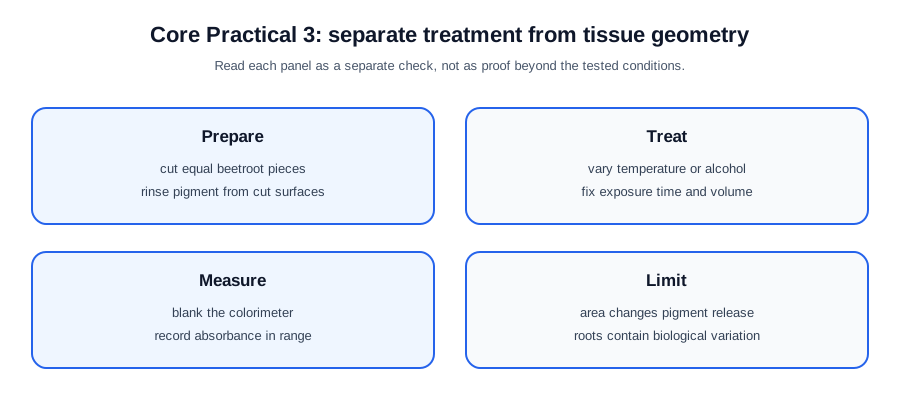
- Cut tissue pieces to matched dimensions, rinse away pigment released during cutting using the same procedure, and blot consistently. Record the source root and allocate pieces randomly within each root to the treatments.
- Investigate temperature and alcohol concentration in separate series. For the temperature series, keep the solution composition fixed and monitor the actual exposure temperature. For the alcohol series, state the alcohol identity and concentration convention, include a zero-alcohol control, and keep temperature fixed. Use the same solution volume and exposure time.
- Remove tissue without squeezing it, mix each solution consistently and record the chosen absorbance response at a fixed suitable wavelength. Use a pigment-free blank matched to the solvent composition and compatible cuvettes; standardise the measurement temperature and delay after exposure. Keep readings within the instrument and method's usable range.
Check this topic from memory
Attempt the matching topic bank before reopening the notes. Use each missed idea to decide what to review next.
Start the topic quiz