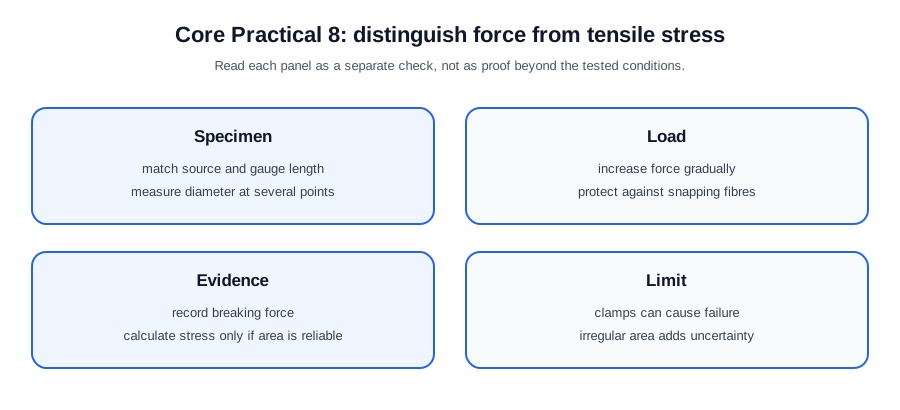
This guide practises comparing plant-fibre tensile behaviour. It is not a complete validated materials-testing protocol or a claim to reproduce Pearson's prescribed procedure. Use an approved setup and loading method with the current course documents and local risk assessment, and name the quantity your measurements actually establish.
Aim and scientific principle
Compare defined plant-fibre specimens under a stated loading procedure. Distinguish force, nominal stress at break and maximum nominal tensile stress: breaking force divided by original cross-sectional area gives nominal breaking stress, while ultimate tensile strength uses the maximum force reached. These need not coincide.
Begin by translating the title into a testable question. Identify what is deliberately changed, what is measured directly, what is calculated and what must remain controlled. Predict a relationship only after naming the mechanism. A prediction without a reason is weak; a reason without measurable variables cannot guide a practical design.
Apparatus and setup
Use specified fibres or fibre bundles, a stable approved support and grip arrangement, masses or a suitable force sensor, equipment capable of resolving the required gauge length and cross-section, a protective screen and a catch tray. A ruler suitable for length may not resolve a thin fibre diameter; do not infer a reliable area from unsuitable measurements. Consider measuring range, resolution, uncertainty, calibration and suitability for the sample, not the instrument name alone. Draw a labelled scientific setup that shows the working geometry and exactly where readings are taken. Include a control or blank when it distinguishes the target effect from drift, contamination or background response.
Before collecting results, check zero readings, calibration, leaks, alignment or sterility as relevant. Record the instrument resolution beside the first raw-data table. If a digital device displays more digits than its underlying accuracy supports, do not treat every digit as equally certain.
Method
Define whether each specimen is a single fibre or a bundle, its plant or batch source, gauge length, preparation and moisture condition. State the original-area measurement method and shape assumptions if stress will be calculated. Retain specimen and source identities.
Align the specimen and grip it using the approved method, avoiding avoidable damage and slippage. Specify loading increments, timing and any dwell period, or the controlled instrument loading procedure. Add masses smoothly rather than dropping them.
For stepped masses, record the last sustained total load and the first applied step at which failure occurs, including relevant hanger load and the stated gravitational conversion. These are protocol-dependent observations, not an exact breaking-force reading. A simple threshold bracket additionally assumes quasi-static loading without important shock or time-dependent effects. With a force sensor, retain the force record, maximum force, defined break event and relevant zero or preload convention.
Check this topic from memory
Attempt the matching topic bank before reopening the notes. Use each missed idea to decide what to review next.
Record failure location, slippage and other procedural observations for every specimen. Apply a justified predeclared exclusion rule without erasing the original records. Test additional specimens, retaining plant or batch identities; successive load steps on one specimen are not independent fibre replicates.
Plan the analysis before starting. This reveals whether an additional measurement is needed for a derived quantity and prevents a completed experiment from lacking a mass, length, concentration, background or calibration value. A method should be detailed enough for another trained student to reproduce, while avoiding decorative steps that do not affect validity.
Variables and controls
Comparison or predictor: named fibre type or treatment, or measured original cross-sectional area as a predictor. Measured area is not necessarily a manipulated variable.
Recorded response: protocol-defined failure-load observations or instrumented force quantities; nominal stress at break or maximum nominal stress only when force and original area support that calculation.
Important controls and records: gauge length, loading procedure and timing, moisture condition, preparation, alignment and gripping, and source identity where not deliberately varied.
For each control, state how it is maintained or monitored. Simply writing "keep temperature constant" is incomplete if the method has no bath, probe, equilibration time or other means of doing so. Choose a range wide enough to reveal the relationship but within safe and scientifically valid limits. Choose the number, range and spacing of values for the expected response and analysis. Concentrating values near an uncertain threshold or optimum can be more useful than uniform spacing; no fixed count establishes an adequate design.
What is distinctive about this practical
Breaking force is a specimen-level response and depends on geometry as well as material and test conditions. Nominal stress normalises by the stated original cross-sectional area, but does not remove uncertainty in irregular shape, preparation, moisture or loading history. Report area assumptions; several diameter readings do not by themselves prove a circular cross-section or a representative area. If area is not defensible, report the force observations and restrict the comparison accordingly.
A break near a grip can indicate stress concentration, grip damage or misalignment, but location alone does not prove the cause. Retain those observations and justify how the chosen method handles them. Do not automatically discard every low result or claim a material property independent of the test conditions.
Recording and processing results
For a quasi-static hanging-load calculation, account for the total supported mass in the actual load path, including the hanger where applicable, and state the gravitational acceleration used. Keep last-sustained and first-failure-step loads distinct. Do not treat the first failed step as an exact threshold or a midpoint as an observed force. For instrumented tests, distinguish maximum force from force at the defined break event and avoid double-counting a load already included by the sensor or zero convention. Calculate nominal stress only with a stated original-area estimate, units and assumptions. Put units in column headings, record raw readings consistently with instrument resolution and the method and distinguish repeats from calculated means. Do not delete an anomaly merely because it is inconvenient. Recheck the condition, look for a procedural explanation and state any exclusion rule.
Retain individual specimen results and source identities, showing spread and any justified exclusions. Use categorical comparisons for fibre types or treatments; use a fitted relationship for a numerical predictor only when justified. Distinguish specimens within a source plant or batch from independently sampled sources when choosing the scope of inference and uncertainty summary.
Safety, ethics and responsible practice
Use eye protection, a screen and a catch tray; keep feet and faces away from falling masses and snapping fibres. A useful safety statement names the hazard, identifies who or what could be harmed and gives a control that reduces likelihood or severity. "Take care" does not specify an action that reduces the identified risk. Biological investigations must also consider contamination, organism welfare and disposal.
Worked application: from raw evidence to a defensible conclusion
In a worked application, the candidate records the observations and measurements required by the method. The candidate defines the comparison or measured predictor, records gauge length and loading conditions, and controls the other relevant factors without treating a deliberately varied source or type as fixed. Raw values are recorded with units and appropriate resolution. The candidate calculates the required response, uses a mean only after inspecting repeats, and presents the actual failure-load observations or specified force/stress response using a display appropriate to the predictor and question. The candidate does not relabel a rupture measurement as a maximum-stress measurement without supporting force data. The conclusion quotes the direction and size of the observed trend rather than saying merely that the prediction was correct. Where possible, repeat the anomalous condition, retain the original observation and justify any exclusion rather than silently removing it. The evaluation then links the main limitation to its likely effect and proposes a targeted change that would improve the evidence.
This chain is stronger than a memorised recipe because every step answers the practical question. If the graph contradicts the prediction, report the evidence honestly and investigate method, range, controls and model assumptions before claiming a new scientific law.
Evaluation: limitation, effect and improvement
Limitation: uncertain original cross-section, grip effects and coarse or inconsistent loading can affect the reported response.
Likely effect: an incorrect area biases nominal stress, while grip damage or misalignment can cause premature failure. Stepped loading limits threshold resolution, and shock or dwell-time differences can change the observed failure step.
Targeted improvement: use a justified cross-section method, validated alignment and grips, and a consistent approved loading procedure with adequate measurement resolution. Inspect and retain grip-failure observations, applying any exclusion rule transparently; padding or automatic exclusion is not a universal remedy.
Separate random variation, systematic bias and model limitation. Repeats help reveal random variation but do not remove a zero error. Calibration establishes the relation between reference values and indications; appropriate adjustment or correction can address an identified offset. It does not make biased sampling representative. Finer resolution and greater repeatability are distinct properties, and finer resolution may improve an estimate only when the reading is a material source of uncertainty.
Common misconceptions and corrections
Repeats automatically make a result accurate. Repeats estimate random variation; they do not correct a biased method or calibration error.
A control variable is just a list item. Explain the apparatus or procedure that keeps it stable.
The line must pass through every point. Use the overall pattern and a best-fit relationship, then investigate justified anomalies.
Percentage error and percentage uncertainty are interchangeable. Error compares a measured value with a suitable reference. Uncertainty characterises dispersion of values attributed to the measurand; it may be expressed as a standard uncertainty or an interval with stated coverage, and includes more than resolution alone. State the reference, denominator and uncertainty convention used.
A successful endpoint proves the theory. The observation supports a conclusion only within the method, range and assumptions tested.
More sophisticated apparatus is always better. The improvement must address the dominant limitation and be practical in the stated context.
Assessment guidance
Pearson states that IAL practical skills are assessed mainly in Unit 3 and Unit 6, with related theory also assessable in the other unit papers. Planning answers need an operational independent variable, a measured dependent variable, a justified range, controls, repeats, safety and a stated analysis. Data answers need units, consistent precision, sensible significant figures and transparent calculations. Graph answers need labelled axes, a scale using the grid well and line treatment appropriate to the data and question. Evaluation answers should use a limitation-effect-improvement chain specific to the apparatus. Do not claim that a memorised core-practical recipe is the only acceptable method when the question supplies a different valid context.
Retrieval practice
Extend or adapt this practical to answer a related question. Where the design uses a continuous variable, justify its planned values. List apparatus with range and resolution where relevant, control methods, a raw record layout, the expected analysis and one hazard-control pair. Then identify one random uncertainty, one systematic bias and one model limitation. Explain which can be reduced by repeats, which needs calibration followed by appropriate correction or adjustment, or a redesign, and how your conclusion would change if the anomaly were confirmed.