

Pearson International A Level Biology Core Practical 9: Investigate antimicrobial properties of plants using aseptic technique
Pearson IAL Biology practical notes on investigate antimicrobial properties of plants using aseptic technique.
This guide practises interpreting plant-extract antimicrobial screening under an institution-approved teaching-laboratory protocol. It is not a complete validated microbiology procedure or a claim to reproduce Pearson's prescribed method. Use current course documents, trained supervision and a local risk assessment.
Aim and scientific principle
Compare microbial growth inhibition using aseptic technique, standardised inoculation and controlled diffusion conditions.
Begin by translating the title into a testable question. Identify what is deliberately changed, what is measured directly, what is calculated and what must remain controlled. Predict a relationship only after naming the mechanism. A prediction without a reason is weak; a reason without measurable variables cannot guide a practical design.
Apparatus and setup
Use institution-approved cultures, sterile agar plates, swabs, forceps, discs or wells, test solutions, disinfectant and suitable measuring equipment. Culture selection, facilities and handling must be approved for the activity; a teaching label does not establish absence of risk. Consider measuring range, resolution, uncertainty, calibration and suitability for the sample, not the instrument name alone. Draw a labelled scientific setup that shows the working geometry and exactly where readings are taken. Include a control or blank when it distinguishes the target effect from drift, contamination or background response.
Before collecting results, check zero readings, calibration, leaks, alignment or sterility as relevant. Record the instrument resolution beside the first raw-data table. If a digital device displays more digits than its underlying accuracy supports, do not treat every digit as equally certain.
Method
- Disinfect the workspace, label the base and prepare a uniform microbial lawn using aseptic technique.
- Apply equal discs or wells with controlled treatment volumes, including positive and negative controls.
- Tape the lid with permitted short strips, incubate in the school's approved conditions and do not reopen grown plates.
- Measure inhibition-zone diameters in two perpendicular directions and compare repeats.
Plan the analysis before starting. This reveals whether an additional measurement is needed for a derived quantity and prevents a completed experiment from lacking a mass, length, concentration, background or calibration value. A method should be detailed enough for another trained student to reproduce, while avoiding decorative steps that do not affect validity.
Variables and controls
- Independent variable: plant extract, antibiotic identity or concentration.
- Dependent variable: inhibition-zone diameter or area.
- Important controls: microbial strain and density, agar depth, disc size, solvent volume, incubation time and temperature.
For each control, state how it is maintained or monitored. Simply writing "keep temperature constant" is incomplete if the method has no bath, probe, equilibration time or other means of doing so. Choose a range wide enough to reveal the relationship but within safe and scientifically valid limits. Choose the number, range and spacing of values for the expected response and analysis. Concentrating values near an uncertain threshold or optimum can be more useful than uniform spacing; no fixed count establishes an adequate design.
What is distinctive about this practical
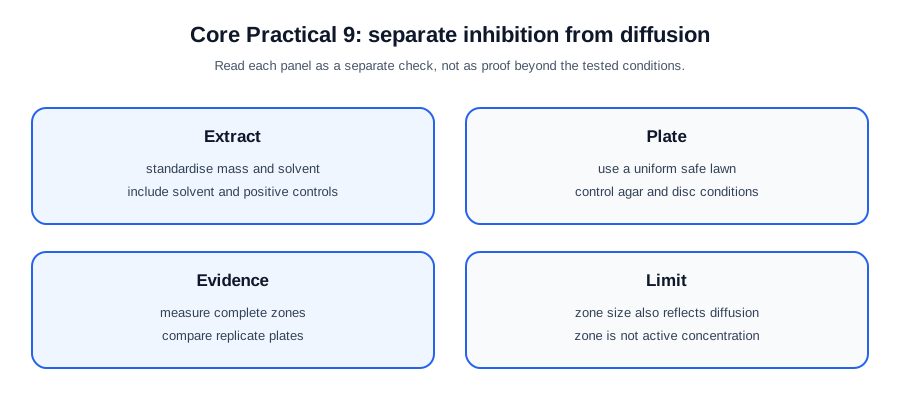
Standardise plant mass, solvent volume, extraction time and extract concentration. A solvent-only control checks the carrier response under the tested conditions. A suitable positive control checks whether the specified organism and assay can show the expected inhibition; it does not establish extract recovery or identify the active compound. Zone diameter is a screening response, not a direct measure of active-compound concentration, because pigments, viscosity and molecular size affect diffusion. A concentration series can explore the response within this screening method. A minimum inhibitory concentration requires an appropriate validated dilution method and defined endpoint; neither a larger zone nor a concentration series alone establishes clinical effectiveness. Do not apply clinical susceptibility breakpoints to an unvalidated plant-extract screen.
Recording and processing results
Compare treatment results with the solvent-only control using the same measurement convention. Do not automatically subtract control-zone diameters: diameter differences are not a validated additive correction for antimicrobial effect. Define whether the recorded diameter includes the disc or well, how no visible inhibition is recorded, and how indistinct or overlapping boundaries are handled. Retain plate, extract-preparation and disc identities. Two perpendicular readings of one zone are technical measurements, not independent experimental repeats. Present summaries with variation at the level justified by the design. Put units in column headings, record raw readings consistently with instrument resolution and the method and distinguish repeats from calculated means. Do not delete an anomaly merely because it is inconvenient. Recheck the condition, look for a procedural explanation and state any exclusion rule.
Choose a fitted line, curve or ruled joins according to the data, scientific relationship and question; do not connect or smooth points mechanically. A gradient should use a large triangle and values read from the fitted line. When a relationship is linearised, explain the transformation and connect gradient or intercept to the requested physical quantity. When observations are categorical, define the category rule before seeing the result.
Safety, ethics and responsible practice
Follow the institution's activity-specific risk assessment, training, containment, approved culture and incubation conditions, and validated decontamination and disposal procedures. Do not substitute unknown environmental or clinical samples. Never reopen incubated teaching plates for these measurements. A useful safety statement names the hazard, identifies who or what could be harmed and gives a control that reduces likelihood or severity. "Take care" does not specify an action that reduces the identified risk. Biological investigations must also consider contamination, organism welfare and disposal.
Worked application: from raw evidence to a defensible conclusion
In a worked application, the candidate records the observations and measurements required by the method. The candidate first checks that plant extract, antibiotic identity or concentration is the only intended change and that microbial strain and density, agar depth, disc size, solvent volume, incubation time and temperature remain controlled. Raw values are recorded with units and appropriate resolution. The candidate calculates the required response, uses a mean only after inspecting repeats, and compares inhibition-zone measurements using an analysis appropriate to the design. Extract identities are categories; a fitted continuous trend requires a justified continuous variable and model. The conclusion quotes the direction and size of the observed trend rather than saying merely that the prediction was correct. Where possible, repeat the anomalous condition, retain the original observation and justify any exclusion rather than silently removing it. The evaluation then links the main limitation to its likely effect and proposes a targeted change that would improve the evidence.
This chain is stronger than a memorised recipe because every step answers the practical question. If the graph contradicts the prediction, report the evidence honestly and investigate method, range, controls and model assumptions before claiming a new scientific law.
Evaluation: limitation, effect and improvement
- Limitation: zone size depends on diffusion as well as antimicrobial effect.
- Likely effect: a substance that diffuses farther can form a larger zone without having a lower minimum inhibitory concentration, so zone diameter alone can mis-rank antimicrobial potency.
- Targeted improvement: standardise agar and disc conditions, include controls and use a dilution assay when minimum inhibitory concentration is required.
Separate random variation, systematic bias and model limitation. Repeats help reveal random variation but do not remove a zero error. Calibration establishes the relation between reference values and indications; appropriate adjustment or correction can address an identified offset. It does not make biased sampling representative. Finer resolution and greater repeatability are distinct properties, and finer resolution may improve an estimate only when the reading is a material source of uncertainty.
Common misconceptions and corrections
- Repeats automatically make a result accurate. Repeats estimate random variation; they do not correct a biased method or calibration error.
- A control variable is just a list item. Explain the apparatus or procedure that keeps it stable.
- The line must pass through every point. Use the overall pattern and a best-fit relationship, then investigate justified anomalies.
- Percentage error and percentage uncertainty are interchangeable. Error compares a measured value with a suitable reference. Uncertainty characterises dispersion of values attributed to the measurand; it may be expressed as a standard uncertainty or an interval with stated coverage, and includes more than resolution alone. State the reference, denominator and uncertainty convention used.
- A successful endpoint proves the theory. The observation supports a conclusion only within the method, range and assumptions tested.
- More sophisticated apparatus is always better. The improvement must address the dominant limitation and be practical in the stated context.
Assessment guidance
Pearson assesses practical understanding throughout the science papers and concentrates it in written Units 3 and 6. Planning answers need an operational independent variable, a measured dependent variable, a justified range, controls, repeats, safety and a stated analysis. Data answers need units, consistent precision, sensible significant figures and transparent calculations. Graph answers need labelled axes, a scale using the grid well and line treatment appropriate to the data and question. Evaluation answers should use a limitation-effect-improvement chain specific to the apparatus. Do not claim that a memorised core-practical recipe is the only acceptable method when the question supplies a different valid context.
Retrieval practice
Extend or adapt this practical to answer a related question. Where the design uses a continuous variable, justify its planned values. List apparatus with range and resolution where relevant, control methods, a raw record layout, the expected analysis and one hazard-control pair. Then identify one random uncertainty, one systematic bias and one model limitation. Explain which can be reduced by repeats, which needs calibration followed by appropriate correction or adjustment, or a redesign, and how your conclusion would change if the anomaly were confirmed.
Official sources and ownership
- Pearson Edexcel, International Advanced Level Biology specification.
- Pearson Edexcel, International Advanced Level Biology Teacher Practical Guide.
Pearson also provides international science practical-assessment guidance.
This note is independently written for the dedicated Biology practical hub. Use the theory hub for mechanisms, equations and conceptual development.
Check this topic from memory
Attempt the matching topic bank before reopening the notes. Use each missed idea to decide what to review next.
Start the topic quiz