

Pearson International A Level Biology Core Practical 10: Investigate factors affecting photosynthesis in an aquatic plant
Pearson IAL Biology practical notes on investigate factors affecting photosynthesis in an aquatic plant.
This guide practises measuring an aquatic plant's oxygen response under specified light conditions. It is not a complete validated gas-exchange protocol or a claim to reproduce Pearson's prescribed procedure. Use current course documents and an approved setup, and distinguish the measured response from the biological rate inferred.
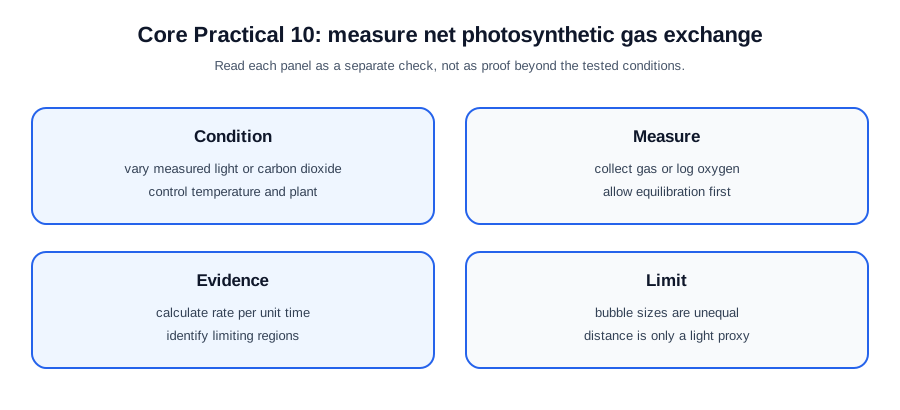
Aim and scientific principle
Measure oxygen production or another photosynthetic response while controlling light, temperature and carbon-dioxide availability.
Begin by translating the title into a testable question. Identify what is deliberately changed, what is measured directly, what is calculated and what must remain controlled. Predict a relationship only after naming the mechanism. A prediction without a reason is weak; a reason without measurable variables cannot guide a practical design.
Apparatus and setup
Use aquatic plant, bicarbonate solution, lamp, ruler, water bath or heat shield, gas collection or oxygen sensor and timer. Consider measuring range, resolution, uncertainty, calibration and suitability for the sample, not the instrument name alone. Draw a labelled scientific setup that shows the working geometry and exactly where readings are taken. Include a control or blank when it distinguishes the target effect from drift, contamination or background response.
Before collecting results, check zero readings, calibration, leaks, alignment or sterility as relevant. Record the instrument resolution beside the first raw-data table. If a digital device displays more digits than its underlying accuracy supports, do not treat every digit as equally certain.
Method
- Define the plant specimen, solution, measurement geometry and oxygen-measurement method. Allow acclimatisation at each condition and specify how a suitable recording interval is chosen.
- Record lamp distance or measure the chosen light quantity near the plant, stating sensor type, units and position. Monitor solution temperature; a heat shield or bath does not by itself prove constant temperature.
- Record collected gas volume over time or the dissolved-oxygen time course after equilibration. Check whether a slope adequately represents the selected interval rather than assuming a constant rate from one endpoint.
- Choose enough light conditions for the expected response and analysis, and counterbalance or randomise order where feasible to investigate drift. Retain specimen and run identities: successive readings from one shoot are not independent plant replicates.
Plan the analysis before starting. This reveals whether an additional measurement is needed for a derived quantity and prevents a completed experiment from lacking a mass, length, concentration, background or calibration value. A method should be detailed enough for another trained student to reproduce, while avoiding decorative steps that do not affect validity.
Check this topic from memory
Attempt the matching topic bank before reopening the notes. Use each missed idea to decide what to review next.
Start the topic quiz