

Pearson International A Level Biology Core Practical 14: Investigate antibiotic effects on bacteria
Pearson IAL Biology practical notes on investigate antibiotic effects on bacteria.
This guide practises interpreting antibiotic inhibition zones in an institution-approved teaching assay. It is not a complete validated susceptibility-testing protocol or a claim to reproduce Pearson's prescribed method. Use current course documents, trained supervision and a local risk assessment; do not use this classroom comparison to select treatment for a patient.
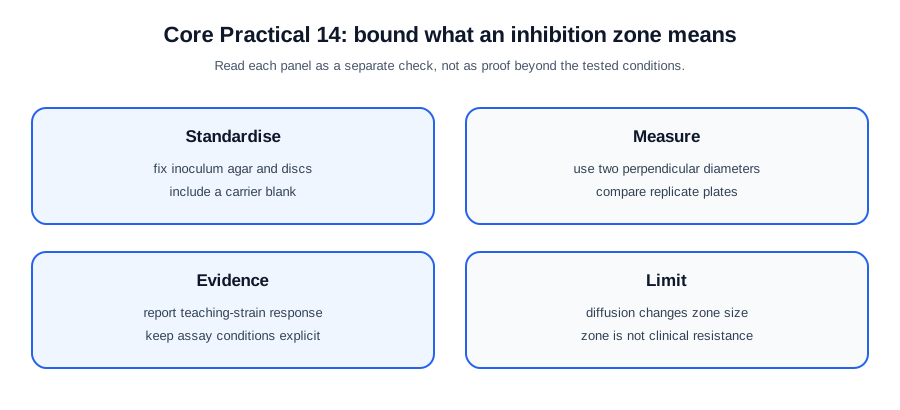
Aim and scientific principle
Compare microbial growth inhibition using aseptic technique, standardised inoculation and controlled diffusion conditions.
Begin by translating the title into a testable question. Identify what is deliberately changed, what is measured directly, what is calculated and what must remain controlled. Predict a relationship only after naming the mechanism. A prediction without a reason is weak; a reason without measurable variables cannot guide a practical design.
Apparatus and setup
Use institution-approved cultures, sterile agar plates, swabs, forceps, discs or wells, test solutions, disinfectant and suitable measuring equipment. Culture selection, facilities and handling must be approved for the activity; a teaching label does not establish absence of risk. Consider measuring range, resolution, uncertainty, calibration and suitability for the sample, not the instrument name alone. Draw a labelled scientific setup that shows the working geometry and exactly where readings are taken. Include a control or blank when it distinguishes the target effect from drift, contamination or background response.
Before collecting results, check zero readings, calibration, leaks, alignment or sterility as relevant. Record the instrument resolution beside the first raw-data table. If a digital device displays more digits than its underlying accuracy supports, do not treat every digit as equally certain.
Method
- Disinfect the workspace, label the base and prepare a uniform microbial lawn using aseptic technique.
- Apply equal discs or wells with controlled treatment volumes, including positive and negative controls.
- Tape the lid with permitted short strips, incubate in the school's approved conditions and do not reopen grown plates.
- Measure inhibition-zone diameters in two perpendicular directions and compare repeats.
Plan the analysis before starting. This reveals whether an additional measurement is needed for a derived quantity and prevents a completed experiment from lacking a mass, length, concentration, background or calibration value. A method should be detailed enough for another trained student to reproduce, while avoiding decorative steps that do not affect validity.
Check this topic from memory
Attempt the matching topic bank before reopening the notes. Use each missed idea to decide what to review next.
Start the topic quiz