

Pearson International A Level Biology Core Practical 17: Investigate exercise effects using spirometer traces
Pearson IAL Biology practical notes on investigate exercise effects using spirometer traces.
This guide practises interpreting supplied spirometer traces. It is not a participant-testing procedure or a claim to reproduce Pearson's prescribed instructions. Check current course documents for assessment requirements, and use the trace's stated calibration, channel and apparatus convention.
Aim and scientific principle
Interpret supplied spirometer traces to compare breathing rate, tidal volume, respiratory minute ventilation and oxygen consumption before and after exercise.
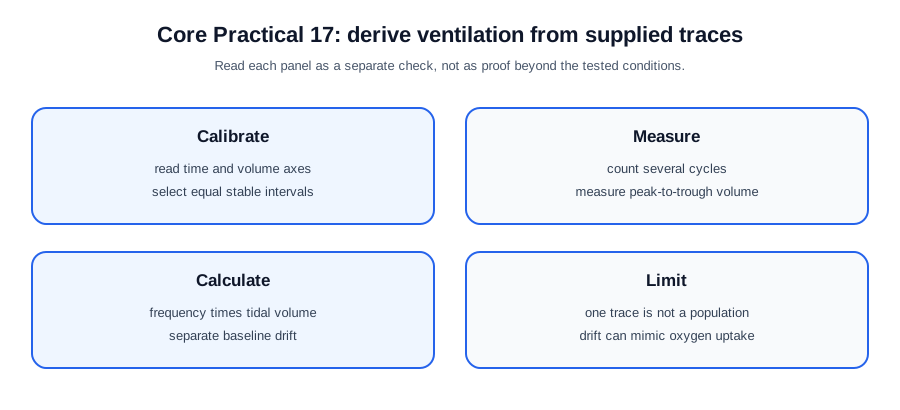
Separate values read directly from the trace from quantities calculated from them. Breathing frequency and tidal volume are measured from calibrated axes; respiratory minute ventilation is their product. Minute ventilation is air volume moved per time, not oxygen uptake or alveolar ventilation. Baseline slope supports an oxygen-consumption calculation only when the trace convention and apparatus conditions justify that interpretation. A flow-derived volume channel, a cycle-reset or drift-adjusted channel and a closed-circuit bell-volume trace are not interchangeable.
Apparatus and setup
Use the supplied spirometer trace, its time and volume calibration, a ruler and a calculator. Mark the rest, exercise and recovery intervals before measuring. This guide uses supplied trace data and does not require collecting participant data. Check the current course documents for the precise assessment task.
Before taking measurements, verify the axis units, direction of volume change and whether the printed or digital scale has been resized. Record the reading resolution used and do not report more precision than the trace supports.
Method
- Read the time and volume scale and identify comparable stable intervals for rest, exercise and recovery.
- Measure tidal volume from representative breaths using the supplied volume convention and any justified baseline correction. Measure breathing frequency from several complete cycles, counting intervals between equivalent cycle positions rather than treating the number of peaks as the number of elapsed cycles.
- Calculate respiratory minute ventilation as tidal volume multiplied by breathing frequency, with consistent units.
- Estimate oxygen consumption only when the trace and its baseline information support that calculation, then state the assumptions and any drift limitation.
Plan the calculation before selecting a trace interval. This makes the required cycle count, time span, volume difference and unit conversion explicit and prevents a visually convenient segment from replacing a consistent selection rule.
Check this topic from memory
Attempt the matching topic bank before reopening the notes. Use each missed idea to decide what to review next.
Start the topic quiz