

Pearson International A Level Biology Core Practical 18: Investigate amylase production in germinating cereal grains
Pearson IAL Biology practical notes on investigate amylase production in germinating cereal grains.
Check the current Pearson course documents and centre-approved method for the required practical context. These independently written notes describe an extract-based comparison; they are not an official instruction sheet. Use one defined assay and preserve its controls, measurements and safety requirements.
Aim and scientific principle
Compare starch-hydrolysing activity in extracts of matched cereal grains at defined germination stages using a standardised assay. Interpret this as amylase activity only within the assay's specificity and controls. Activity alone does not establish the amount newly synthesised, the production rate or the contribution of a particular amylase type.
Begin by translating the title into a testable question. Identify what is deliberately changed, what is measured directly, what is calculated and what must remain controlled. Predict a relationship only after naming the mechanism. A prediction without a reason is weak; a reason without measurable variables cannot guide a practical design.
Apparatus and setup
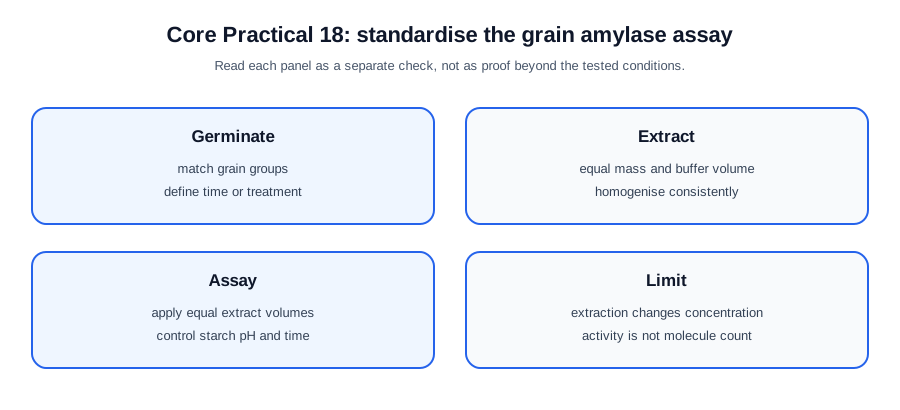
Use matched germinating and non-germinated cereal grains, extraction buffer, balance, mortar and pestle, pipettes, starch agar or a standardised starch solution, iodine reagent, incubator or water bath and measuring equipment. Select instruments by range and resolution. Use a buffer-only assay control and, where specified, a matched heat-treated extract control. The buffer control checks assay background without grain extract; the heat-treated comparison tests the effect of that treatment, which may also alter the extract matrix. A non-germinated grain group is a biological comparison, not an enzyme-free assay blank.
Check the measuring instrument and record its resolution. For a quantitative assay, use the specified standards, blanks, timing and validated response range. A zero adjustment or extra displayed digits do not establish calibration, specificity or extraction recovery.
Method
- Germinate matched grain groups for defined times or under the specified treatment, alongside a non-germinated control.
- Homogenise equal grain mass with equal buffer volume and clarify extracts consistently.
- Apply equal extract volumes to identical starch assays and incubate for the same time at controlled pH and temperature.
- At the defined endpoint, use the specified iodine readout or other assay response. For starch agar, define the zone boundary and geometry; for a solution assay, define the blank, response direction and calibration. Compare separately prepared grain groups, retaining their identities.
Check this topic from memory
Attempt the matching topic bank before reopening the notes. Use each missed idea to decide what to review next.
Start the topic quiz