

Pearson International A Level Chemistry Unit 1: Structure, Bonding and Introduction to Organic Chemistry
Pearson IAL Chemistry notes on amount of substance, atomic structure, bonding, alkanes and alkenes.
Pearson Edexcel International A Level Chemistry Unit 1 is an externally assessed written unit. This note follows the official specification content and keeps theory ownership separate from the dedicated practical-skills hub. Experimental evidence can appear inside theory questions, but Units 3 and 6 remain the written practical-skills papers.
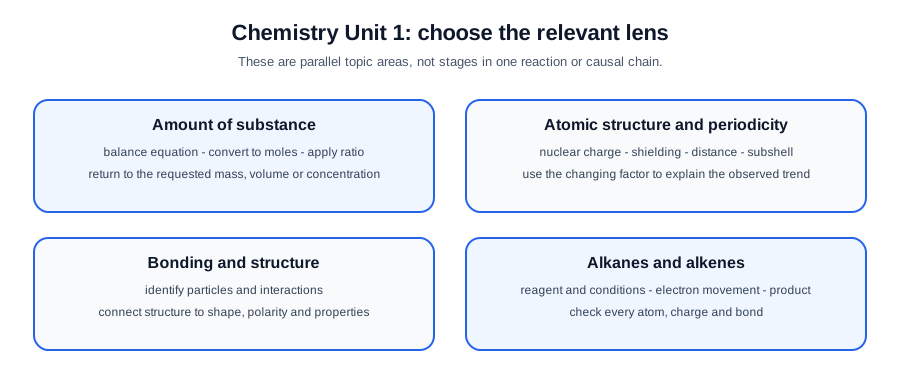
Official unit scope
- Formulae and amount of substance. Balance equations, move between mass, moles, particles, gas volume and solution concentration, and use the equation coefficients only after identifying the reacting amount ratio.
- Atomic structure and periodicity. Connect successive ionisation energies and Period 2 and 3 trends to nuclear charge, shielding, subshell and distance rather than describing trends without a cause.
- Bonding and structure. Use electron-pair repulsion, electronegativity and intermolecular forces to explain shape, polarity and physical properties across molecular, ionic, metallic and giant covalent structures.
- Introductory organic chemistry. Apply nomenclature, structural and stereoisomerism, free-radical substitution and electrophilic addition to alkanes and alkenes with the specified reagents and conditions.
The content is assessed through unfamiliar contexts as well as direct recall. Build explanations from first principles: identify the system, name the relevant quantities or structures, state the mechanism, connect cause to observation and limit the conclusion to the evidence supplied. A list of keywords is not a causal explanation.
Core reasoning and methods
- Convert the given quantity to moles before applying an equation ratio, then convert to the requested quantity.
- Explain periodic trends through nuclear attraction, shielding and distance rather than reciting direction only.
- Use electron-pair and intermolecular reasoning to connect structure with melting point, conductivity or solubility.
Quantitative work should begin with the governing relationship, followed by unit conversion, substitution, calculation and a reasonableness check. Keep additional significant figures during working and round at the end. Qualitative work needs the same discipline: compare like with like, identify a control or baseline, and distinguish an observed result from an inferred mechanism.
Graphs and tables are arguments in compressed form. Read axes, units, uncertainty indicators and scales before describing a trend. A valid conclusion identifies the relevant interval, direction and evidence. If data scatter or overlap weakens the claim, say so. Extrapolation beyond the measured range requires justification.
Check this topic from memory
Attempt the matching topic bank before reopening the notes. Use each missed idea to decide what to review next.
Start the topic quiz