

Pearson International A Level Chemistry Unit 2: Energetics, Group Chemistry, Halogenoalkanes and Alcohols
Pearson IAL Chemistry notes on energetics, intermolecular forces, redox, groups, kinetics, equilibria and organic chemistry.
Pearson Edexcel International A Level Chemistry Unit 2 is an externally assessed written unit. This note follows the official specification content and keeps theory ownership separate from the dedicated practical-skills hub. Experimental evidence can appear inside theory questions, but Units 3 and 6 remain the written practical-skills papers.
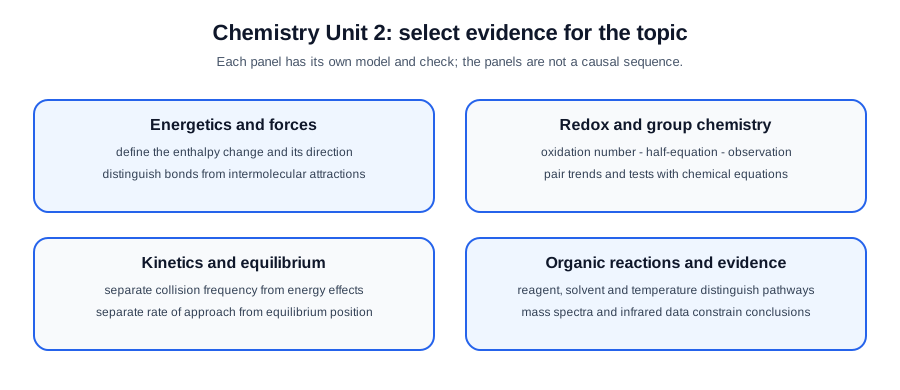
Official unit scope
- Energetics. Construct Hess cycles with consistent directions and signs, distinguish standard enthalpy definitions, and use mean bond enthalpies as averaged gas-phase estimates.
- Intermolecular forces. Relate London forces, permanent dipoles and hydrogen bonding to structure and physical properties without confusing them with covalent bonds.
- Redox and group chemistry. Use oxidation numbers, half-equations, observations and trends for Groups 1, 2 and 7, including the specified tests and thermal behaviour.
- Kinetics and equilibria. Explain rates through collision frequency and activation energy, and distinguish a faster approach to equilibrium from a change in equilibrium position.
- Halogenoalkanes, alcohols and evidence. Apply nucleophilic substitution, elimination, oxidation and dehydration with the required conditions, then use mass spectra and infrared evidence within their stated limits.
The content is assessed through unfamiliar contexts as well as direct recall. Build explanations from first principles: identify the system, name the relevant quantities or structures, state the mechanism, connect cause to observation and limit the conclusion to the evidence supplied. A list of keywords is not a causal explanation.
Core reasoning and methods
- Choose formation, combustion or reaction data to build a Hess cycle with arrow directions that match the target change.
- For a rate explanation, distinguish collision frequency from the fraction of collisions exceeding activation energy.
- Use observations and equations together in group-chemistry questions.
Quantitative work should begin with the governing relationship, followed by unit conversion, substitution, calculation and a reasonableness check. Keep additional significant figures during working and round at the end. Qualitative work needs the same discipline: compare like with like, identify a control or baseline, and distinguish an observed result from an inferred mechanism.
Graphs and tables are arguments in compressed form. Read axes, units, uncertainty indicators and scales before describing a trend. A valid conclusion identifies the relevant interval, direction and evidence. If data scatter or overlap weakens the claim, say so. Extrapolation beyond the measured range requires justification.
Check this topic from memory
Attempt the matching topic bank before reopening the notes. Use each missed idea to decide what to review next.
Start the topic quiz