

Pearson International A Level Chemistry Unit 4: Rates, Equilibria and Further Organic Chemistry
Pearson IAL Chemistry notes on kinetics, entropy, equilibria, acids, bases, carbonyls, carboxylic acids and chirality.
Pearson Edexcel International A Level Chemistry Unit 4 is an externally assessed written unit. This note follows the official specification content and keeps theory ownership separate from the dedicated practical-skills hub. Experimental evidence can appear inside theory questions, but Units 3 and 6 remain the written practical-skills papers.
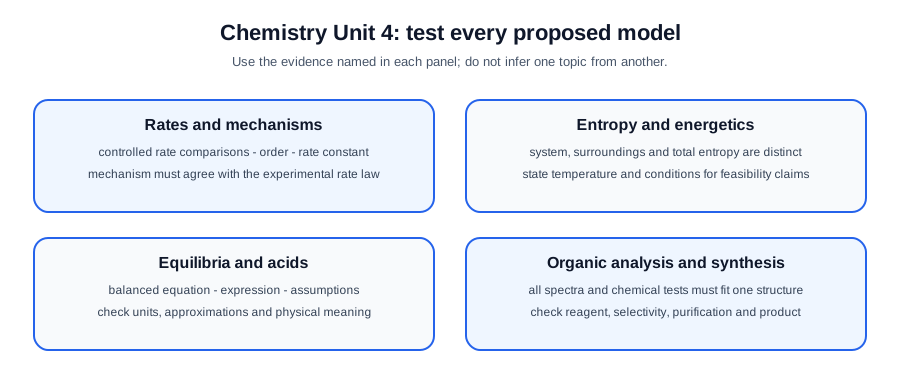
Official unit scope
- Rates and mechanisms. Determine orders from controlled rate data, derive rate constants and units, use half-life and Arrhenius evidence, and propose mechanisms consistent with the experimental rate equation.
- Entropy and energetics. Calculate system, surroundings and total entropy changes, apply temperature dependence, and construct Born-Haber cycles without treating one favourable term as a complete feasibility argument. Gibbs energy can express the same feasibility test, but Pearson lists it as an optional approach rather than required specification content.
- Equilibria and acids. Build equilibrium expressions from balanced equations, apply concentration and pressure constants, and use acid-base, buffer and solubility relationships with their assumptions.
- Further organic chemistry. Apply carbonyl, carboxylic-acid and acyl-derivative reactions, nucleophilic addition, condensation and chirality with correct reagents, mechanisms and products.
- Analysis and synthesis. Combine chemical tests, mass spectra, infrared and nuclear magnetic resonance evidence, then plan multistep routes while checking selectivity and purification.
The content is assessed through unfamiliar contexts as well as direct recall. Build explanations from first principles: identify the system, name the relevant quantities or structures, state the mechanism, connect cause to observation and limit the conclusion to the evidence supplied. A list of keywords is not a causal explanation.
Core reasoning and methods
- Derive reaction orders from controlled comparisons in data rather than from stoichiometric coefficients.
- Write an equilibrium expression from the balanced equation and omit pure solids and liquids where appropriate.
- For multistep organic synthesis, identify the functional-group change, reagent, conditions and evidence at each stage.
Quantitative work should begin with the governing relationship, followed by unit conversion, substitution, calculation and a reasonableness check. Keep additional significant figures during working and round at the end. Qualitative work needs the same discipline: compare like with like, identify a control or baseline, and distinguish an observed result from an inferred mechanism.
Check this topic from memory
Attempt the matching topic bank before reopening the notes. Use each missed idea to decide what to review next.
Start the topic quiz