

Pearson International A Level Chemistry Unit 5: Transition Metals and Organic Nitrogen Chemistry
Pearson IAL Chemistry notes on redox equilibria, transition metals, arenes, nitrogen compounds and synthesis.
Pearson Edexcel International A Level Chemistry Unit 5 is an externally assessed written unit. This note follows the official specification content and keeps theory ownership separate from the dedicated practical-skills hub. Experimental evidence can appear inside theory questions, but Units 3 and 6 remain the written practical-skills papers.
Official unit scope
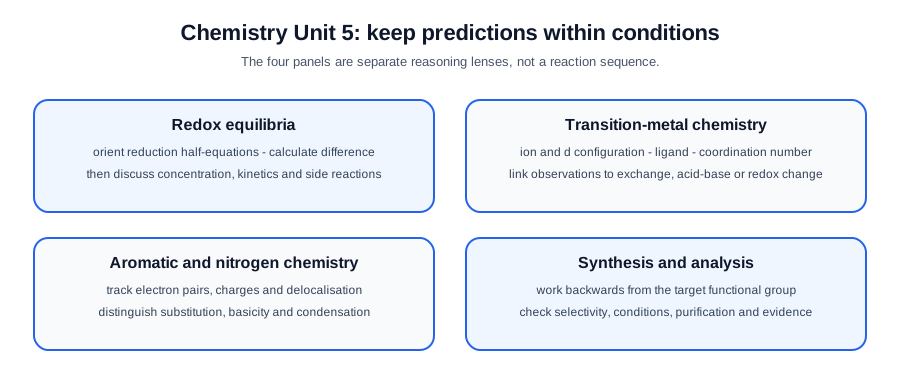
- Redox equilibria. Use standard electrode potentials with explicit half-equation directions, calculate cell potentials and explain why standard-data feasibility does not determine reaction rate or every non-standard outcome.
- Transition metals. Apply the incomplete-d-subshell definition, ligand exchange, coordination, colour, catalysis, acid-base and redox chemistry to specified ions and observations.
- Arenes. Explain benzene stability and electrophilic substitution through delocalisation, then use the correct catalysts and conditions rather than transferring alkene addition rules.
- Nitrogen chemistry and proteins. Compare amine basicity, form amides, interpret amino-acid acid-base behaviour and connect peptide bonding and protein structure to interactions.
- Synthesis and analysis. Plan multistep organic routes, identify functional-group changes and combine chemical and spectroscopic evidence while recognising selectivity and yield limitations.
The content is assessed through unfamiliar contexts as well as direct recall. Build explanations from first principles: identify the system, name the relevant quantities or structures, state the mechanism, connect cause to observation and limit the conclusion to the evidence supplied. A list of keywords is not a causal explanation.
Core reasoning and methods
- Use standard electrode potentials with a clearly chosen oxidation and reduction direction, then discuss limitations of standard-data predictions.
- For transition-metal observations, connect colour or precipitate changes to ligand exchange, acid-base or redox chemistry.
- Plan synthesis backwards from the target functional group while checking selectivity, conditions and purification.
Quantitative work should begin with the governing relationship, followed by unit conversion, substitution, calculation and a reasonableness check. Keep additional significant figures during working and round at the end. Qualitative work needs the same discipline: compare like with like, identify a control or baseline, and distinguish an observed result from an inferred mechanism.
Check this topic from memory
Attempt the matching topic bank before reopening the notes. Use each missed idea to decide what to review next.
Start the topic quiz