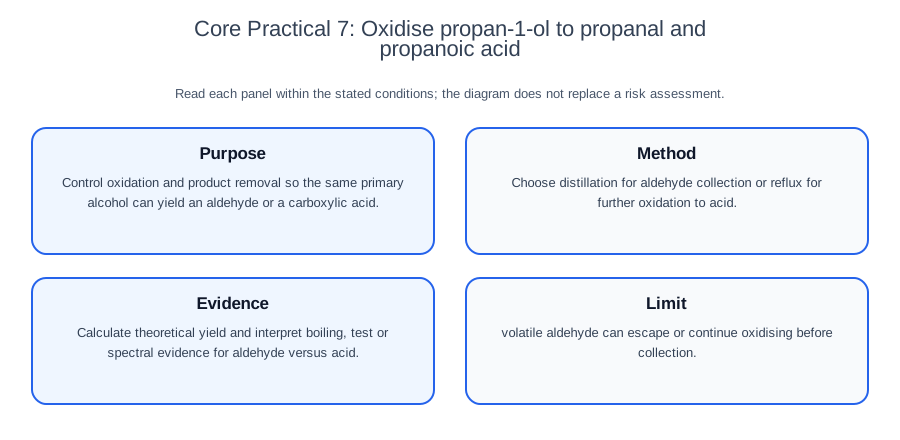
This outline compares approved oxidation arrangements intended to obtain propanal or propanoic acid from propan-1-ol. It is not a complete authorised procedure or confirmation of current Pearson oxidant,quantities or apparatus. Select the actual reagent system,addition,temperature,collection,analysis and waste controls through the approved practical plan and current course documents. Apparatus choice alone does not determine or prove the product.
Aim and scientific principle
Relate oxidation conditions and product residence/removal to separately measured product evidence. A primary alcohol may form an aldehyde and,under a suitable further-oxidation system,a carboxylic acid. Distinguish the intended product from demonstrated identity,purity,isolated yield,conversion and selectivity.
Begin by translating the title into a testable question. Identify what is deliberately changed, what is measured directly, what is calculated and what must remain controlled. Predict a relationship only after naming the mechanism. A prediction without a reason is weak; a reason without measurable variables cannot guide a practical design.
Apparatus and setup
Use only the reaction,addition,heating,condensing,collection and analytical equipment specified for the approved reagent system. Explain whether condensed material returns to the reaction vessel or is collected separately. Record the relevant pressure,temperature and collection conditions. Distillation and reflux arrangements must remain safely vented as specified;neither is an improvised sealed heating system. Consider measuring range, resolution, uncertainty, calibration and suitability for the sample, not the instrument name alone. Draw a labelled scientific setup that shows the working geometry and exactly where readings are taken. Include a control or blank when it distinguishes the target effect from drift, contamination or background response.
Before collecting results, check zero readings, calibration, leaks, alignment or sterility as relevant. Record the instrument resolution beside the first raw-data table. If a digital device displays more digits than its underlying accuracy supports, do not treat every digit as equally certain.
Method
Establish the actual balanced oxidation steps and approved reagent/amount conditions for the intended product. Record what differs between the aldehyde and acid arrangements. If oxidant availability and apparatus both change,describe a comparison of condition sets rather than claiming one isolated causal variable.
Assemble and operate the approved reaction,addition and thermal-control arrangement with the required exposure,ignition and pressure controls. Define collection/residence conditions and retain observations of reaction and material losses. Do not replace the oxidant or increase heating to obtain a desired colour change.
Check this topic from memory
Attempt the matching topic bank before reopening the notes. Use each missed idea to decide what to review next.
In an appropriate system,removing volatile aldehyde from the oxidising mixture can limit further oxidation;reflux can return volatile material and permit further reaction if the chemistry supports it. Check actual removal/retention and completion rather than assuming either apparatus guarantees a pure aldehyde or acid.
Collect and analyse the relevant fractions according to the approved method. Use suitable chemical or spectroscopic evidence with controls and reference conditions. Report identity/functional-group evidence separately from quantitative yield,and state how any conversion or selectivity estimate is established.
Plan the analysis before starting. This reveals whether an additional measurement is needed for a derived quantity and prevents a completed experiment from lacking a mass, length, concentration, background or calibration value. A method should be detailed enough for another trained student to reproduce, while avoiding decorative steps that do not affect validity.
Variables and controls
Independent variable: approved condition set,or one specified reaction/collection factor in a controlled investigation.
Dependent variable: product identity, yield or analytical response.
Important controls: starting-material identity/purity and amount,oxidant identity/availability,solvent/acidity,addition/thermal history,residence/collection conditions and analytical method. State which belong to the intended comparison;do not call deliberately changed apparatus or oxidant conditions constant. A preparative comparison does not automatically need a fitted graph.
For each control, state how it is maintained or monitored. Simply writing "keep temperature constant" is incomplete if the method has no bath, probe, equilibration time or other means of doing so. Choose a range wide enough to reveal the relationship but within safe and scientifically valid limits. Choose the number, range and spacing of values for the expected response and analysis. Concentrating values near an uncertain threshold or optimum can be more useful than uniform spacing; no fixed count establishes an adequate design.
What is distinctive about this practical
Distillation can reduce an aldehyde product residence time in an oxidising mixture when the approved system permits effective removal. Reflux returns condensable volatile material to the vessel;it is not a stronger oxidant,and does not itself demonstrate complete retention or oxidation. Reagent identity,availability,medium and reaction history also matter. Do not transfer an aldehyde-isolation rule to every oxidant system.
For a justified theoretical product amount,the isolated percentage yield is YP=100nP,rec/nP,theor. Use the actual balanced steps,limiting amount and recovered-sample composition. Functional-group tests,an oxidant colour change or a boiling observation do not alone supply recovered product moles or establish unique purity/identity.
For an explicitly defined one-alcohol/one-product-molecule model without carbon-skeleton cleavage, X=100nA,converted/nA,0 describes alcohol conversion and Sald=100nald,formed/nA,converted describes aldehyde selectivity when the converted amount is non-zero. These require reaction-mixture amount evidence,not merely isolated aldehyde mass. Use the stated stoichiometric basis for more general systems;do not add isolated fractions and assume they account for all converted material.
Recording and processing results
Record input amounts/purity,the balanced oxidation basis,reagent conditions,thermal and collection history,all retained fractions and loss observations. State which tests or spectra support functional groups or compound identification,and what controls/reference conditions are used. Report recovered-sample mass/volume and any purity/density basis before calculating yield. Quantitative conversion or selectivity needs suitable amount measurements with recovery accounted for. A mixed spectrum or positive functional-group response need not identify a single pure product. Keep observations and anomalies rather than assigning every collected fraction the intended identity.
Choose a fitted line, curve or ruled joins according to the data, scientific relationship and question; do not connect or smooth points mechanically. A gradient should use a large triangle and values read from the fitted line. When a relationship is linearised, explain the transformation and connect gradient or intercept to the requested physical quantity. When observations are categorical, define the category rule before seeing the result.
Safety, ethics and responsible practice
Follow the approved substance-specific risk assessment for the actual oxidant,acid/solvent,alcohol and volatile products,including ventilation,eye/skin protection,controlled addition,ignition and pressure controls. Oxidant systems have different hazards and waste requirements;do not treat them as interchangeable. Use the approved condenser/collection and safely vented heating arrangement. This outline does not approve an oxidant recipe,quantity,addition rate,heating setting or a hands-on procedure.
Worked application: from raw evidence to a defensible conclusion
Consider a constructed one-to-one amount example,not experimental data or an approved reaction scale. From an initial 0.0100mol of alcohol,the independently established isolated aldehyde amount is 0.00600mol,so its isolated yield is 60.0 percent if the theoretical aldehyde amount is 0.0100mol. This does not establish 60.0 percent alcohol conversion or aldehyde selectivity;unrecovered aldehyde,further oxidation and other products need separate evidence.
For a separate constructed complete no-loss mixture balance,suppose 0.00600mol aldehyde,0.00200mol acid and 0.00200mol unchanged alcohol account for the initial 0.0100mol on the stated model. Conversion is 80.0 percent and aldehyde selectivity is 75.0 percent. These inferences rely on the complete species/amount balance;isolated fractions or a positive aldehyde test alone would not establish it. Report the different claims separately.
Evaluation: limitation, effect and improvement
Limitation: volatile-product loss,incomplete oxidation,further oxidation,mixed fractions and ambiguous analytical responses can affect recovery and product claims.
Likely effect: escaped aldehyde lowers its isolated amount. Longer residence can permit further oxidation when the reagent system supports it,but its extent is not fixed by delay alone. Water or other collected material counted as product can raise apparent yield. Distinguish collection loss from reaction conversion and selectivity rather than diagnosing the mechanism from isolated yield.
Targeted improvement: use the approved effective condensing/collection and reaction-control method,track fractions and obtain suitable product/amount evidence. Check apparatus operation and analytical specificity rather than increasing reagent or heat. A collection improvement does not by itself establish conversion,selectivity or purity.
Separate random variation, systematic bias and model limitation. Repeats help reveal random variation but do not remove a zero error. Calibration establishes the relation between reference values and indications; appropriate adjustment or correction can address an identified offset. It does not make biased sampling representative. Finer resolution and greater repeatability are distinct properties, and finer resolution may improve an estimate only when the reading is a material source of uncertainty.
Common misconceptions and corrections
Repeats automatically make a result accurate. Repeats estimate random variation; they do not correct a biased method or calibration error.
A control variable is just a list item. Explain the apparatus or procedure that keeps it stable.
The line must pass through every point. Use the overall pattern and a best-fit relationship, then investigate justified anomalies.
Percentage error and percentage uncertainty are interchangeable. Error compares a measured value with a suitable reference. Uncertainty characterises dispersion of values attributed to the measurand; it may be expressed as a standard uncertainty or an interval with stated coverage, and includes more than resolution alone. State the reference, denominator and uncertainty convention used.
A successful endpoint proves the theory. The observation supports a conclusion only within the method, range and assumptions tested.
More sophisticated apparatus is always better. The improvement must address the dominant limitation and be practical in the stated context.
Assessment guidance
Pearson states that IAL practical skills are assessed mainly in Unit 3 and Unit 6, with related theory also assessable in the other unit papers. Planning answers need an operational independent variable, a measured dependent variable, a justified range, controls, repeats, safety and a stated analysis. Data answers need units, consistent precision, sensible significant figures and transparent calculations. Graph answers need labelled axes, a scale using the grid well and line treatment appropriate to the data and question. Evaluation answers should use a limitation-effect-improvement chain specific to the apparatus. Do not claim that a memorised core-practical recipe is the only acceptable method when the question supplies a different valid context.
Retrieval practice
Extend or adapt this practical to answer a related question. Where the design uses a continuous variable, justify its planned values. List apparatus with range and resolution where relevant, control methods, a raw record layout, the expected analysis and one hazard-control pair. Then identify one random uncertainty, one systematic bias and one model limitation. Explain which can be reduced by repeats, which needs calibration followed by appropriate correction or adjustment, or a redesign, and how your conclusion would change if the anomaly were confirmed.