

Pearson International A Level Chemistry Core Practical 8: Analyse inorganic and organic unknowns
Pearson IAL Chemistry practical notes on analyse inorganic and organic unknowns.
This outline develops evidence-based identification within an approved set of possible ions or organic substances. It is not a complete authorised test scheme or confirmation of current Pearson reagent lists or assessed scope. Select the actual tests, quantities, conditions, controls and waste route through the approved practical plan and current course documents. An unknown sample must still have sufficient hazard information for its approved handling.
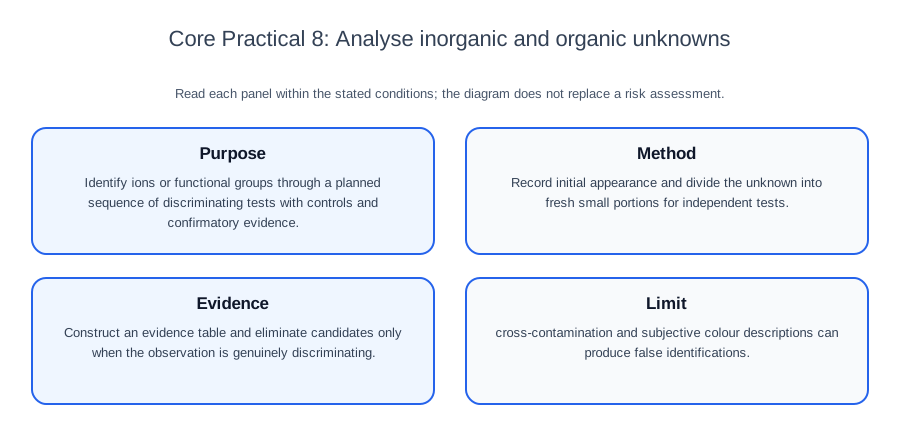
Aim and scientific principle
Narrow an explicitly stated candidate set using tests whose discrimination and operating conditions are understood. Record observations before inference, and distinguish evidence for an ion or functional group from unique identification of an entire compound, purity or composition. One positive colour or precipitate is not automatically specific.
Begin by translating the title into a testable question. Identify what is deliberately changed, what is measured directly, what is calculated and what must remain controlled. Predict a relationship only after naming the mechanism. A prediction without a reason is weak; a reason without measurable variables cannot guide a practical design.
Apparatus and setup
Use the approved vessels, clean dedicated transfer tools, reagents, reference/control materials and any required temperature or analytical equipment. Equipment choice follows the test and sample hazards; neither small volume nor an unknown label establishes safety. Keep source samples separate from reacted portions and record sample/reagent identities without cross-contamination. Consider measuring range, resolution, uncertainty, calibration and suitability for the sample, not the instrument name alone. Draw a labelled scientific setup that shows the working geometry and exactly where readings are taken. Include a control or blank when it distinguishes the target effect from drift, contamination or background response.
Before collecting results, check zero readings, calibration, leaks, alignment or sterility as relevant. Record the instrument resolution beside the first raw-data table. If a digital device displays more digits than its underlying accuracy supports, do not treat every digit as equally certain.
Method
- Establish the allowed candidate set, sample context and approved test decision scheme. Record initial appearance without smelling, tasting or improvised exposure. Label and divide fresh portions for separate tests as the method requires; do not return reacted material to the source.
- Choose tests that distinguish the remaining candidates under the actual concentration, matrix and conditions. Run appropriate reagent/procedure blanks and known positive controls, and a negative reference where needed to assess discrimination. Define valid observations and control acceptance before interpreting the unknown.
Check this topic from memory
Attempt the matching topic bank before reopening the notes. Use each missed idea to decide what to review next.
Start the topic quiz