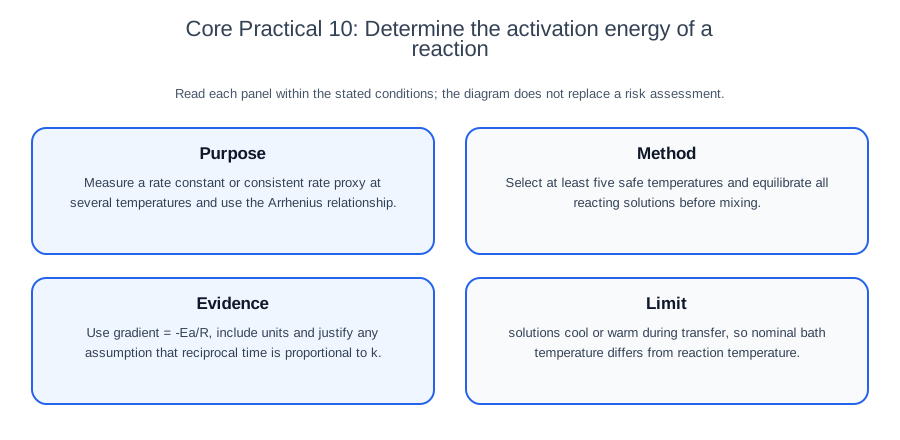
This outline develops an effective Arrhenius analysis from a specified reaction and measurement method. It is not a complete authorised procedure or confirmation of current Pearson reagents or assessed scope. Select the actual chemistry, temperature range, quantities, timing/analysis and waste controls through the approved practical plan and current course documents. A fitted activation energy is conditional on that system, method and temperature interval.
Aim and scientific principle
Estimate a rate constant, or a proxy demonstrably proportional to it by a temperature-independent factor, at several actual reaction temperatures. Test whether an effective Arrhenius model describes the measured interval and obtain its activation-energy parameter using the stated logarithm and reciprocal-temperature axis scale. A fixed colour endpoint alone does not establish proportionality to the rate constant or identify a molecular barrier.
Begin by translating the title into a testable question. Identify what is deliberately changed, what is measured directly, what is calculated and what must remain controlled. Predict a relationship only after naming the mechanism. A prediction without a reason is weak; a reason without measurable variables cannot guide a practical design.
Apparatus and setup
Use the approved reaction and temperature-control system, a suitable calibrated temperature probe, volume-transfer and timing equipment, and the specified analytical method. Measure the reacting mixture where feasible rather than assuming its temperature equals the bath setting. Account for equilibration, transfer, mixing and any reaction heating. A clock endpoint, sampling method or optical signal needs its own validity and calibration checks. Consider measuring range, resolution, uncertainty, calibration and suitability for the sample, not the instrument name alone. Draw a labelled scientific setup that shows the working geometry and exactly where readings are taken. Include a control or blank when it distinguishes the target effect from drift, contamination or background response.
Before collecting results, check zero readings, calibration, leaks, alignment or sterility as relevant. Record the instrument resolution beside the first raw-data table. If a digital device displays more digits than its underlying accuracy supports, do not treat every digit as equally certain.
Method
Choose a justified temperature interval and distribution of points within the approved method and a defensible kinetic regime. A fixed minimum number is not a universal validity rule. Equilibrate the relevant materials, define time zero and record actual reaction temperature and any drift during each measurement.
Check this topic from memory
Attempt the matching topic bank before reopening the notes. Use each missed idea to decide what to review next.
Obtain repeat rate measurements using the validated analysis at each temperature. Use final mixed concentrations and relevant medium/catalyst conditions, accounting for changes with temperature. For clock work, establish endpoint concentration change, timing delays and the conditions linking the measured response to the rate constant; the same visual endpoint is insufficient.
Convert measured Celsius temperatures to kelvin by adding 273.15. Determine the rate constant from the justified rate law, or explicitly establish a proxy whose proportionality factor is independent of temperature over this interval. Keep units and reference conventions consistent; do not take a logarithm of zero or a negative estimate.
Fit the appropriate logarithmic response against the stated reciprocal-temperature variable. Inspect residuals and uncertainty rather than forcing a straight line. Convert the gradient using its actual logarithm base and axis scale, report the effective activation energy with units and range, and investigate curvature or invalid proxy behaviour.
Plan the analysis before starting. This reveals whether an additional measurement is needed for a derived quantity and prevents a completed experiment from lacking a mass, length, concentration, background or calibration value. A method should be detailed enough for another trained student to reproduce, while avoiding decorative steps that do not affect validity.
Variables and controls
Independent variable: absolute temperature.
Dependent variable: a rate constant calculated from validated measurements and a specified rate law, or a proxy with a justified temperature-independent proportionality factor. Time, titre or optical response remains a raw measurement, not automatically the rate constant.
Important controls: final mixed concentrations, relevant medium and catalyst state, volume/evaporation, mixing and time zero, analytical calibration, and endpoint concentration change or sampling conditions. Temperature is deliberately varied; check other conditions at each temperature instead of assuming identical preparation guarantees identical kinetics.
For each control, state how it is maintained or monitored. Simply writing "keep temperature constant" is incomplete if the method has no bath, probe, equilibration time or other means of doing so. Choose a range wide enough to reveal the relationship but within safe and scientifically valid limits. Choose the number, range and spacing of values for the expected response and analysis. Concentrating values near an uncertain threshold or optimum can be more useful than uniform spacing; no fixed count establishes an adequate design.
What is distinctive about this practical
For a constant effective prefactor and activation energy over the fitted interval, k=Aexp(−Ea/(RT)). A dimensionless logarithmic form is ln(k/kref)=ln(A/kref)−RTEa, using a fixed positive reference rate constant with the same units. This is equivalent to plotting logarithms of numerical rate constants in one fixed unit convention; changing that fixed convention shifts the intercept, not the gradient.
For x=1/T,m=−Ea/R, temperature is in kelvin and the fitted gradient has units of kelvin. If the horizontal variable is instead x=1000/T,m=−Ea/(1000R), the numerical slope is smaller by a factor of 1000 and that factor must be restored when calculating energy. For a base-10 logarithm on the unscaled reciprocal-temperature axis, multiply its gradient by the natural logarithm of 10 before applying the natural-log energy formula. Do not apply the natural-log slope formula unchanged. Use energy units consistent with the chosen gas constant.
A proxy p=Ck has the same logarithmic slope only when the positive factor C is independent of temperature. Constant endpoint concentration change can justify reciprocal time as an average-rate proxy, but linking it to the rate constant additionally requires valid kinetic and concentration assumptions. Temperature-dependent endpoint chemistry, detection, medium or concentration factors can change the slope. A straight plot is compatible with an effective treatment, not proof of one unchanged mechanism or a directly measured microscopic barrier. For a positive effective activation energy the natural-log plot has a negative slope; do not assume every effective fitted parameter must be positive.
Recording and processing results
Retain raw temperature histories, times or analytical values, final mixed concentrations, calibration evidence and repeats. Show how each rate constant or proxy was obtained and which assumptions connect it to the kinetic parameter. Tabulate absolute temperature, the actual reciprocal-temperature variable and a consistently referenced logarithmic response with sufficient retained precision. State the logarithm base, horizontal scaling and gas-constant units. Do not replace actual reaction temperature with a nominal bath value without evidence of agreement.
Fit the model only over the justified interval and inspect residuals, scatter and evidence of drift or curvature. Use appropriate uncertainty treatment for temperature and rate estimates; transformation does not remove their uncertainty. A large gradient triangle is useful when a graph-based estimate is requested, but it is not a substitute for checking the model. Do not discard points merely to straighten the plot or extrapolate a fitted mechanism claim beyond the tested interval.
Safety, ethics and responsible practice
Follow the approved substance-specific risk assessment and apparatus limits for the actual reaction, heating/cooling, additions, sampling and waste. Use appropriate eye/skin protection and ventilation, and control ignition or pressure where relevant. Do not improvise higher temperatures, sealed heating or stronger reagents to extend the graph. A water bath or small quantity alone does not establish safety; this outline approves no temperature range, recipe or hands-on procedure.
Worked application: from raw evidence to a defensible conclusion
Consider a constructed graph-reading example, not experimental data or an approved reaction range. A natural-log response plotted against reciprocal kelvin temperature has gradient −6000K. With the gas constant 8.314Jmol−1K−1, the effective activation energy is 49884Jmol−1, or 49.9kJmol−1 to three significant figures. The corresponding graph using 1000 divided by kelvin temperature has numerical slope -6.00; restoring its factor of 1000 gives the same energy. Treating -6.00 as the unscaled gradient would make the calculated energy 1000 times too small.
If a positive proxy is exactly twice the rate constant by a temperature-independent factor, its natural-log graph is shifted vertically by the natural logarithm of two and has the same slope. A factor that varies with temperature can change the slope, even if each run has the same-looking colour endpoint. Check the actual response-to-rate-constant relation and reaction temperatures before interpreting the fitted value as an effective activation energy. Neither the constructed numbers nor an apparently straight plot validate the chemistry or mechanism.
Evaluation: limitation, effect and improvement
Limitation: actual reaction temperatures may differ from nominal bath settings or drift during a run; temperature-dependent proxy factors, timing delays or changing kinetic regimes can also distort the fit.
Likely effect: incorrect temperatures displace reciprocal-temperature coordinates and can bias the gradient in either direction depending on the error pattern. A changing response-to-rate-constant factor contributes its own logarithmic temperature dependence. These effects may produce curvature or a misleading straight trend; repeats alone do not remove shared bias.
Targeted improvement: use the approved equilibrated arrangement, measure representative reaction temperature where feasible and document stability during the measured interval. Validate the analytical response and kinetic/proxy assumptions across the range, and use a justified narrower interval if the model changes. Logging or insulation helps only when it addresses the demonstrated limitation and remains compatible with safe operation.
Separate random variation, systematic bias and model limitation. Repeats help reveal random variation but do not remove a zero error. Calibration establishes the relation between reference values and indications; appropriate adjustment or correction can address an identified offset. It does not make biased sampling representative. Finer resolution and greater repeatability are distinct properties, and finer resolution may improve an estimate only when the reading is a material source of uncertainty.
Common misconceptions and corrections
Repeats automatically make a result accurate. Repeats estimate random variation; they do not correct a biased method or calibration error.
A control variable is just a list item. Explain the apparatus or procedure that keeps it stable.
The line must pass through every point. Use the overall pattern and a best-fit relationship, then investigate justified anomalies.
Percentage error and percentage uncertainty are interchangeable. Error compares a measured value with a suitable reference. Uncertainty characterises dispersion of values attributed to the measurand; it may be expressed as a standard uncertainty or an interval with stated coverage, and includes more than resolution alone. State the reference, denominator and uncertainty convention used.
A successful endpoint proves the theory. The observation supports a conclusion only within the method, range and assumptions tested.
More sophisticated apparatus is always better. The improvement must address the dominant limitation and be practical in the stated context.
Assessment guidance
Pearson states that IAL practical skills are assessed mainly in Unit 3 and Unit 6, with related theory also assessable in the other unit papers. Planning answers need an operational independent variable, a measured dependent variable, a justified range, controls, repeats, safety and a stated analysis. Data answers need units, consistent precision, sensible significant figures and transparent calculations. Graph answers need labelled axes, a scale using the grid well and line treatment appropriate to the data and question. Evaluation answers should use a limitation-effect-improvement chain specific to the apparatus. Do not claim that a memorised core-practical recipe is the only acceptable method when the question supplies a different valid context.
Retrieval practice
Extend or adapt this practical to answer a related question. Where the design uses a continuous variable, justify its planned values. List apparatus with range and resolution where relevant, control methods, a raw record layout, the expected analysis and one hazard-control pair. Then identify one random uncertainty, one systematic bias and one model limitation. Explain which can be reduced by repeats, which needs calibration followed by appropriate correction or adjustment, or a redesign, and how your conclusion would change if the anomaly were confirmed.