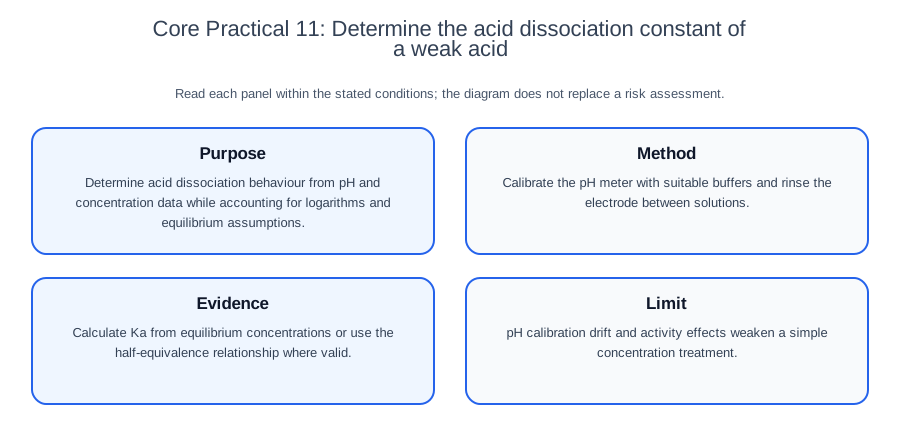
This outline develops a weak-acid equilibrium estimate from a specified solution or titration method. It is not a complete authorised procedure or confirmation of current Pearson reagents or assessed scope. Select the acid system, concentrations, pH calibration, temperature, titration and waste controls through the approved practical plan and current course documents. State whether the result is a concentration-based estimate under a declared activity approximation, rather than an unqualified thermodynamic constant.
Aim and scientific principle
Use measured pH together with independently established acid composition and an appropriate equilibrium model. Distinguish formal acid concentration, equilibrium species concentrations and the concentration or activity approximation used. A glass-electrode reading is not a direct measurement of the dissociation constant; repeated pH values alone do not establish the equilibrium model or eliminate calibration bias.
Begin by translating the title into a testable question. Identify what is deliberately changed, what is measured directly, what is calculated and what must remain controlled. Predict a relationship only after naming the mechanism. A prediction without a reason is weak; a reason without measurable variables cannot guide a practical design.
Apparatus and setup
Use the approved acid solution and preparation or independent concentration evidence, a suitable calibrated pH measurement system, volumetric equipment and temperature measurement. For titration, use alkali of established concentration and an appropriate volume/curve method. Follow the electrode and buffer instructions for calibration, rinsing, conditioning and a stable reading. Record buffer identity, temperature and calibration checks; extra display digits do not prove accuracy. Consider measuring range, resolution, uncertainty, calibration and suitability for the sample, not the instrument name alone. Draw a labelled scientific setup that shows the working geometry and exactly where readings are taken. Include a control or blank when it distinguishes the target effect from drift, contamination or background response.
Before collecting results, check zero readings, calibration, leaks, alignment or sterility as relevant. Record the instrument resolution beside the first raw-data table. If a digital device displays more digits than its underlying accuracy supports, do not treat every digit as equally certain.
Method
Establish the acid identity, formal concentration and relevant composition. Specify whether the solution contains one monoprotic acid, added conjugate base, another acid/base or significant background electrolyte. Choose the equilibrium model before converting pH into concentration.
Check this topic from memory
Attempt the matching topic bank before reopening the notes. Use each missed idea to decide what to review next.
Calibrate and check the pH system with suitable buffers at the relevant temperature, following its approved instructions. Avoid carry-over, record stable readings and monitor drift. Measure actual sample temperature; a meter temperature-compensation setting does not by itself establish that equilibrium constants refer to one common temperature.
For the acid-only method, combine pH with the independently known formal concentration and explicitly justified activity, mass-balance and charge-balance approximations. Check whether water ionisation, other species or appreciable acid dissociation invalidate the simplified calculation.
For titration, retain cumulative added volume and pH, allow appropriate mixing/equilibration and establish the equivalence volume with uncertainty. Use half-equivalence only where the single-acid buffer model and species-balance approximation hold. Repeat and compare estimates at matched temperature/medium, explaining discrepancies rather than forcing agreement.
Plan the analysis before starting. This reveals whether an additional measurement is needed for a derived quantity and prevents a completed experiment from lacking a mass, length, concentration, background or calibration value. A method should be detailed enough for another trained student to reproduce, while avoiding decorative steps that do not affect validity.
Variables and controls
Independent variable: acid concentration or titrant volume.
Dependent variable: calibrated pH; any derived hydrogen-ion concentration and dissociation estimate depend on the stated model and activity approximation.
Important controls: sample temperature, calibration/drift, electrode condition and carry-over, relevant ionic medium, mixing/equilibration, composition and volume preparation. Dilution can change ionic conditions; do not assume a concentration-based estimate must remain identical across all concentrations without checking its approximation.
For each control, state how it is maintained or monitored. Simply writing "keep temperature constant" is incomplete if the method has no bath, probe, equilibration time or other means of doing so. Choose a range wide enough to reveal the relationship but within safe and scientifically valid limits. Choose the number, range and spacing of values for the expected response and analysis. Concentrating values near an uncertain threshold or optimum can be more useful than uniform spacing; no fixed count establishes an adequate design.
What is distinctive about this practical
The pH system converts electrode response to an operational pH through calibration. Converting that reading to hydrogen-ion concentration requires an activity approximation; it is not an unconditional identity. Under a stated dilute-solution approximation, x≈c∘10−pH estimates the hydrogen-ion concentration, with the concentration reference taken as one mole per litre. Activity effects, liquid-junction response and calibration remain separate limitations; do not call the reading a direct concentration or dissociation-constant measurement.
A concentration-based quotient is Ka,c=[HA][H+][A−], using equilibrium concentrations for a single monoprotic acid model. For an acid-only solution of formal concentration C, no added conjugate base or other important acid/base species, and negligible water contribution, the hydrogen-ion and conjugate-base concentrations are approximately x and the remaining acid concentration is C minus x. Thus Ka,c≈C−xx2. This expression still depends on those assumptions and is not an activity-based thermodynamic determination. Further replacing C minus x by C gives Ka,c≈Cx2, but only when the neglected fraction is sufficiently small for the stated uncertainty goal. The word weak alone does not justify this step.
Using the fixed molar concentration reference, define pKa,c=−log10(Ka,c/c∘). Within the same concentration/pH approximation, pH≈pKa,c+log10([A−]/[HA]). At half the independently established equivalence volume in an appropriate single-monoprotic-acid/strong-base titration, the buffer species concentrations may be approximately equal, giving pH approximately equal to the corresponding negative-log constant. Half the volume is a stoichiometric statement, not proof of exact equality of equilibrium activities or of validity for mixtures, polyprotic systems or very dilute solutions. Do not use the acid-only x-squared calculation for a buffer containing added conjugate base.
Recording and processing results
Record formal concentration and its preparation/standardisation basis, sample and buffer temperatures, calibration checks, stable pH readings, raw titrant volumes and any drift. Show equilibrium concentrations or the justified buffer ratio used, and retain the distinction between the concentration-based estimate and a thermodynamic constant. For titration, report how the equivalence volume and half-volume pH were obtained and how their uncertainties propagate. Keep individual readings; state whether averaging was done before or after the logarithmic conversion because these operations are not interchangeable.
Choose a graph for the actual method: a pH-versus-added-volume curve for titration, or an explicitly justified concentration/equilibrium comparison. Do not fit an arbitrary straight line or interpret a generic gradient as the dissociation constant. Inspect whether temperature, drift or ionic-medium changes explain differences, and investigate anomalies without silently deleting them. A constant pH offset can produce a systematic and nonlinear change in a concentration-based estimate; repeats alone do not diagnose or remove it.
Safety, ethics and responsible practice
Follow the approved substance-specific risk assessment for the actual acid, alkali, calibration buffers and waste. Use suitable eye/skin protection, secure vessels and protect the glass electrode from impact according to its instructions. Concentration, handling and breakage controls depend on the materials and equipment. Do not improvise electrode treatments, reagent mixtures or heating. This outline approves no concentration range, titration recipe or hands-on procedure.
Worked application: from raw evidence to a defensible conclusion
Consider a constructed acid-only calculation, not experimental data or an approved solution. Let formal concentration be 0.0200molL−1 and pH be 3.000. Under the stated concentration approximation, the hydrogen-ion concentration is 0.00100molL−1. Retaining the remaining-acid denominator gives a concentration-based constant of 0.0000526molL−1 to three significant figures; dropping the dissociated amount from that denominator gives 0.0000500molL−1. The second estimate is five percent lower than the first: whether that approximation is acceptable depends on the uncertainty goal, not merely the acid being weak.
With the same formal concentration but a constructed positive pH offset of 0.100, the recorded pH would be 3.100 and the same model gives approximately 0.0000329molL−1. This is a substantial systematic change, not a 0.100molL−1 concentration error, and repeating the offset reading does not correct it. A half-equivalence approach has different balance and volume assumptions; verify these and the activity approximation rather than expecting either route to yield an exact universal value.
Evaluation: limitation, effect and improvement
Limitation: pH calibration/drift, electrode/junction response, composition or volume uncertainty, water contribution and activity effects can invalidate or bias the simple model.
Likely effect: under the acid-only model at fixed formal concentration, a positive pH offset lowers inferred hydrogen-ion concentration and the resulting concentration-based constant. Other errors need not share that direction. Ionic-medium changes can create systematic model deviations; using formal concentration as remaining undissociated acid or using acid-only balance for a buffer introduces a separate calculation error.
Targeted improvement: use appropriate buffer and drift checks, representative temperature measurements and independently justified composition/volume evidence. Test the mass-balance and activity approximations for the actual range and report a conditional estimate if they remain limiting. More repeats or display digits do not replace model validation; additional electrolyte is not an automatically approved correction.
Separate random variation, systematic bias and model limitation. Repeats help reveal random variation but do not remove a zero error. Calibration establishes the relation between reference values and indications; appropriate adjustment or correction can address an identified offset. It does not make biased sampling representative. Finer resolution and greater repeatability are distinct properties, and finer resolution may improve an estimate only when the reading is a material source of uncertainty.
Common misconceptions and corrections
Repeats automatically make a result accurate. Repeats estimate random variation; they do not correct a biased method or calibration error.
A control variable is just a list item. Explain the apparatus or procedure that keeps it stable.
The line must pass through every point. Use the overall pattern and a best-fit relationship, then investigate justified anomalies.
Percentage error and percentage uncertainty are interchangeable. Error compares a measured value with a suitable reference. Uncertainty characterises dispersion of values attributed to the measurand; it may be expressed as a standard uncertainty or an interval with stated coverage, and includes more than resolution alone. State the reference, denominator and uncertainty convention used.
A successful endpoint proves the theory. The observation supports a conclusion only within the method, range and assumptions tested.
More sophisticated apparatus is always better. The improvement must address the dominant limitation and be practical in the stated context.
Assessment guidance
Pearson states that IAL practical skills are assessed mainly in Unit 3 and Unit 6, with related theory also assessable in the other unit papers. Planning answers need an operational independent variable, a measured dependent variable, a justified range, controls, repeats, safety and a stated analysis. Data answers need units, consistent precision, sensible significant figures and transparent calculations. Graph answers need labelled axes, a scale using the grid well and line treatment appropriate to the data and question. Evaluation answers should use a limitation-effect-improvement chain specific to the apparatus. Do not claim that a memorised core-practical recipe is the only acceptable method when the question supplies a different valid context.
Retrieval practice
Extend or adapt this practical to answer a related question. Where the design uses a continuous variable, justify its planned values. List apparatus with range and resolution where relevant, control methods, a raw record layout, the expected analysis and one hazard-control pair. Then identify one random uncertainty, one systematic bias and one model limitation. Explain which can be reduced by repeats, which needs calibration followed by appropriate correction or adjustment, or a redesign, and how your conclusion would change if the anomaly were confirmed.