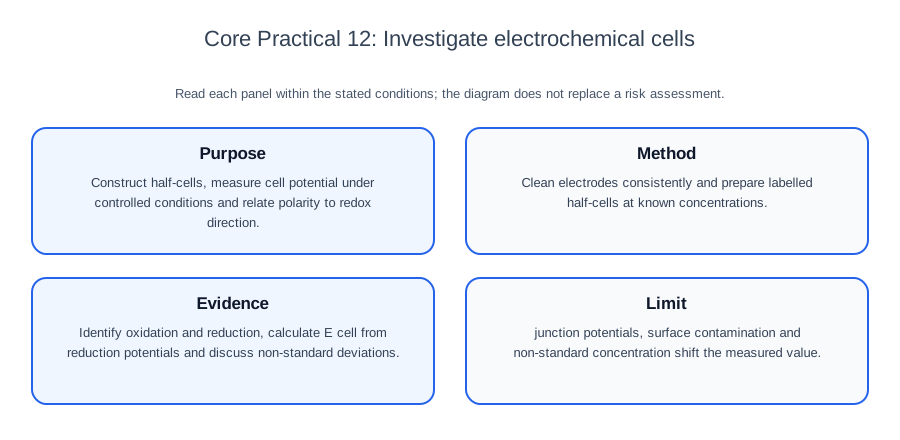
This outline develops a controlled comparison of electrochemical-cell potential and polarity. It is not a complete authorised procedure or confirmation of current Pearson electrodes, electrolytes or assessed scope. Select the actual half-cells, bridge, surface preparation, measurement and waste controls through the approved practical plan and current course documents. Distinguish a measured terminal voltage from an ideal reversible potential and from a tabulated standard value.
Aim and scientific principle
Construct the approved half-cells and measure signed terminal potential with documented connections, temperature and solution conditions. Interpret the reading using the specified redox couples and an appropriate reversible-cell model, rather than assuming the sign uniquely identifies the chemistry. A potential difference alone does not measure reaction rate, current-delivery capability or power.
Begin by translating the title into a testable question. Identify what is deliberately changed, what is measured directly, what is calculated and what must remain controlled. Predict a relationship only after naming the mechanism. A prediction without a reason is weak; a reason without measurable variables cannot guide a practical design.
Apparatus and setup
Use the approved electrodes and redox solutions, a chemically compatible bridge, clean contacts, temperature measurement and a suitable high-input-impedance voltmeter. An inert electrode is appropriate only with the required redox species present and a suitable interface. Record which electrode connects to each meter input. A labelled standard solution does not by itself establish all standard-state or reversible-cell conditions. Consider measuring range, resolution, uncertainty, calibration and suitability for the sample, not the instrument name alone. Draw a labelled scientific setup that shows the working geometry and exactly where readings are taken. Include a control or blank when it distinguishes the target effect from drift, contamination or background response.
Before collecting results, check zero readings, calibration, leaks, alignment or sterility as relevant. Record the instrument resolution beside the first raw-data table. If a digital device displays more digits than its underlying accuracy supports, do not treat every digit as equally certain.
Method
Identify each redox couple, solution composition, phase and actual temperature. Prepare or condition each electrode by its approved method; do not assume every surface should be polished in the same way. Record any oxide, coating, contamination or visible change relevant to the interface.
Assemble the specified ionic connection and meter circuit, using the approved compatible bridge and sound contacts. Record the red/positive and black/common input assignments and the meter range/input characteristics. Avoid shorting or loading the cell beyond the approved measurement.
Check this topic from memory
Attempt the matching topic bank before reopening the notes. Use each missed idea to decide what to review next.
Record sign, magnitude, time evolution and actual conditions after an appropriate stability check. Repeat with consistent connections or perform a deliberately documented lead reversal. Vary only the planned half-cell identity or concentration in a comparison; retain the intended changes separately from controls.
Write reduction half-equations with their reference/state conventions and balance the overall reaction. Calculate a standard prediction only for the stated tabulation conditions, or use an explicitly justified non-standard model. Compare that prediction with the measured terminal voltage while considering junction, interface and loading effects; do not label every discrepancy random error.
Plan the analysis before starting. This reveals whether an additional measurement is needed for a derived quantity and prevents a completed experiment from lacking a mass, length, concentration, background or calibration value. A method should be detailed enough for another trained student to reproduce, while avoiding decorative steps that do not affect validity.
Variables and controls
Independent variable: half-cell identity or ion concentration.
Dependent variable: signed terminal voltage and observed polarity with a stated meter connection. An ideal reversible or standard cell potential is a model/reference quantity, not automatically the raw reading.
Important controls: temperature, composition/activity approximation, phase and relevant pressure, electrode preparation and immersion, bridge condition, contact quality and meter orientation/input characteristics. Keep intended concentration or identity changes distinct from controls. Electrode area can affect loading and interfacial behaviour but is not a factor multiplying an ideal equilibrium potential.
For each relevant condition, explain how it is maintained or checked. Comparing half-cell identities is categorical; an arbitrary number of evenly spaced values is not meaningful for that design. A concentration series needs justified values and analysis for the actual redox system and activity approximation. Changing a bridge or surface can alter chemistry or junction response, not merely repeat the same ideal cell.
What is distinctive about this practical
Tabulated electrode potentials are reduction potentials relative to a stated reference. For the intended galvanic reaction under the corresponding standard-state and temperature conventions, Ecell∘=Ered,cathode∘−Ered,anode∘. Balance electron transfer in the half-equations, but do not multiply electrode potentials by stoichiometric coefficients. A difference of relative potentials is measurable; one isolated electrode does not supply an independently measurable absolute potential.
For a reversible-cell model at the actual conditions, Ecell=Ecell∘−nFRTlnQ, with temperature in kelvin, electron-transfer number n for the reaction as written and a dimensionless activity-based reaction quotient. Concentration substitution requires a stated approximation; pressure/state and reference conventions must also match. A high-impedance meter reduces current draw but does not establish standard conditions, eliminate junction potential or guarantee a reversible interface. A stable terminal reading can still include loading, contamination or mixed-potential effects.
For the specified reaction and corresponding reversible potential, ΔG=−nFEcell. Positive potential indicates thermodynamic favourability in that written direction under those conditions, not a guaranteed observable rate or useful power. In spontaneous galvanic discharge, reduction is at the positive cathode and oxidation at the negative anode; electrons pass through the external connection when current flows, while ions provide the bridge connection. A nearly open-circuit voltage measurement is not direct evidence of sustained electron flow. Swapping only the meter leads reverses the displayed sign, not the cell chemistry. Do not transfer galvanic terminal-sign rules unqualified to an externally driven electrolytic cell.
Recording and processing results
Record the complete cell description, both meter connections, signed readings over time, solution composition, relevant phase/pressure, temperature, surface preparation, bridge and instrument information. Show reduction half-equations, the balanced intended reaction and the source/state conventions of reference potentials. Separate the standard or reversible prediction from measured terminal voltage and state any activity/concentration approximation. Keep numerical signs rather than averaging their absolute values; compare repeat voltages only with a consistent orientation and conditions.
Tabulate half-cell identity and categorical polarity rather than fitting arbitrary numeric identity labels. A concentration-dependent graph needs a defined reaction quotient and justified Nernst/activity treatment at the stated temperature. Do not infer a kinetic rate or power output from that gradient or from open-circuit voltage. Investigate contact, bridge, surface and composition differences before treating departures from a tabulated standard value as random scatter.
Safety, ethics and responsible practice
Follow the approved substance-specific risk assessment for the actual metal-ion solutions, electrodes, bridge material and waste. Use suitable eye/skin protection, secure vessels and contacts, prevent unintended short circuits, and segregate waste by the actual materials. Do not improvise bridge electrolytes, electrode polishing chemicals or an external driving source. This outline approves no cell recipe, reagent concentration, surface treatment or hands-on procedure.
Worked application: from raw evidence to a defensible conclusion
Consider a constructed pair of compatible half-reactions P and Q, not real electrode data or an approved cell. Suppose their standard reduction potentials on the same reference and temperature basis are EP∘=+0.250V and EQ∘=−0.150V. For P reduction and Q oxidation, the ideal standard cell prediction is Ecell∘=+0.400V. In that ideal comparison with the positive meter input on P, the display is positive. Reversing only the leads gives −0.400V; it does not reverse the spontaneous chemistry or require changing the tabulated reduction potentials. Multiplying a half-equation for electron balance also leaves its reduction potential unchanged.
If a later bench reading were +0.350V with the same connection, the discrepancy alone would not identify its cause or establish a new standard potential. Check actual state/activity conditions, temperature, contacts, bridge, surface and meter loading. Do not increase a tabulated reduction potential or arbitrarily rescale it to fit the observed reading. These constructed values test sign and subtraction bookkeeping, not the reversibility, reaction identity, kinetics or performance of an actual cell.
Evaluation: limitation, effect and improvement
Limitation: junction response, surface contamination or mixed potentials, non-standard activities and finite meter loading can shift terminal voltage away from the intended reversible/standard prediction.
Likely effect: state/activity and junction differences can shift voltage in either direction, while inconsistent interfaces and contacts can add drift or variation. In a simple source-with-internal-resistance model, finite meter input resistance loads the source; real electrochemical behaviour may also involve polarisation. A reproducible reading or high meter impedance alone does not distinguish these causes.
Targeted improvement: use approved reproducible electrode preparation, compatible bridge and well-characterised solutions, verify contacts/orientation and choose suitable low-loading measurement. Check relevant temperature/state conditions and interface stability. A fresh bridge or more polishing is not a universal correction; it must address the demonstrated failure without introducing a different reaction or contamination.
Separate random variation, systematic bias and model limitation. Repeats help reveal random variation but do not remove a zero error. Calibration establishes the relation between reference values and indications; appropriate adjustment or correction can address an identified offset. It does not make biased sampling representative. Finer resolution and greater repeatability are distinct properties, and finer resolution may improve an estimate only when the reading is a material source of uncertainty.
Common misconceptions and corrections
Repeats automatically make a result accurate. Repeats estimate random variation; they do not correct a biased method or calibration error.
A control variable is just a list item. Explain the apparatus or procedure that keeps it stable.
The line must pass through every point. Use the overall pattern and a best-fit relationship, then investigate justified anomalies.
Percentage error and percentage uncertainty are interchangeable. Error compares a measured value with a suitable reference. Uncertainty characterises dispersion of values attributed to the measurand; it may be expressed as a standard uncertainty or an interval with stated coverage, and includes more than resolution alone. State the reference, denominator and uncertainty convention used.
A successful endpoint proves the theory. The observation supports a conclusion only within the method, range and assumptions tested.
More sophisticated apparatus is always better. The improvement must address the dominant limitation and be practical in the stated context.
Assessment guidance
Pearson states that IAL practical skills are assessed mainly in Unit 3 and Unit 6, with related theory also assessable in the other unit papers. Planning answers need an operational independent variable, a measured dependent variable, a justified range, controls, repeats, safety and a stated analysis. Data answers need units, consistent precision, sensible significant figures and transparent calculations. Graph answers need labelled axes, a scale using the grid well and line treatment appropriate to the data and question. Evaluation answers should use a limitation-effect-improvement chain specific to the apparatus. Do not claim that a memorised core-practical recipe is the only acceptable method when the question supplies a different valid context.
Retrieval practice
Extend or adapt this practical to answer a related question. Where the design uses a continuous variable, justify its planned values. List apparatus with range and resolution where relevant, control methods, a raw record layout, the expected analysis and one hazard-control pair. Then identify one random uncertainty, one systematic bias and one model limitation. Explain which can be reduced by repeats, which needs calibration followed by appropriate correction or adjustment, or a redesign, and how your conclusion would change if the anomaly were confirmed.